
 By
By 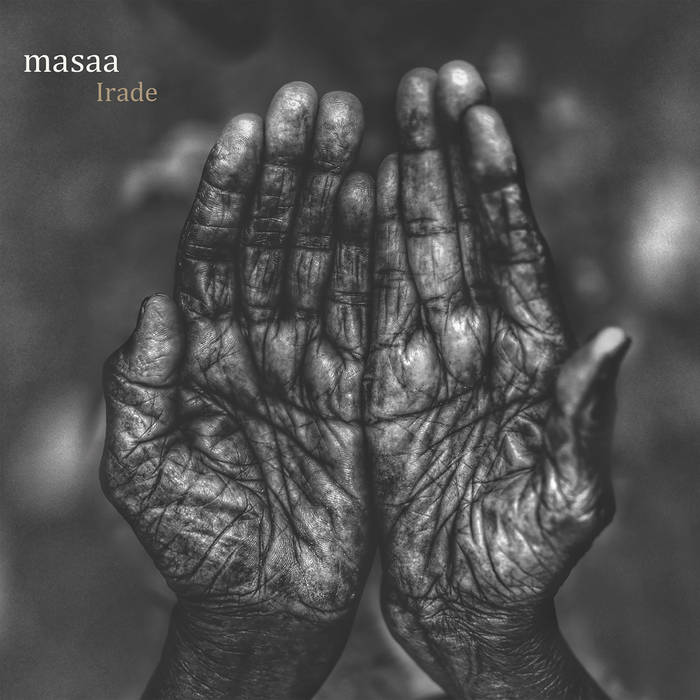
Irade (Traumton Records)
Masaa
Released February 14, 2020
German Jazz Prize National Vocal Album 2021
YouTube:
https://music.youtube.com/playlist?list=OLAK5uy_kwnylz5drCcRwcy_9t3QGxnfbj7u_dd-Q
Spotify:
About:
Almost three years have passed since the release of the CD Outspoken and a lot has happened since then. The quartet’s tour for the release took them to Tunisia, Azerbaijan and Izmir, and from Spain to England all across Western Europe. Enthusiastic reactions from audience and media indicated that Masaa would successfully continue on their path. “The music has an incredible flow, an ingenious dramaturgy, is emotionally very intense and captivates with a trumpet and flugelhorn sound that can hardly be surpassed in nearness and warmth,” stated NDR Info. And Süddeutsche.de wrote: “[…] each individual shows his personal note, together they become a music that combines loud and quiet, contemplative and intense sounds, Orient and Occident in an extraordinary way.” But then an unexpected change: pianist Clemens Pötzsch left the perfectly attuned band in 2018. “After some thought we decided to continue with guitar instead of piano,” trumpeter Marcus Rust explains, “especially since we knew Reentko Dirks from our college days in Dresden.”
The change naturally also brings about changes in sound and aesthetics, which Masaa know how to use to their advantage. Still the striking vocals of Rabih Lahoud, tastefully embellished with arabesques, are at the center; his warm timbre over several octaves and his expressiveness up into high registers characterize all songs on Irade. What has also remained are the intricate arrangements, whose powerful dynamics occasionally go beyond the common chamber musical scope. This is not only the result of the enormous range of Lahoud’s gravitational voice, but also of the extremely variable playing of Rust and drummer Demian Kappenstein, unmistakably rooted in contemporary jazz. At their side Reentko Dirks now creates nuanced sounds thus far unheard in Masaa, thanks to his special acoustic guitar, from whose body two necks grow.
One of them is the usual classical model, on which Dirk plays graceful pickings and powerful or relatively hard chords. At times they evoke memories of Arabo-Andalusian stylistics and even reach Flamenco vehemence, for example in the at first quiet, later fast-paced “Averoes”. The second neck is stringed partly with bass strings and partly with double strings, and there are no frets on the upper half of the fingerboard, which facilitates the playing of glissandi and quarter tones. In this way Dirks can recreate the sound of a double bass and an Arabian lute. “Reentko has made the oud sound his own and masterfully interweaves it with other timbres,” Rabih Lahoud praises, “I haven’t heard such diversity with this intensity from any other musician. He creates new themes for our musical dialogs.”
“We have included many of Reentko’s compositions in our repertoire,” Marcus Rust adds, “in order to open a new chapter of the band, in which he will play a decisive role.” Undoubtedly this has moved the music more towards the Orient. The string leaping of the award-winning musician, his counterpoints and the unisons with Lahoud’s singing leave no doubt that the 40-year-old from Lower Saxony has intensively studied traditions of the Eastern Mediterranean. In addition, he has a profound knowledge of European classical music and knows how to purposefully abstract his already broad sound spectrum with extreme tunings or mechanical preparations, as can be heard in “Sara” for example. Only very rarely and very discreetly, like in “Farascha” for example, Dirks uses an e-bow for long lasting notes.
Marcus Rust’s pieces are inspired by well-known crossover artists with Arab roots, namely Dhafer Youssef, Anouar Brahem and Rabih Abou-Khalil. “I had to rethink my composing. Composing for piano was familiar to me because I play it myself. Writing for guitar, on the other hand, required a more conscious approach. On his main instruments trumpet and flugelhorn, Rust creates diverse, often atmospheric timbres, changing from dark to shimmering to vibrant colors, from lyrical passages to rhythmic phrasing or to unisons or dialogs with Lahoud’s lively melismas.
Irade means willpower and was determined to be the title of the album early on. “The willpower of my heart sleeps when I don’t believe in it – for example when someone told me I had no will, I had no power, I couldn’t change anything,” Rabih Lahoud explains. “But as soon as I know that I have all this in my heart, my willpower awakens and I experience myself and my life in a new way. I can change things.” Born and raised as a child of Catholic Maronites in Lebanon in 1982, Lahoud already questioned early on the omnipresent demand there to have to choose a side. Until today he rebels against black and white rules, with which he was confronted not only in the Middle East, but also during his studies in Düsseldorf. Fortunately, he met the trumpeter Markus Stockhausen in mid-2008, who encouraged him to explore the musical traditions of his original homeland. From Germany Lahoud developed a new perspective of the rich Arab culture, and at the same time the idea for Masaa emerged in 2011. Trumpeter Marcus Rust already had a band with his fellow students in Dresden, Clemens Pötzsch and Demian Kappenstein; the fact that the trio and Lahoud crossed paths was again thanks to Stockhausen.
Since Outspoken, Lahoud says he has “become more independent of my past, to which the work with this band has contributed a lot. I totally engage with my fellow musicians and experience the flow of music more and more strongly.” The nature of Masaa’s music lives from the moment, Lahoud explains, thoughts about past and tradition, future and innovation are increasingly fading into the background. In his emotional and poetic lyrics, which are like always printed in four languages in the booklet, he doesn’t leave out bad things of the present. He sometimes concretely addresses fences, war and destruction, but still always keeps an eye on the beautiful and gives hope instead of lamenting. “To see reality as it is, is an important quality for me. To allow the momentary feeling, so also melancholy, is important to gain courage. For me that is the underlying mood and attitude of the songs.”
All tracks on Irade were written specifically for the current constellation, and as before, the band created the arrangements together. The new, intricately woven Masaa sound is even more lively and dynamic. It shifts between intimacy and unique melodies, dazzling twists and surprising contrasts, changing tempos and grooves. More than ever the quartet creates a consistently independent, incomparable language of sound, which in many respects artistically unites what others often separate with imaginary barriers or real borders.
Track Listing:
1. Hakim 03:37
2. Fadai 02:52
3. Farascha 02:58
4. Hala 04:29
5. Dafa 04:37
6. Lullaby for Jasu 04:17
7. Herzlicht 04:59
8. Ruhakayar 04:00
9. Sara 04:17
10. Averoes 03:23
11. Irade 03:45
12. La rue 02:58
Personnel:
Rabih Lahoud: vocals
Marcus Rust: flugelhorn, trumpet
Reentko Dirks: guitar
Demian Kappenstein: drums, percussion
Recorded and mixed at Traumton Studios, Berlin, by Andreas Lammel
Mastered by Wolfgang Loos at Traumton Studios, Berlin
Produced by Andreas Lammel & Masaa
Review:
Masaa means evening. And yet the Arabic word means much more than its German equivalent. Masaa not only describes the period between day and night, but also the encounters between people and the conversations that take place during that time. It is not for nothing that trumpeter Marcus Rust and Lebanese vocalist Rabih Lahoud named their band after this time of storytelling, exchange and open communication, after their paths crossed by chance at a big band workshop in 2012. The chemistry was right from the start, and the desire to work together was quickly expressed, but it was only afterwards that Rust realized that he had come across his current favorite singer there – Lahoud was studying with Markus Stockhausen in Cologne at the time and had recorded an album with his band Eternal Voyage two years earlier. Support came from Till Brönner, who had been teaching at the Dresden University of Music since 2009 and was immediately enthusiastic about the plan to add Lahoud to Rust’s trio at the time, which included pianist Clemens Pötzsch (p) and Demian Kappenstein (dr). As a result of the recording sessions supported by Brönner, the debut album by the Masaa quartet, Freedom Dance , was released in 2013. A year earlier, they had already been awarded the Bremen Jazz Prize in the category “Jazz with ethnic influences”.
Masaa also lives up to this attribute with their current album, their fourth for Traumton: world music in the best sense can also be heard on Irade (“Willpower”). However, the emphasis has shifted a little further towards the Orient. After Pötzsch left in 2018, Rust, Lahoud and Kappenstein decided to replace the pianist with a guitarist. Rust and Kappenstein were also well acquainted with Reentko Dirks from their days studying together in Dresden. Dirks plays a model with two necks, which expands the spectrum of his instrument to include the sound characteristics of both the double bass and the oud. In this way, he not only compensates for the absence of a bassist, but also underlines and complements the melismas and arabesques in Lahoud’s singing. There are also borrowings from the Andalusian flamenco tradition.
The extent of the bond with the new band member is underlined by the fact that half of the songs on Irade were written by the guitarist. For example, the cantabile ballad “Lullaby for Jasu”, which defines the middle of the album not only in the playlist – an irresistible serenade as a concentrate of tenderness that makes up the essence of this lyrical long player characterized by chamber music intensity and intimacy, even where the boundary is occasionally crossed in the direction of a dance dynamic.
Exchange and communication characterize the process by which Masaa’s songs are created. “The basic idea is that everyone brings what they hear inside, to which the others respond,” says Rust, explaining the band’s approach. “It’s mainly about capturing a specific mood, about getting as close as possible to an emotional idea.” Accordingly, the improvisations do not follow the principle of the soloist emerging from the group, but are interwoven. Lahoud’s poetic texts are always based on existing music and often, like Japanese haikus, only contain a few lines. The singer takes advantage of the fact that the meaning of words in Arabic is larger than in others. Furthermore, he allows the sounds to open up a field beyond semantics, an improvisational “language of sounds” (Rust) beyond the meaning of words. With a very individual voice that is a pleasure to listen to, Lahoud gives his poetry a sonorous space – in the act of singing, his lyrics become true poetry.
Accordingly, Rust and Kappenstein are also concerned with expanding the range of their expressive possibilities when it comes to playing techniques and instruments. The trumpeter often uses the flugelhorn. Perhaps Masaa’s music is so remarkable precisely because Rust and Lahoud’s approach took place in reversed roles: the singer, who grew up in Lebanon as the child of Catholic Maronites, began his musical career as a pianist and has been intensively involved with Beethoven since childhood, whereas Rust, the son of classical musicians, discovered his passion for the music of foreign cultures during his community service in India and is particularly influenced by Arab musicians such as Dhafer Youssef, Anouar Brahem and Rabih Abou-Khalil. Masaa cultivate a highly specific synthesis that produces a sensitive, lively diversity – an organic interweaving of Orient and Occident, but one that does not aim for crossover.
Harry Schmidt (Jazzthetik)


