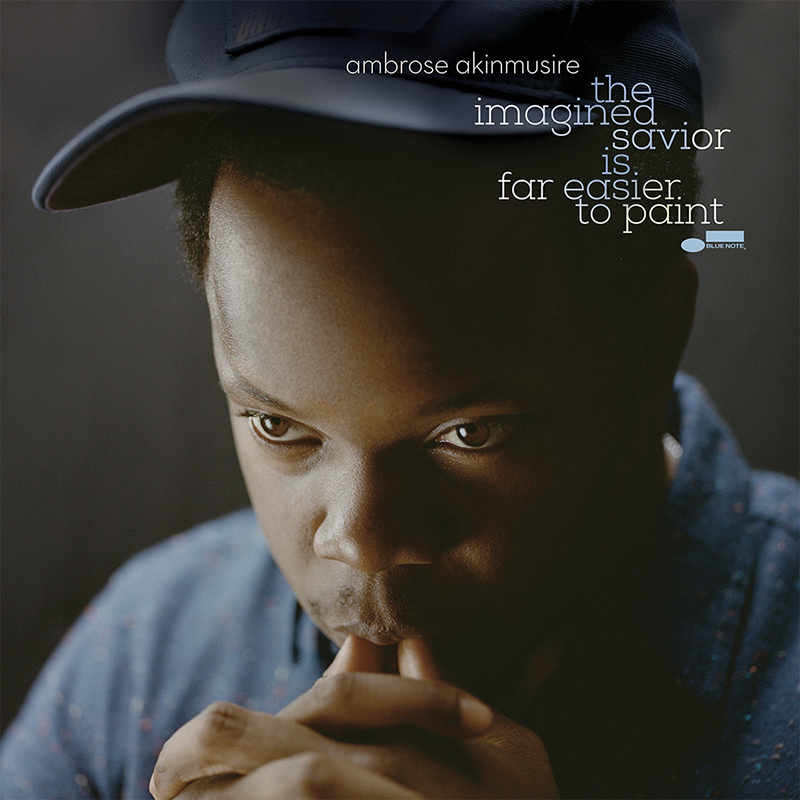
The Imagined Savior Is Far Easier To Paint (Blue Note)
Ambrose Akinmusire
Released March 10, 2014
Arts Fuse 2014 Jazz Critics Poll Top 10 New Album
JAZZ FM Album of The Year Nominee 2014
AllMusic Favorite Jazz Albums 2014
YouTube:
https://music.youtube.com/playlist?list=OLAK5uy_kIV0ataDocWp1sPRg3U9oCVaLSvSAmijU
Spotify:
About:
Ambrose Akinmusire, “a thrilling young trumpeter and astute bandleader [with a] unique spark in his playing” (The New Yorker), brings his artistic vision to the next level with the imagined savior is far easier to paint, his second release for Blue Note Records. The album follows his acclaimed major label debut When the Heart Emerges Glistening, which New York Times critic Nate Chinen named his #1 album of 2011, Akinmusire takes a more compositional turn on the imagined savior…, writing 12 of the 13 tracks and producing the album himself.
While Akinmusire continues to feature his extraordinary working quintet with tenor saxophonist Walter Smith III, pianist Sam Harris, bassist Harish Raghavan, and drummer Justin Brown, he also broadens his palette by enlisting guitarist and fellow Northern California native Charles Altura. In addition, Akinmusire unveils gripping new collaborations with the OSSO String Quartet and flutist Elena Penderhughes, as well as vocalists Becca Stevens, Theo Bleckmann, and Cold Specks.
However, these encounters with strings and voices don’t at all diminish the central role of Akinmusire’s quintet, now edging toward a sextet with the addition of Altura. It’s awe-inspiring to hear the band’s energy and focus as it confronts every challenge in “As We Fight (willie penrose),” “Vartha,” “Bubbles (john william sublett)” (inspired by tap-dance legend John Bubbles), and “Richard (conduit),” a 16-minute-plus closing epic recorded live at Jazz Standard in New York City.
Also, while Akinmusire’s virtuoso trumpet is still very present on the imagined savior…, it coexists in a larger sonic framework than before. “Composition is what I’ve been focusing on the last few years,” the trumpeter says. “I want to be able to write a song and not have it need improvisation”
Reflecting on his penchant for long and poetic album titles, Akinmusire comments: “I don’t think I’ve been able to make an album yet where one word can capture the whole vibe. Maybe eventually I will. Right now I’m drawing from so many different parts of myself, and things that are outside of myself, that it’s hard to just have one word that says, ‘This means this.’”
Akinmusire continues: “The last album was about me — about things that I was experiencing and trying to change or accept about myself. The inspiration for this album is things outside of myself: people that I know, documentaries that I’ve watched, characters that I’ve made up.” Indeed, many song titles on the imagined savior… have a name attached in parentheses, and some of these reflect Akinmusire’s practice of creating elaborate storylines and fictional characters as an inspiration for his writing. On the imagined savior… he took this in a new direction, giving each of his guest vocalists a sketch of an idea and allowing them to create their own lyrics based on that idea.
The results are astonishing, beginning with Becca Stevens’ performance on her original “Our Basement (ed)”: centered by a pulsing heartbeat of a tempo, Stevens’ words and eerie unfolding harmonies mesh with Akinmusire’s quintet and the Osso String Quartet together in a complex and beautiful arrangement. The lyrical inspiration is “ed,” a homeless man on Akinmusire’s block who managed to save a couple hundred dollars to give back to the church that feeds him on weekends.
Theo Bleckmann, without question an innovator in vocal performance, met Akinmusire at the famed music workshop in Banff, Alberta. “We were on faculty and we played a Kate Bush song,” Akinmusire recalls. “After we played we looked at each other and I was like, ‘Ok, we have to work together.’” The resulting “asiam (joan),” featuring Bleckmann with the quintet, is inspired by Joni Mitchell — specifically, Michelle Mercer’s portrait of “Joan” in her 2009 book Will You Take Me As I Am: Joni Mitchell’s Blue Period.
“Ceaseless Inexhaustible Child (cyntoia brown)” — dedicated to the imprisoned young woman at the heart of the documentary The 16-Year-Old Killer — features the dramatic “doom soul” vocals of Cold Specks, the Canadian-born, London-based singer-songwriter. “I’m a huge fan of hers,” says Akinmusire. “In June I did this tribute to Joni up in Toronto. I wrote [Cold Specks] an email asking her to be on my album, and she wrote back saying she was just about to invite me to be on her album.”
Along with the vocal tracks, there are two additional pieces with string quartet and flute, “The Beauty of Dissolving Portraits” and “inflatedbyspinning.” The former stems from Akinmusire’s influences outside of jazz: “I’m really into people like Arvo Pärt, people whose compositions tend to evolve slowly. They’re adding and taking things away in a way that you don’t notice until a certain amount of time has gone by. It’s really hard with jazz instrumentation in a quintet format to get that sort of sustain.”
With “inflatedbyspinning,” Akinmusire captures a daydream: “I had an image of women standing on a cliff spinning. One was holding a red balloon, and at the start of the spinning the balloon wasn’t inflated, but when the spinning stopped, it was inflated.” Raghavan’s broad-toned arco bass supplements the strings and flute here.
In a loose parallel to “my name is OSCAR” (dedicated to the late Oscar Grant) on his previous album, Akinmusire offers “Rollcall for Those Absent” as an overt statement on “a certain reality that you can’t deny that goes on here in America and in the world: this fear of black men that causes a lot of sad stories.” The instrumentation here is wholly different from the rest of the album: Harris plays the melody on mellotron while Akinmusire plays chords and bass notes on Juno synth, and Muna Blake (the young daughter of drummer Johnathan Blake) reads aloud the names of numerous people killed by police — or by vigilante action, as in the prominent case of Trayvon Martin. “Having a young voice read the names, it’s like the beginning of life talking about the end of life,” Akinmusire says. “I wanted to capture that. In the same way, sounds that are really high and really low are like the beginning and the end.”
Track Listing:
1. Marie Christie (Ambrose Akinmusire) 03:17
2. As We Fight (Ambrose Akinmusire) 06:25
3. Our Basement (Becca Stevens) 06:28
4. Vartha (Ambrose Akinmusire) 07:48
5. Memo (Ambrose Akinmusire) 05:53
6. The Beauty of Dissolving Portraits (Ambrose Akinmusire) 04:14
7. Asiam (Ambrose Akinmusire / Theo Bleckmann) 06:03
8. Bubbles (Ambrose Akinmusire) 03:55
9. Ceaseless Inexhaustible Child (Ambrose Akinmusire / Cold Specks) 06:12
10. Rollcall for Those Absent (Ambrose Akinmusire) 03:39
Personnel:
Ambrose Akinmusire: trumpet (1 to 9, 11), percussion (9), keyboards (10)
Sam Harris: piano (1 to 5, 7 to 9, 11), mellotron (10)
Harish Raghavan: bass (2, 4 to 9, 11, 12)
Justin Brown: drums (2 to 5, 7 to 9, 11)
Walter Smith: tenor saxophone (2, 5, 7, 8)
Charles Altura: guitar (2, 4, 5, 8, 9, 11)
Kallie Ciechomski: viola (3, 6, 12)
Brooke Quiggins Saulnier: violin (3, 6, 12)
Maria Im: violin (3, 6, 12)
Maria Jeffers: cello (3, 6, 12)
Becca Stevens: vocals (3)
Elena Pinderhughes: flute (6, 12)
Theo Bleckmann: vocals and effects (7)
Cold Specks: vocals (9)
Muna Blake: reading (10)
Recorded in 2013, at Brooklyn Recording, by Andy Taub (tracks 1-8, 10-12) and Jim Anderson (track 9), assisted by Jack Clow
Mixed and Mastered by Dave Darlington
Photography by Autumn De Wilde
Graphic Design: Lawrence Azerrad, LADdesign
Management: Mariah Wilkins Artist Management LLC
Producer: Ambrose Akinmusire
Review:
The title’s prose speaks of trumpeter Ambrose Akinmusire’s poetic leanings. A rising jazz star who’s received a lion’s share of awards and accolades yet is not resting on past laurels, he continues to search for artistic expression with in-demand chops and inventive writing that has illuminated the recordings of other artists and his own band since 2008’s debut Prelude: to Cora (Fresh Sound New Talent).
the imagined savior is far easier to paint is a fresh page in Akinmusire’s evolving narrative, this time integrating progressive music with songs and lyrics contributed by a number of today’s brightest vocalists. Becca Stevens provides abstract musings in “Our Basement” and Theo Bleckmann offers an affecting declaration of the heart in “Asiam” as Akinmusire’s full bodied horn expresses a range of moods from blustery flights to animated screeches and slurs in the “Ceaseless Inexhaustable Child” with Cold Specks singer Al Spx articulating her unforgettable style of bittersweet lyrics.
A stellar quintet that includes Akinmusire’s longtime associate saxophonist Walter Smith III and guest guitarist Charles Altura}, the band is on top of its game, burning bright in complex yet melodic numbers such as “As We Fight” and “Bubbles” or swinging through turbulence in the episodic 16 minute live track “Richard.” The release also unveils a gorgeous surprise in “The Beauty of Dissolving Portraits” which spotlights the trumpeter and the Osso String Quartet resulting in a piece that breathes multiple disciplines and highlights the trumpeter’s writing acumen. “inflatedbyspinning” is another composition featuring string quartet and even though the trumpeter doesn’t perform on the piece, it declares his prowess as a composer.
Like his previous releases, Akinmusire’s seeks to link themes and moods into a listening experience that move beyond the typecast set of up-tempo tracks and slower ballads. “Rollcall for Those Absent” is similar to “My Name is Oscar” from his 2011 Blue Note debut When the Heart Emerges Glistening as it provides social commentary, this time through a child’s reading of the names of young people killed from gunfire(including Trayvon Martin) while Akinmusire quietly accompanies on keyboards. This is another significant release from one of music’s brightest.
Mark F. Turner (All About Jazz)