
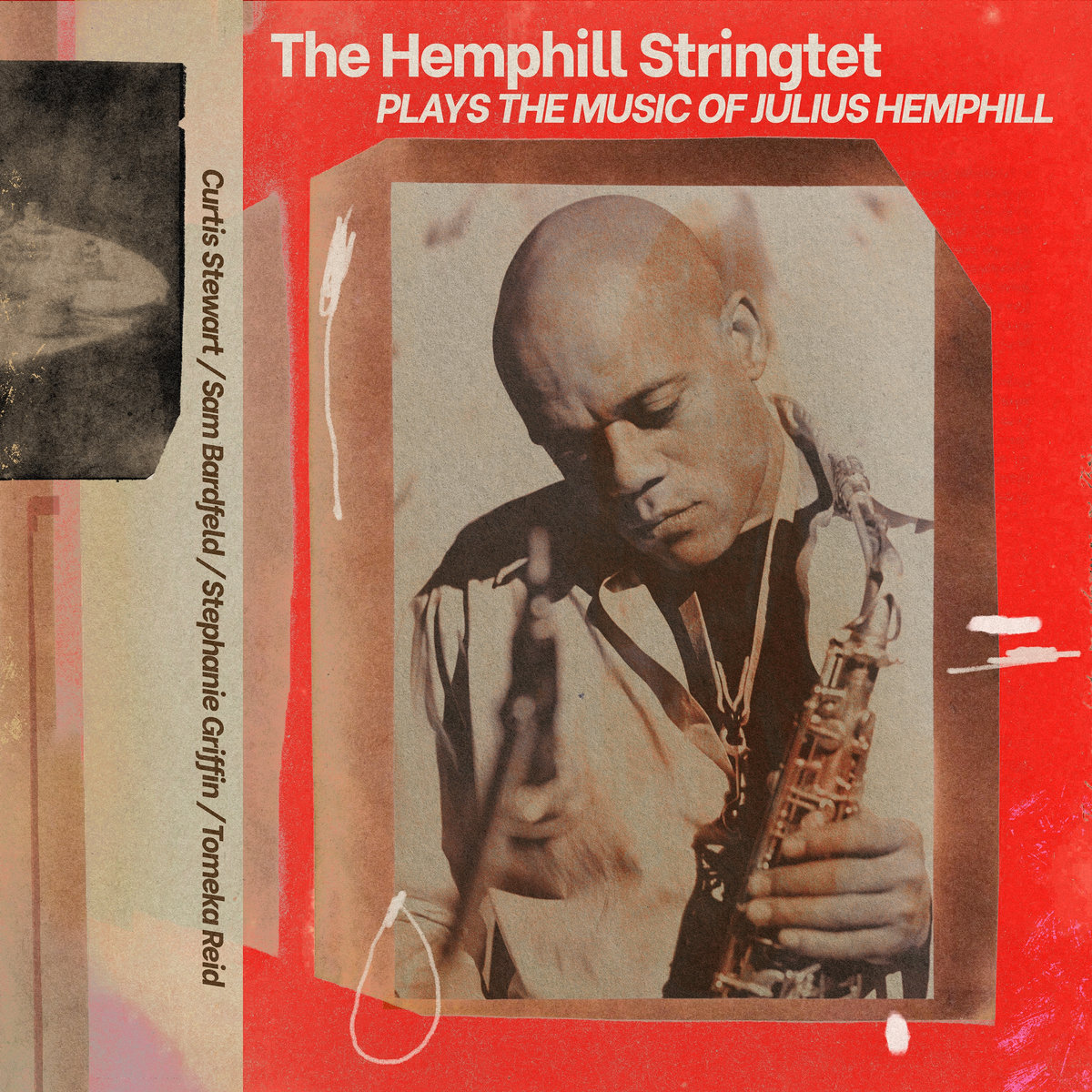
The Hemphill Stringtet Plays the Music of Julius Hemphill (Out Of Your Head Records)
The Hemphill Stringtet
Released April 4, 2025
All About Jazz Best Jazz Albums of 2025
YouTube:
https://music.youtube.com/playlist?list=OLAK5uy_kLQURscW8uylX7GrBdGLZXqx3bijpVuWg
Spotify:
About:
“Think of the music of Julius Hemphill (1938-1995), most likely your first thought is of saxophones. He played a few, and his dry, indelible alto sound in particular spoke of the savannah and the blues belt. And he was primary composer and conceptualist for the vastly influential World Saxophone Quartet, starting in 1977, before leading the Julius Hemphill Saxophone Sextet from 1989.
Still, when I think of Hemphill, the first sound that comes to mind is of four bowed strings: his frequent partner Abdul Wadud grinding away on cello on 1972’s unforgettable Dogon A.D. There had been cellos in jazz before, but Hemphill and Wadud made it sound like a blues guitar struck with a bow. Their bond was deep, and they’d reconvene periodically throughout their performing careers. Wadud, known to classical audiences as Ronald DeVaughn, would also record with new music dynamos Frank Lowe, Arthur Blythe, Anthony Davis and James Newton. He’s influenced dozens of improvising cellists to come, his champion Tomeka Reid conspicuous among them.
Tomeka Reid:
“Abdul Wadud, what can I say? A total giant and a deep voice in this music. (And the synergy between him and Hemphill was indeed magical.) His technique was impeccable, with the bow or pizzicato: You could hear the whole history of the music in his playing and he could weave in and out of styles effortlessly.” In that respect he’s a perfect role model for Reid and her fellow interpreters of Hemphill’s blues-infused chamber music here.
Sam Bardfeld:
“The quartet’s origin was a little serendipitous. I ran into Marty Ehrlich at a gig in Brooklyn and he told me that he had just published the World Saxophone Quartet music in an edition for strings and suggested I play them. I touched base with Tomeka – she and I were both huge Hemphill fans already – who said Peter Margasak had just asked her to put together a group to play Mingus Gold at Chicago’s 2022 Frequency Festival. We agreed to ask Curtis and Stephanie to join us. Besides being great improvisers, each co-leads a string quartet that deals extensively with contemporary classical music – Curtis with the Publiq Quartet and Stephanie with the Momenta Quartet. We all enjoyed playing together and playing this music so we kept going.”
Circa 2020, Marty Ehrlich – longtime Hemphill friend, sideman, aide and now archivist – had been preparing Julius’s saxophone music for publication. “Twenty-five years after his death, I was entering these works into the computer, listening back to them in a different way. It became clear that for all their rich idiomatic conception for saxophone choir, those compositions would work just fine for string quartet. And if one goal is to have the compositions of Julius Hemphill performed, string-quartet editions would open up a wider world.”
For that “rich idiomatic conception,” hear WSQ’s 1980 take of “Revue,” specifically the succession of slow chords starting around 1:20, and the idiosyncratic jostle of four distinctly individual reed voices. (The Ellington model: a sax section of individualists.) Now listen to the Stringtet play that same section, blending as string players are wont to do. The wild unpruned chords are now more orderly, more composerly, as four lines (say) move in parallel fourths, or outline a sturdy dominant seventh chord. The latter sets up the next section of “Revue,” where the score invites players to improvise over the tune’s anchoring cello vamp and its two – chord feel – an open episode announced by ceiling-scrape high violin harmonics. That launches a collective improvisation from which each member briefly emerges for a short solo.
Whatever else they do, Hemphill’s quartet pieces are designed to get improvisers moving, and if it’s expedient to skip a section, so be it. There’s collective improvising on each Hemphill composition here. “Choo Choo,” with its click-clack undercarriage, was an early (if unrecorded) composition for WSQ, its echoic title echoing Duke Ellington’s first train song, a 1924 novelty. (No resemblance. The posthumous Hemphill Saxophone Sextet recorded “Choo Choo” in 1997 for the album At Dr. King’s Table.) The tone poem “My First Winter” leads (via improvised transition) to the vampy dance “Touchic,” linked here just as they appeared back to back on WSQ’s Live in Zurich. Curtis Stewart takes the gorgeous wintry melody statement on the former, raising the bar for fellow violinist Sam Bardfeld’s follow-up. Violist Stephanie Griffin takes a particularly lyrical improvisation under wispy high harmonics and over a cello ostinato on “Touchic.”
Adapting saxophone quartet music to his Sextet, Hemphill might double a couple of parts at a higher or lower octave to fatten the texture. Editing the music for strings, Marty Ehrlich wisely forbore adding fortifying double-stops to Hemphill’s meticulous four-part voicings. The players thicken things up on their own, taking it from there.
But here we also have Hemphill’s own richly idiomatic writing for jazz-inflected string quartet: his 1988 settings of three 1959 compositions by Charles Mingus, who like Hemphill valued propulsive riffs, romantic harmony with blues extensions, music built in layers, and the occasional languid tempo. The suite Mingus Gold was commissioned but not recorded by Kronos. (A 2007 live version by the Daedalus Quartet is in the JH archival box The Boyé Multi-National Crusade for Harmony.) There’s some four-part writing in the suite, but double-stops abound. “Nostalgia in Times Square” is played as written. On “Alice,” the score calls for an “ad lib cadenza in D-flat” from cello, following a flashy pizzicato line to put the player in the mood and to draw the listener’s attention celloward. Reid repays the composer’s courtesy.
“Better Git Hit in Your Soul” is the most familiar of these Mingus melodies, and treated most familiarly by the Stringtet; the score even renders the title as “Betta Git It in Yo Sole.” In that spirit, violins start embellishing on the first repeat, itching to get to their “duo-solo” as some call it: a dual improvisation over plucked viola and cello locked together playing (scored) chunky chords below, a handsome effect. Mingus’s tempo modulations between sections are observed. Mingus references in the pizzicato cello parts are unmistakable. The infectious bowed riff that cello breaks out around 5:35 is Mingus’s, but it plays like pure Abdul Wadud.
Give Marty Ehrlich the last word: “I’ve always made the point that this rich body of work can be played by non-improvising sax or string groups in a suite form, or by improvising groups that can extend the works as Julius did with WSQ and the Julius Hemphill Saxophone Sextet. It’s wonderful that Tomeka and Sam and Curtis and Stephanie have done all of that.”
Kevin Whitehead (from the liner notes)
Track Listing:
1. Revue 07:44
2. Mingus Gold: Nostalgia in Times Square 04:43
3. Mingus Gold: Alice in Wonderland 07:51
4. Mingus Gold: Better Get Hit in Your Soul 07:31
5. My First Winter/Touchic 12:10
6. Choo Choo 05:46
Personnel:
Curtis Stewart: violin
Sam Bardfeld: violin
Stephanie Griffin: viola
Tomeka Reid: cello
All music by Julius Hemphill (Subito Music Corporation)
Recorded, edited, and mixed by Ryan Streber at Oktaven Audio
Mastered by Paul Zinman, Soundbyte Productions
Produced by Adam Hopkins
Cover photography by Nina Contini Melis
Artwork + design by TJ Huff (huffart.com)
Review:
Let us borrow a famous tagline from the dairy industry: Got Hemphill? If not, it is time to take a closer listen. Julius Hemphill (1938-1995) was a towering figure in the creative music scenes of both St. Louis, where he co-founded the Black Artists’ Group (BAG), and New York’s vibrant loft jazz scene of the 1970s and ’80s.
At a time when Miles Davis was going electric and fusion bands were battling for airtime against the neo- conservative ‘young lions,’ Hemphill was forging a different path. With the groundbreaking World Saxophone Quartet (WSQ), alongside Oliver Lake, Hamiet Bluiett and David Murray, he created an alternate vision of jazz steeped in composition, groove and daring exploration.
Hemphill’s influence is still deeply felt today, particularly in the work of his student Tim Berne and longtime advocate Marty Ehrlich. Ehrlich, a tireless Hemphill archivist, curated The Boyé Multi-National Crusade for Harmony: Archival Recordings, 1977-2007 (New World, 2021), an expansive seven-CD box set that shines a spotlight on Hemphill’s wide- ranging output. One of the discs in that set featured the non-improvising ensemble Daedalus String Quartet performing “Mingus Gold,” Hemphill’s arrangement of Charles Mingus compositions for string quartet.
This new release reimagines that concept with a fresh lineup of improvising musicians: The Hemphill Stringtet, featuring violinists Sam Bardfeld and Curtis Stewart, violist Stephanie Griffin and cellist Tomeka Reid. Bardfeld is well-known for his work with Roy Nathanson’s Jazz Passengers, and Reid, an AACM member and cornerstone of Chicago’s creative music scene, seems to be everywhere at once. Stewart and Griffin bring deep experience from their primary groups, PUBLIQuartet and Momenta Quartet, respectively.
This project deepens the ongoing reevaluation of Hemphill’s remarkable body of work. The album opens with “Revue,” originally written for the World Saxophone Quartet, and it bursts with a bright, full-bodied melody evocative of Aaron Copland’s Americana. “My First Winter/Touchic,” another WSQ-era piece, begins with a gentle fairytale-like melody that soon dissolves into a cosmic swirl of texture and pulse. Hemphill’s playful side emerges in “Choo Choo,” a nod to Duke Ellington’s classic train motifs, reimagined with rhythmic flair.
The centerpiece of the album is “Mingus Gold,” Hemphill’s tribute to the legendary bassist-composer. Originally composed for string quartet, the piece seamlessly integrates “Nostalgia in Times Square,” “Alice in Wonderland,” and “Better Get Hit in Your Soul” into a rich, cohesive suite. Reid’s cello offers the grounding resonance of Mingus’ voice, while the other strings glide through the melodies with grace and drive.
This recording not only honors Hemphill’s compositional brilliance, but also showcases the enduring vitality of his vision, where jazz, chamber music, and improvisation coexist in a sound entirely his own. It is a reminder that Hemphill’s music still has plenty to teach us, and plenty of room to grow.
Mark Corroto (All About Jazz)


