
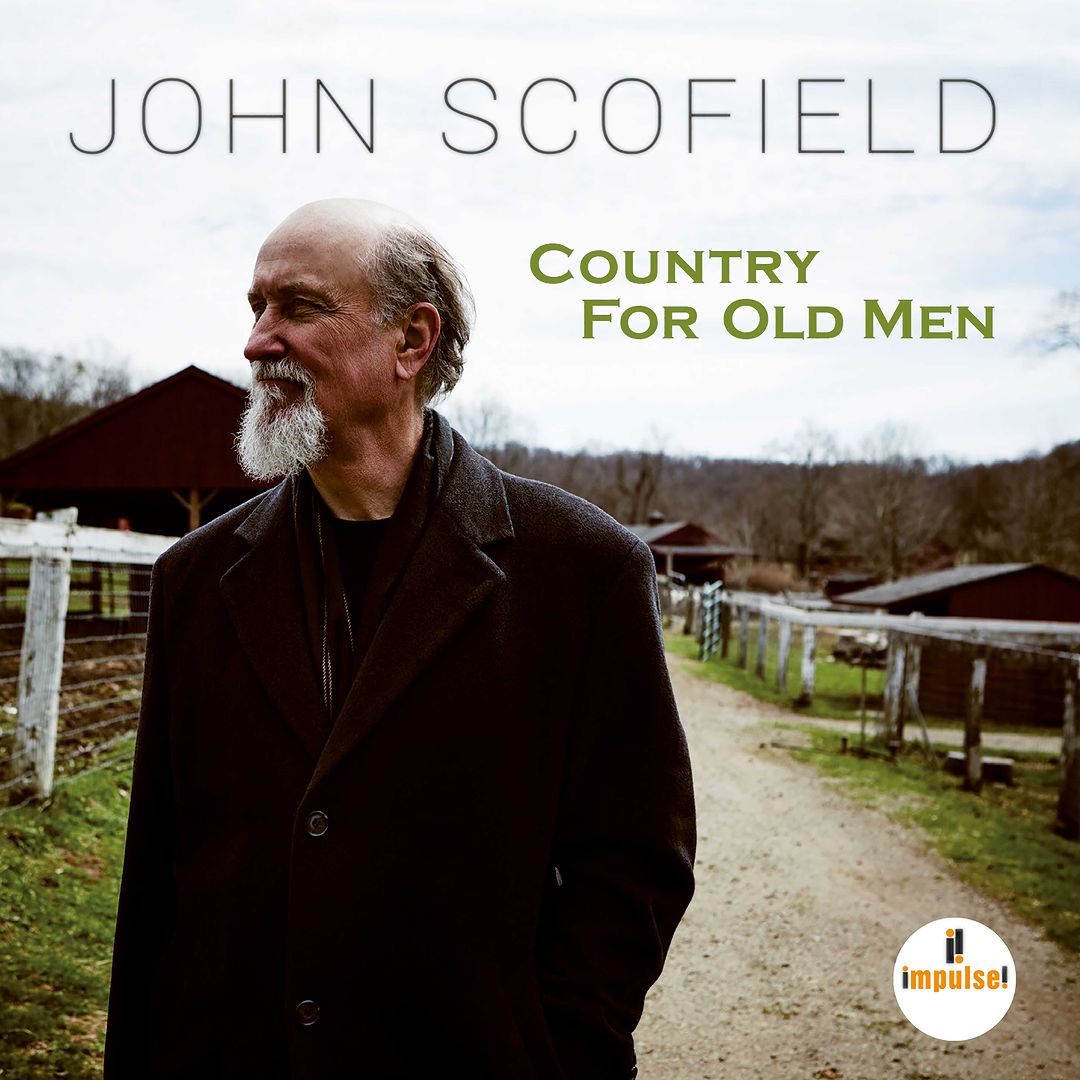
Country for Old Men (Impulse Records)
John Scofield
Released September 2016
Grammy Award for Best Jazz Instrumental Album 2017
JazzTimes Top 10 Albums of 2016
YouTube:
https://music.youtube.com/playlist?list=OLAK5uy_lDi3kubDEEfb6-Kb_Qj3x5Hx2SUmXfsyg
Spotify:
https://open.spotify.com/intl-pt/album/1Rr0Ltkn8v3pq3zQRh0twy?si=JxI5GVHuQ8KQo3k-QIYisQ
About:
John Scofield is known for pushing genre boundaries with his guitar, and his most recent foray into musical hybridity is Country For Old Men (Impulse!/Verve), an album on which the six-string veteran wrangles classic country tunes. The 12-track program reaches back to legends like Hank Williams (“I’m So Lonesome I Could Cry”), George Jones (“Mr. Fool”) and Merle Haggard (“Mama Tried”). But don’t worry: While Scofield puts a little twang in his trusty Ibanez ax, he never loses his jazz identity.
The band—featuring pianist Larry Goldings, bassist Steve Swallow and drummer Bill Stewart—honors the vintage country winsomeness of these songs while refusing to be limited by it. Their hard-swinging jams allow Sco’s angular disposition to emerge vividly. DownBeat spoke with Scofield as he and the band prepared for a weeklong appearance at The Blue Note in New York City.
So what prompted an album of country covers?
For a long time, I’ve thought it would be great to do a whole country album, and I had toyed with the idea of going to Nashville and playing with country guys. But then I thought, “You know, there’s a way to do what we did on this album, which is really blending jazz and country more, and to do it with some of the guys I play with, who are sympathetic to country music.” I’ve had a trio with Bill Stewart and Steve Swallow for years, and Larry Goldings played in my band for a few years in the ’90s, so I really know how those guys play and I knew we could make jazz out of these songs.
You seem to have adopted the idiomatic twang of these country classics into your own sound. How did you get yourself and your band into a country state of mind for this album?
I just listened to country music, and listened specifically to songs I knew we wanted to play and I learned them. I knew them anyway, but just sat down and played the melodies on my guitar and really thought about performing them as single-note melodies. And for the other guys, I sent them a little four-track demo that I made of my arrangements of the songs, where I had a drum track going and played bass and rhythm guitar. And I also sent them links to the original tunes so they could hear those, too. But I’m not sure how much of that they listened to [laughs]. Then we got together and recorded.
The band really captures the original authenticity of these melodies before departing into some burning jazz, yet the transition never seems forced or awkward.
I picked tunes where I could have them turn into jazz, so we could blow and swing on them, and I maybe changed the chords a little bit to make each song a real blowing vehicle. That was really important because I didn’t want to do just folk-country. I wanted to be able to make jazz out of it.
You’ve talked about coming up in the ’60s in the suburbs of New York, during the heyday of electric blues and folk. But when did country first catch your ear?
I listened to the radio all the time, so I was aware of all the country music hits, since childhood, really. “Ring Of Fire,” “Jolene” and “Mama Tried”—you just heard them on the radio. Country music was big. Even though I wasn’t a country music freak, I appreciated the guitar work, and I’ve always loved Appalachian music and bluegrass and that deep country sound of George Jones and Hank Williams. I’m a fan of that, along with being a fan of a lot of different music. I never tried to play country music before and never hung out with many country musicians, so I’m certainly not qualified to be a country player. But I wasn’t trying to do that on this album.
On the last track, you play this ultra-catchy vignette of Johnny Mercer’s “I’m An Old Cowhand” on ukulele. How did that happen?
I was in Honolulu, playing at a jazz club there, and they gave me that ukulele, and I’d never really played one before. But the first thing I played when I picked it up was “I’m An Old Cowhand” because I was still learning songs for this record. And I liked the way it came out on the ukulele, so I used that. It’s a four-string ukulele with My Dog Has Fleas [G-C-E-A] tuning.
Did recording these songs your own way, with your own arrangements, enhance your connection to them?
Well, I’ve played these melodies on tour now and I feel a real connection to the songs, and of course I love the artists who sang them. They sang these melodies that I’m interpreting on the guitar, which makes it somehow different, and that’s why I wanted to do it. When we were recording, I felt an emotional bond with the music that was very strong, and I remember feeling surprised about that. And then when we’d take them into jazz, it didn’t feel fake; it just felt right.
Chris J. Bahnsen (DownBeat)
Track Listing:
1. Mr. Fool (Darell Edwards / George Jones / Herbie Treece) 5:04
2. I’m So Lonesome I Could Cry (Hank Williams) 7:01
John Scofield Grammy Award for Best Improvised Jazz Solo 2017
3. Bartender’s Blues (James Taylor) 5:17
4. Wildwood Flower (Joseph Philbrick Webster) 3:53
5. Wayfaring Stranger (Traditional) 6:30
6. Mama Tried (Merle Haggard) 5:18
7. Jolene (Dolly Parton) 7:35
8. Faded Love (Billy Jack Wills / Bob Wills / Johnny Lee Wills) 6:32
9. Just a Girl I Used to Know (Jack Clement) 4:10
10. Red River Valley (Traditional) 6:16
11. You’re Still the One (John Lange / Shania Twain) 4:20
12. I’m an Old Cowhand (Johnny Mercer) 0:30
Personnel:
John Scofield: guitar, ukulele
Larry Goldings: piano, Hammond organ
Steve Swallow: bass
Bill Stewart: drums
Recorded April 3 and 4, 2016 in the Carriage House Studios in Stamford, Connecticut
Produced by John Scofield
Recording and Mixing: Jay Newland
Assistant Engineer: Mikhail Pivovarov
Mastering: Mark Wilder
Cover Photo: Nicholas Suttle
Design: Françoise Bergmann
Executive Producer: Farida Bachir
Review:
When guitarist Bill Frisell first began a more decided focus on roots music,
bluegrass and country & western music with the release of 1996’s Nashville (Nonesuch),
despite being largely very well-received, jazz purists rankled when the largely
bluegrass/folk-informed album began to garner awards like Downbeat
Magazine‘s Best Jazz Album of the Year. While Frisell’s oftentimes
Americana-tinged work has, in the ensuing years, become more fully accepted for
the wonderful music that it is, fellow six-stringer John Scofield is unlikely
to find himself the subject of such purist criticism with Country for
Old Men. A play on the Coen Brothers’ acclaimed 2007 film No
Country for Old Men, a reference to the vast majority of source material on
Scofield’s first album of entirely non-original music since 2005’s That’s
What I Say: John Scofield Plays The Music Of Ray Charles (Verve), and
a not-so-subtle reminder that the 64 year-old guitarist isn’t getting any
younger, Country for Old Men may demonstrate his clear love of
music from songwriters including George Jones, Hank Williams, Merle Haggard,
Dolly Parton and Bob Wills, but it is still unequivocally a jazz record…one
that may have a touch of twang but also swings mightily on nearly half of its
twelve songs.
Scofield may be approaching the midpoint of his
seventh decade on earth, but maintains an active touring schedule and a pretty
reasonable certainty that fans can expect at least one new album every year.
Still, beyond culling its material from genre that many jazz fans hate with a
vengeance, that the guitarist is releasing another jazz album back-to-back with
the 2016 Grammy Award-winning reunion with saxophonist Joe
Lovano on his superb Impulse! Records
debut, Past Present (2015)—which turned into one of the 2016
TD Ottawa Jazz Festival’s most memorable performances. It breaks a long
streak of alternating between jam band records like 2013’s Überjam Deux (EmArcy,
2013) and concept albums like his Ray Charles tribute and the blues/New Orleans-informed Piety
Street (EmArcy, 2009), with more decidedly jazz-oriented albums
including his collaboration with composer/arranger Vince Mendoza and the Metropole Orkest, 54 (EmArcy,
2010) and smaller but no-less ambitious albums like the particularly
exceptional This Meets That (EmArcy, 2007) and EnRoute (Verve,
2004).
Still, at this point in his life and career,
Scofield can pretty much do as he pleases and, not unlike This Meets
That—which shares the same longstanding trio of longtime bassist Steve
Swallow and drummer Bill
Stewart but is, this time, fleshed out to a
quartet with the addition of another evergreen musical compatriot, keyboardist Larry
Goldings—what makes Country for Old Men such
a captivating listen is that it brings together many of the guitarist’s core
loves: the blues (which has always been a part of his DNA in any context, with
his thick, gritty tone and distinctive bends); singer/songwriters like James
Taylor, whose “Bartender Blues,” first
heard on 1977’s JT (Columbia), is given a gently balladic
treatment; traditional folk music like “Wayfaring Stranger,” which is
delivered New Orleans style, with Stewart’s near-Second Line support; and, of
course, plenty of bop-informed jazz, in particular Sco’s ability to build
relentless tension and release by moving harmonically “outside,” only
to bring things back “inside” with the unerring jazz equivalent of a
great comedian’s perfect timing.
Rather than divide up his many interests,
however, on Country for Old Men Scofield brings many of them
together under one umbrella even more successfully than This Meets That,
where the same core trio of Swallow and Stewart was augmented by a four-piece
brass and reed section on a set of largely Scofield originals, a horn-heavy,
rockin’ but surprisingly re-harmonized look at the Rolling Stones’ “(I Can’t Get No) Satisfaction,” and a
metrically head-scratching “House of the Rising Sun,” where guest
Bill Frisell adds some perfectly nostalgic tremelo guitar.
Scofield opens Country for Old Men with
a relatively down-the-middle rendition of the gospel-tinged George
Jones/Darrell Edwards/Herbie Treece song “Mr.Fool” (a single that can
be found on recently expanded reissues of Jones’ 1959 album, Country
Church Time). One of the best, most immediately evident aspects to his
playing here and throughout the record—as was also true with Past
Present—is his decision to forego the bevy of effects that often expand his
tonal palette with Medeski, Scofield, Martin & Wood, his Überjam Band, his
earlier fusion efforts and more recent special projects.
Not that there’s anything wrong with effects,
and Scofield has, over the decades, certainly evolved a distinctly personal
approach that sends his playing on albums like 2015’s Sco-Mule (Evil
Teen)—a long overdue document of one of two 1999 encounters with Gov’t
Mule—right up into the same stratospheric highs
as the high-octane, high-decibel southern jam band’s guitarist, Warren
Haynes. But, as both Past Present and
Scofield’s Ottawa performance with Lovano, Stewart and bassist Ben
Street the following year demonstrated,
sometimes all those effects get in the way of the purity and beauty of the
simplest setup: a great axe, great cable and great amplifier.
Things change quickly, however, when a
completely unexpected look at “I’m So Lonesome I Could Cry” follows
“Mr. Fool.” Bolstered by Swallow’s high-velocity, walking bass lines,
Stewart’s lithe, thoroughly interactive kit work and Goldings’ otherworldly
textured Hammond organ, Hank Williams’ familiar melody may be instantly
recognizable but beyond that, Scofield’s group fires on all cylinders, as the
guitarist takes a motif-driven solo filled with the kind of inside/outside
movement that other guitarists may employ, but never with Sco’s effortless
combination of fluid phrasing and, again, perfect timing, as he engages
empathically with his band mates at a mitochondrial level honed across two-plus
decades of working together. Goldings’ solo is a masterclass in pulling a
wealth of colors from the Leslie-amplified instrument, but it may be his
accompaniment behind Scofield that’s most impressive…at least, on this
track.
Fans of the Grateful Dead’s Bob Weir and his
interpretation of “Mama Tried” will be taken aback by this quartet’s
reading of Merle Haggard’s evergreen tune, as Scofield and his partners
dispense with the theme quickly and open up into another fervently swinging
interpretation. This time Goldings is on piano and, alongside Scofield, gets
more space for his solo; his highest profile gig has been, in recent years, as
musical director and keyboardist for James Taylor (rendering “Bartender
Blues” all the more relevant); but as has been the case with a singer/songwriter
who regularly draws upon musicians with jazz in their DNA (the
gone-too-soon Don Grolnick and Carlos
Vega, and still-with-us Michael
Landau, Jimmy Johnson and Steve Gadd amongst them), Goldings’ jazz cred remains as
strong ever, and if his piano playing is impressive, his Hammond work is even
more so, the harmonic anchor behind eight of the album’s eleven group
tunes.
Scofield takes Dolly Parton’s
“Jolene”—the hit title track to her 1973 album that was ranked #217
on Rolling Stone‘s “500 Greatest Songs of All Time” list
in 2004—and turns it into a simmering 6/8 reading that, with Goldings’
fourths-based pianism, Stewart’s Elvin Jones-tinged pulse and Swallow’s ever-flowing lines, provides Scofield with
all the support he needs to deliver one of his most flat-out lyrical solos of
the set. Swallow may be featured relatively infrequently on Country for
Old Men, but his solo here is just one more reason why he continues to
garner awards for his utterly unique approach to electric bass. His ensemble
work is as potent and idea-filled as ever and, alongside Stewart’s inimitably
melodic, finely nuanced kit work, provides every good reason why Scofield has
been working with the bassist, on and off, since 1980’s Bar Talk,
with the drummer, similarly, since 1991’s Meant to Be, and with the
pair together since the guitarist’s 1996 Verve debut, Quiet,
following the guitarist’s five-year, seven-album string of releases for Blue
Note Records.
Since his career took particular flight after
his mid-’80s tenure with Miles Davis,
Scofield has always had great engineers handling the recording, mixing and
mastering of his albums. Since moving to Impulse! with Past Present,
however, the sound of his recordings has taken a particular leap forward, with
Jay Newland beautifully capturing the sound of the group for both recordings at
Stamford, Connecticut’s The Carriage House Studios, where he recorded and mixed
the albums, and Mark Wilder behind the board at New York’s Battery Studios,
where Past Presentand Country for Old Men were
mastered. From the precision of Stewart’s cymbals and the deep in-the-gut
resonance of Swallow’s bass to the rich sound of Goldings’ instruments and, of
course, the purity of Scofield’s thick, alternatively sweet and tangy but
always gritty and grease-filled tone, Sco’s two Impulse! dates sound better
than ever (and that’s an accomplishment), especially on a system that can
deliver the goods. The music is always what matters most, of course; but when
it’s possible to marry stellar playing with superb sound, the result is
something as glorious for the ears as it is the head, the heart and the
soul…all of which Country for Old Men possesses, in
spades.
And, beyond the lyrical, country-tinged ballads
and fiery swingers, Country for Old Men saves its biggest
surprises for its final minutes: a version of the traditional “Red River
Valley” that opens as the closest thing to rock ‘n’ roll as can be found
on the record, with Goldings delivering the familiar theme on Hammond but,
before long, shifting to a bright, ambling swing for Scofield’s solo on what
ultimately becomes the most mainstream song of the set.
After a gentle look at Shania Twain and John
Robert Lange’s “You’re Still the One”—the Canadian country singer’s
first song to break the top ten on Billboard‘s Hot 100, peaking at
#2—Scofield closes the hour-long career milestone of Country for Old
Men all on his own, contributing a thirty-second version of Johnny
Mercer’s “I’m an Old Cowhand,” played on ukulele and produced,
intentionally, lower-fi and with the sound of scratched vinyl blended in. It’s
a curious but somehow perfect closer to an album which suggests that not only
does Scofield—playing better than he ever has—have plenty of surprises still up
his sleeve, but that he may well be moving in a direction where the myriad of
music he loves is now all fair game, all while still remaining
firmly in the jazz sphere.
Only time will tell.
John Kelman (All About Jazz)


