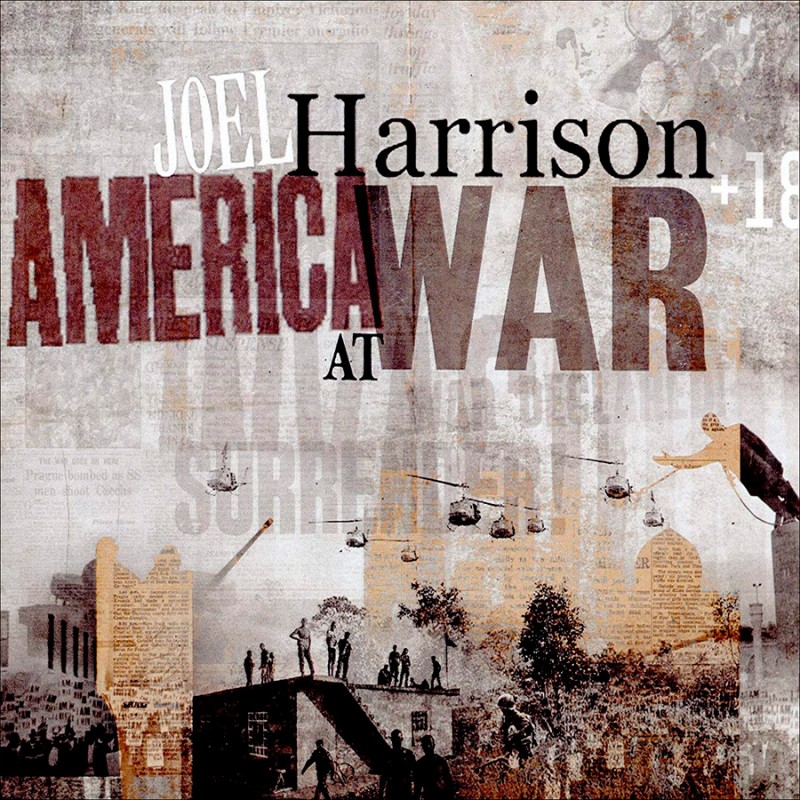
America At War (Sunnyside Records)
Joel Harrison
Released April 24, 2020
AllMusic Favorite Jazz Albums 2020
YouTube:
https://music.youtube.com/playlist?list=OLAK5uy_k3b5ad2v1UWP3okbTvrn6o0FxlbWwHfDo
Spotify:
About:
The United States has been in the midst of a foreign military engagement nearly every year since composer Joel Harrison’s birth in 1957. This endless state of war has had lasting impacts on the country’s wellbeing, and far reaching repercussions on generations of soldiers and their families. Guitarist and composer Joel Harrison’s new large ensemble recording, America At War, is a musical meditation on a lifetime of ruinous armed conflicts conducted by the United States.
After composing and recording his first large ensemble works (Infinite Possibility, 2011, Sunnyside), he looked for a strong theme upon which to build his new work. It was 2014 and the United States was still immersed in an unending 13-year conflict in Afghanistan and the “War on Terror,” as well as the longstanding Iraq military conflict. He was aghast at the waste of it all and the effects on those in battle, along with the effects on those expected to finance them.
The more that he wrote, the more effective the music became. Harrison then received grants from the Aaron Copland Foundation and the New York State Council on the Arts, which led to a revamping of the charts and a recording in January 2019.
There were a number of goals: to create music with pathos and intensity, to utilize unusual orchestration such as timpani, English horn, and shakuhachi, to embrace his roots in rock music, and to elicit both fire-breathing and poignant performances appropriate to the work’s theme.
The ensemble includes 18 musicians game to the task of presenting this demanding and emotionally charged music. Matt Holman was called in as conductor, and expert instrumentalists like trumpeters Ingrid Jensen, Dave Smith and Seneca Black, trombonists Curtis Hasselbring and Alan Ferber, and a “murderer’s row” of woodwinds, Ben Kono, Jon Irabagon, Stacy Dillard and Ken Thomson, make the music incredibly rich and emotive.
Harrison states, “I was astonished out how powerful the bands’ performance was. The players executed at an amazingly high level, technically and emotionally.” The results seem immediate and live with a fat bottom end and inspired playing in all the sections. The recording begins with “March On Washington,” a raucous piece that hearkens to the electric, funky sounds of the turbulent 1960s and 1970s and features a Charles Ivesian collage in a three-dimensional march peppered with snippets of anthems from the era. The piece ends with a very raw, chanted message.
Named for the type of uranium that formed the basis of George W. Bush’s false claims before the Iraq war, “Yellowcake” contrasts the cadence of the former president’s speech with the elements of the inane popular music of the time, represented here by 50 Cent’s “In Da Club.” This gallows humor speaks to the gravity of Bush’s false declaration that would soon cause thousands to perish in the midst of a country beset with denial.
Harrison was inspired to write the brooding “My Father In Nagasaki” by the story of his father being one of the first two Americans to reach the demolished city of Nagasaki after the bomb dropped. The quietly menacing piece includes an incredibly moving shakuhachi solo by the great Ned Rothenberg.
The percussion heavy “The Vultures of Afghanistan” utilizes a 14 beat cycle in contrasting sections with a dramatic melody threading through the whole. “Requiem for an Unknown Soldier” offers a beautiful lament that evolves towards anger, perfectly executed in Ingrid Jensen’s testifying trumpet leading to a swirling final melody. Written in a flood of emotion while Harrison was recovering from a debilitating concussion at an artist colony, the beautiful “Gratitude” uses a hypnotic rhythmic cycle and gospel inflections to show the composer’s empathy for those who experience trauma, and are fortified with the tenuous gift of life.
The stirring “Honor Song” takes its inspiration from the Native American tradition of honoring warriors through song. A powerful chant is followed by a fantastic solo by saxophonist Stacy Dillard. Tom Waits’s “Day After Tomorrow” may be one of the most moving songs about a soldier’s emotions. Harrison felt compelled to arrange and sing this lengthy work of lyrical genius. And we end with a hurricane-force consideration of “Stupid, Pointless, Heartless Drug Wars,” a title which more than speaks for itself and features a relentless, circling rhythm and claustrophobic, cathartic screams from Thomson’s sax.
Understanding that most actions taken by soldiers are ordered by superiors, Joel Harrison does not want to denigrate these men and women. On his new recording, America At War, Harrison hopes to shine a spotlight on their situation, namely as individuals caught up in messes caused by others, and asks for an end to the United States’ obsession with conflict for conflict’s sake.
Track Listing:
1. March on Washington (Joel Harrison) 09:52
2. Yellowcake (Joel Harrison) 07:01
3. My Father in Nagasaki (Joel Harrison) 08:15
4. The Vultures of Afghanistan (Joel Harrison) 06:27
5. Requiem for an Unknown Soldier (Joel Harrison) 10:15
6. Gratitude (Joel Harrison) 09:38
7. Honor Song (Joel Harrison) 07:36
8. Day After Tomorrow (Tom Waits) 06:40
9. Stupid, Pointless, Heartless Drug Wars (Joel Harrison) 06:50
Composed & Arranged by Joel Harrison
Conducted by Matt Holman
Personnel:
Seneca Black: trumpet
Dave Smith: trumpet & flugelhorn
Ingrid Jensen: trumpet (1, 3, 5, 6, 8)
Chris Rogers: trumpet (2, 4, 7, 9)
Marshal Sealy: french horn
Alan Ferber: trombone
Sara Jacovino: trombone
Curtis Hasselbring: trombone
Ben Staap: tuba
Ben Kono: english horn, oboe, soprano, alto saxophone & flute
Ken Thomson: alto saxophone, Bb clarinet & bass clarinet
Stacy Dillard: tenor saxophone
Jon Irabagon: tenor saxophone, flute
Lisa Parrot: baritone saxophone & bass clarinet
Joel Harrison: guitar, voice
Daniel Kelly: piano
Gregg August: electric & acoustic bass
Jard Schonig: drums
Wilson Torres: vibraphone, congas, timpani, concert bass drum, bongos, bells & shaker
Ned Rothenberg: shakuhachi (3)
Recorded January 2019, Oktaven Studio, by Ryan Streber
Mixed by Liberty Ellman
Mastered by Dave Darlington
Photography by Scott Friedlander
Graphic Design: Christopher Drukker
Assistant Producer: George Schuller
Review:
Over two-plus decades spent living and working in New York, there is very little guitarist, composer, producer, and educator Joel Harrison hasn’t tried. Early outings included the seminal Free Country with Norah Jones and David Binney, the orchestral Infinite Possibility, and the singer/songwriter date Other River. Harrison is working with a concept here. America at War is a big-band meditation on America’s obsession with armed conflict; the country has been at war through 226 of its 240 years. In writing and arranging for a large group (they are conducted by trumpeter Matt Holman), Harrison pursues many musics under the rubric of jazz in eight originals and a cover of Tom Waits’ “Day After Tomorrow,” an antiwar song from 2004’s Real Gone, issued the year after the U.S. invasion of Iraq. Some of Harrison’s 18 collaborators include trumpeter Ingrid Jensen, saxophonists Jon Irabagon and Lisa Parrot, trombonist Curtis Hasselbring, bassist Gregg August, and pianist Daniel Kelly.
The nearly ten-minute opener, “March on Washington,” starts as a funky assertion with tubas, trap kit, a punchy brass groove, and Harrison’s electric guitar laying out a sinister funk vamp adorned by Wilson Torres’s vibraphone. It winds itself out to play off the funky, bluesy vamp evoking early Hot Rats- and Waka Jawaka-era Frank Zappa as it proceeds. Dave Smith’s trumpet solo presages an explosive fuzzed-out wah-wah six-string break before the martial snare of Jared Schonig ushers in an extended cacophonous horn chart with a surprise conclusion. While “Yellowcake” begins with a noir-ish, dramatic, orchestral interlude, it suddenly shifts gears and finds a mean Latin groove accented by bright brass, hand percussion, and vibes, with killer solos from Hasselbring and Irabagon. “The Vultures at Afghanistan” is where the modernist big-band innovations of the Clarke-Boland Big Band meet the Afro-Cuban grooves of Irakere. Its solos from Irabagon, Ben Kono’s snaky soprano saxophone, and Alan Ferber’s boss trombone are underscored by Schonig’s frenetic kit, as well as Torres’ bongos, congas, and shakers.” “Requiem for an Unknown Soldier” is moodier, more expressionistic. The piano shimmers while introducing a slowly developing horn chart that offers staggered harmonies and pillowy textures in a long, languid suite, complete with stellar blues-inflected soloing from Jensen and Harrison. “Gratitude” weaves soul, gospel, and sunshine pop into its arrangement. Its processional tempo begins to accelerate and nod at the influence of Oliver Nelson halfway through, with swirling orchestral colors and polyrhythms. While Harrison’s guitar playing is front and center on Waits’ “Day After Tomorrow,” it is granted further poignancy by him singing the lyric in front of restrained and tasteful accompaniment. Finally, “Stupid, Heartless, Pointless Drug War,” melds post-bop jazz balladry, gritty blues, funky syncopation, and swinging tempos that would make Henry Mancini doff his hat to the composer. With America at War, Harrison proves once again he is a master of articulating and innovating on the modern big-band form and is a compelling contributor to its written literature. This is a masterful work whose significance and musical importance will endure.
Thom Jurek (AllMusic)