
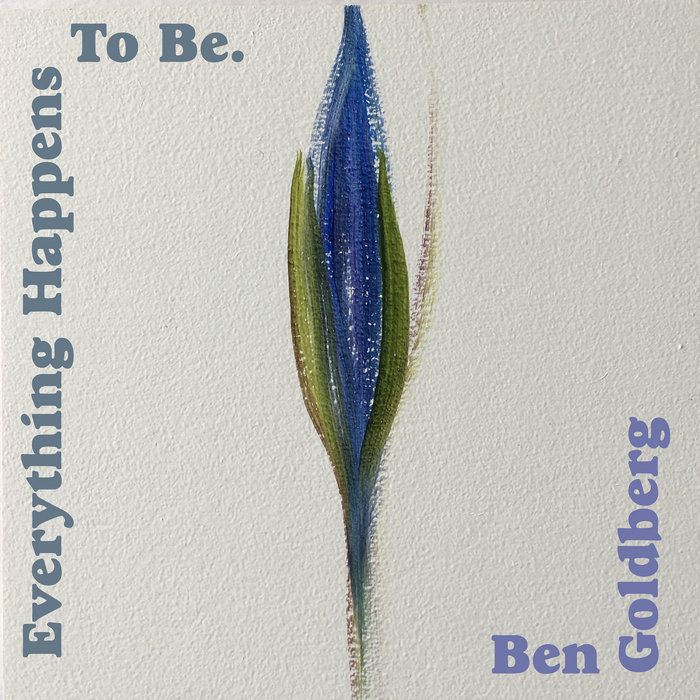
Everything Happens To Be (BAG Production Records)
Ben Goldberg
Released June 18, 2021
DownBeat Four-and-a-Half-Star Review
Arts Fuse 2021 Jazz Critics Poll Top 30 New Album
YouTube:
https://music.youtube.com/playlist?list=OLAK5uy_nGyU9ODXRIHZlE8pNwVEvrCo0-94dgZT8
Spotify:
About:
For his latest record, Everything Happens to Be., Bay-Area stalwart and clarinet innovator Ben Goldberg convened a group of what he refers to as “distinct and eccentric musical personalities.” His formidable ensemble is composed of some of New York’s most exciting musicians – guitarist Mary Halvorson, tenor saxophonist Ellery Eskelin, bassist Michael Formanek, and drummer Tomas Fujiwara. On formulating the band, Goldberg remarks: “As a composer, I write not for instruments but for specific people. When I give someone a task, I need to know that they will carry it out specifically according to how they, as an individual, hear and imagine it. And it helps if they are stubborn, so when you boss them around they both do and do not follow your instructions: that way, you can count on everyone to chart their own course and meet you at the end. So I need to be selective about who I invite to the party. And this record, I should say, is some party.”
In the pre-Covid reality, Goldberg had been spending an increasing amount of time in New York, performing and working with a wide swath of the city’s fertile improvising community. He forged a special bond with Halvorson and Fujiwara in their improvised trio The Out Louds wherein Goldberg says he “got to know their contours, and where they might like to lunge.” These improvisations served to further Goldberg’s desire to compose music for them which would both harness these proclivities and also suggest new pathways — to shine a light on different corners of their burgeoning language.
Goldberg’s relationship with Eskelin began when the clarinetist wrote the saxophonist a letter in 1993. Goldberg’s love of Eskelin’s distinct and rich approach persists to this day, and Goldberg admiringly notes that “Ellery’s sound is the ragged heart of the modern world.” Eskelin played on Goldberg’s Unfold Ordinary Mind in 2013, but their reunion on this new album is special. Their shared melodic sensitivity and the depths of lyricism find perfect simpatico with one another.
Goldberg began playing with bassist Formanek in the last decade in many groups, especially prizing their work in the duo context. Goldberg says of Formanek that “Mike is one of our most accomplished, deeply thoughtful, and thoroughly swinging musicians. I learn something every time I play with him.” Formanek’s long-standing relationship with Halvorson and Fujiwara – in the acclaimed groups Thumb Screw, Halvorson’s Code-Girl, in addition to Formanek’s Ensemble Kollosus – also bears heavily on the intimacy and familiarity conjured throughout Everything Happens to Be.
Track Listing:
1. What About (Ben Goldberg) 5:41
2. 21 (Ben Goldberg) 6:14
3. Fred Hampton (Ben Goldberg) 4:48
4. Everything Happens To Be. (Ben Goldberg) 7:04
5 Cold Weather (Ben Goldberg) 6:23
6. Chorale Type (Ben Goldberg) 9:53
7. Tomas Plays The Drums (Ben Goldberg) 5:51
8. Long Last Moment (Ben Goldberg) 5:10
9. To-Ron-To (Ben Goldberg) 5:32
10. Abide With Me (William Monk) 1:10
Personnel:
Ben Goldberg, B-flat clarinet, E-flat Albert System clarinet, contra alto clarinet
Ellery Eskelin, tenor saxophone
Mary Halvorson, electric guitar
Michael Formanek, bass
Tomas Fujiwara, drums
Recorded June 2018 at Firehouse 12 Studio, New Haven
Engineer: Nick Lloyd
Mixed by Michael Coleman
Cover art by Molly Barker
Design by Joshua Pfeffer
Review:
There’s a lovely stretchiness to the start of this album, as Ben Goldberg and his bandmates tug and squish the phrases of “What About” as if they were so much musical taffy. Goldberg’s clarinet leads the way, declaiming the melancholy lines with cantorial gravity as Ellery Eskelin’s tenor follows at a not-quite antiphonal distance. Below them, the rhythm section loosely sketches the rhythmic and harmonic lines, with Michael Formanek’s bass gently pushing the beat as Mary Halvorson’s delay-leavened guitar invariably lingers behind. But then, after a lyrical solo by drummer Tomas Fujiwara, whose fluttering brushwork has been the glue holding the ensemble together, the other four musicians return with a new melody — this one presented as a neat and tidy chorale, with Goldberg and Halvorson playing in such close unison you’d swear they were a single instrumental voice. Those varied ways of playing together describe this album in a nutshell. Although the recording is firmly centered on Goldberg’s writing, the joy of the playing derives from the many different approaches these five take with the tunes. It can be playful, as on “Fred Hampton,” where Halvorson’s guitar disrupts the gently crepuscular melody with shimmery, burbling distortion; it can just as easily be delivered deadpan, as with their church-perfect rendition of the Henry Francis Lyte spiritual “Abide With Me.” Mostly, though, it stays between extremes, playing off organized structures while ensuring the structure never entirely organizes the playing. “Chorale Type” is impressively ambitious, offering well-harmonized ensemble playing, group improvisations, an unaccompanied bass solo, a playfully conversational guitar and clarinet duet, plus an eloquent, semi-straightahead tenor solo. For “Tomas Plays The Drums,” the theme is stated in a loose, Ornette Coleman-style unison as Fujiwara plays freely; for “To-Ron-To,” the horns and guitar repeat a giddily lilting riff built around a mispronunciation of that Canadian city’s name. In both cases, the setup is followed by collective improvisation that takes the band somewhere else entirely. Goldberg has said that part of his inspiration for this album was the acquisition of an E-flat Albert System clarinet, a instrument much beloved by Dixieland clarinetists, and it’s not hard to hear echoes of that New Orleans approach in the way he and Eskelin play off each other. Still, the album’s strength has less to do with the weight of tradition than with the communality of the players, for the music here is definitely greater than the sum of its parts.
J.D. Considine (DownBeat)


