
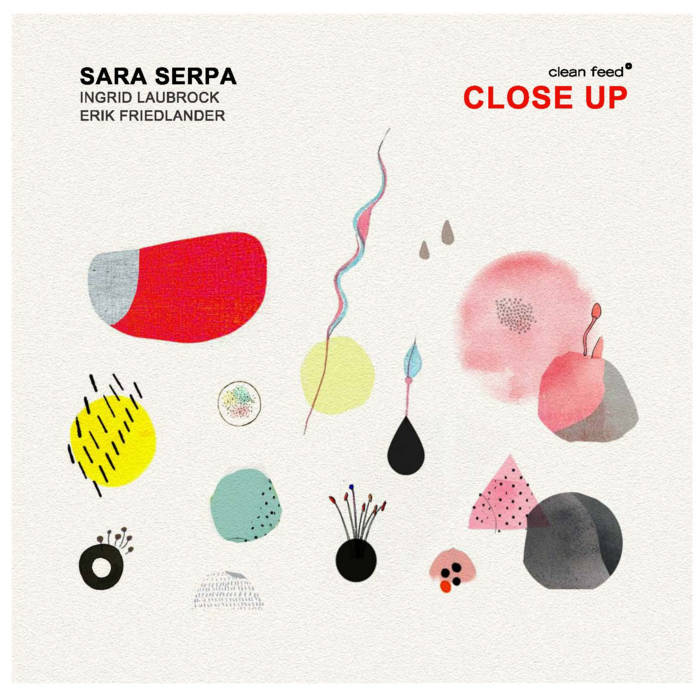
Close Up (Clean Feed)
Sara Serpa
Released March 20, 2018
2018 NPR Music Jazz Critics Poll Top 5 Vocal Album
YouTube:
https://music.youtube.com/playlist?list=OLAK5uy_kM8pQtaWSN55vLMqVhXTrHkjm5jlI8744
Spotify:
About:
Close Up can be explained, interpreted, and heard through multiple angles of its creative process and performance.
The configuration of voice, saxophone and cello exposes each instrument in a vulnerability that sometimes verges on discomfort, much like a Close Up photograph that is saturated with detail. As a trio, we are faced with the challenges of finding a way to work together while playing within this hyper-detailed setting and this uneasy close range. From within this exposure, we look for cohesion, and collective sound. I wrote the material, but the music took shape in the process of our rehearsals and the time we spent together, discussing and trying. The recording process, too, continued the concept of exposure. All of us were present in the same room as we recorded, taking away the possibility of correcting mistakes — no chance of going back. The compositions themselves also reveal Close Ups of different episodes in my life. Each episode as it took place by itself felt simultaneously important and isolated. Put together the episodes create a whole— life itself, with its moments of joy and sadness. The compositions assume the different languages from throughout my life. In English, my adopted second language, there are texts by two women whose writing I greatly admire: Virginia Woolf and philosopher and feminist Luce Irigaray. Portuguese, my mother tongue, appears in “Pássaros”, a poem by the late Ruy Bello, gone too soon. Departure from and avoidance of language is part of my work. When I come to sing or compose, in the moment I lack words, I sing sounds. Sounds that alone find their meaning. The wordless voice becomes another Close Up of a moment, emotion or expression. There are different challenges imposed on the voice in this music – to create a background, to hold down a bass line, to sing long tones that become textures, to traverse complex lines, to find its place without a harmonic instrument, to be independent, to feature as a solo, to act in ensemble. These are all challenging situations, from which I am continually learning: to find the place for my human voice.
Finally, at the time I was writing and working on this music, the film Close Up by Iranian director Abbas
Kiarostami appeared in my life. The film was transformative for me, and has stayed alive in my mind as very few films are able to do. It is inspired by real life events and performed by the participants themselves—the people involved in the events become the subjects of the film. Subjects become objects, the viewers become the actors, and the actor(s) become(s) the director(s), as they reenact and reconstruct present and past events. Cinephile Sabzian fraudulently impersonates a well-known Iranian filmmaker to get access to a family’s house and daily private life. With the pretense that the family members and their house are ideal for his new film, he spends weeks in the house until his fraud is eventually discovered and he is taken to court. Sabzian is the anti-hero, in the sense that he lies and deceives. And yet it is impossible to see him as a bad person. The way he naively speaks and behaves shows his humanity and suffering. In the film, while Sabzian is in the courtroom, in a real-life trial, Kiarostami interviews him, showing a Close Up pan of his face:
Sabzian:
….Then a good man comes up and portrays all my sufferings in his films and I can watch them again and
again. They show the evil faces of those who play with the lives of others, the rich who pay no attention to
the most basic needs of the poor. For that reason I felt compelled to read this script. I read it and it
brought calm to my heart. It says the things I wish to express.
Kiarostami:
…Now that you have interpreted this role, are you a better actor or director?
Sabzian:
I don’t want to brag, but I am more interested in acting. I feel that I can express all the bad experiences I
have had, all the deprivations I have had inside me. I believe I can make others feel my feelings through
acting.
Kiarostami:
Aren’t you acting right now? What are you doing in this present moment?
Sabzian:
I am talking about my suffering. I am not acting. I speak from my heart. It is not acting. For me, art is the
experience of what you feel inside. If someone can nurture that experience…it is like what Tolstoy says,
art is the experience felt by the artist and made public to his audience. Given all the positive feelings I
have experienced, just as deprivation and suffering, and my interest in acting, I believe I could be a great
actor and communicate that inner reality.
Kiarostami:
Why did you pretend to be a director and not an actor?
Sabzian:
To interpret a director’s role is in itself acting. For me, that is acting.
Kiarostami:
What role would you like to interpret?
Sabzian:
Myself.
Kiarostami:
Haven’t you done that already?
Sabzian:
(Silence)
Track Listing:
1. Object 4:04
2. Pássaros 4:19
3. Sol Enganador 6:01
4. The Future 5:37
5. Listening 2:57
6. Storm Coming 5:20
7. Woman 4:06
8. Quiet Riot 3:57
9. Cantar Ao Fim 4:59
All music by Sara Serpa
Personnel:
Sara Serpa: voice | composition
Ingrid Laubrock: tenor | soprano saxophone
Erik Friedlander: cello
Texts:
“Future” by Virgina Wolf, entry in The Diary of Virgina Woolf: 1915-1919
“Woman” by Luce Irigaray, in Between East and West: From Singularity to Community, 2002
“Pássaros” by Ruy Belo from “Algumas proposições com pássaros e árvores que o poeta remata com
uma referência ao coração”, in Homem de Palavras, 1970
Recorded live by Pete Rende, June 15th 2017, at Pete’s House, Brooklyn, New York
Produced by Sara Serpa
Mixed by Pete Rende
Mastered by Luís Delgado
Photography by Hurgten Gtiythim
Design: Travassos
Executive Production by Pedro Costa
Review:
The incomparable Portuguese vocalist/composer Sara Serpa remains faithful to her own musical signature, receiving universal acclaim with recent projects such as Sara Serpa’s Recognition (with harpist Zeena Parkins and saxophonist Mark Turner), Serpa/Matos duo, and now this fantastic new trio, whose first album, Close Up, is the subject of this review. Whether creating textural consonance or embarking on precise contrapuntal effects, the work of German-born saxophonist Ingrid Laubrock and American cellist Erik Friedlander coexists beautifully and pacifically with Serpa’s flawless phrasing and multi-sensitive tone.
Like in some past works, this album includes many references to literature, a deep-rooted passion now extended to film, with Abbas Kiarostami’s 1990 masterpiece Close-Up surfacing as an extra inspiration.
“Object” shows the threesome dancing in different ways, using distinct cadences yet perfectly integrated as a group. Brief cello slashes provide a thin tapestry for both Serpa’s lyrical buoyancy and Laubrock’s world music-inspired inflections on the soprano. The vocalist perambulates since the moment that sax and cello agree on standing side-by-side, anticipating a grand finale delivered in unison.
“Quiet Riot” is clearly hooked on Serpa’s style. Elegant parallel motions and counterpoints, phrase complementations, and Laubrock’s soprano knottiness over the groovy bends and swift drives imposed by Friedlander. These bright moments make you want to go back and re-listen to them again.
Exhibiting multiple ostinatos and the words of the Portuguese poet Ruy Bello, “Pássaros”, is a furtive chamber-jazz effort with a well-defined identity. Still, it couldn’t match the irresistible enunciation of “The Future”, a poignant, unswerving song awaken by a continuously reiterated sax-vox pointillism and cello wails. Inspired by Virginia Woolf, the song merges light and darkness in genial moments of metrical defiance. This is naked music where the words mean highly focused sounds.
Friedlander’s seductive fingerstyle drives “Sol Enganador”, a meditative cinematic odyssey where Godard’s philosophical freedom gets in touch with a Fellini-esque flamboyance. Laubrock’s air blows, percussive and invasive at the same time, end up falling into short, feverish phrases that contrast with Serpa’s syllabic patterns, sparsely laid down with an infallible precision.
Floating like a breezy folk song, “Woman” was devised with a sort of angelic flair and erudite expressiveness, meaning that the spirit of Luce Irigaray, who inspired the composition, was properly captured and relocated into the music.
The album closes with “Cantar Ao Fim”, a spellbinding piece with a strong connection to nature, whose freedom erupts from all the pores of its smooth skin. The natural, impromptu vocal chant that inaugurates this piece is followed by a blossoming groove that pushes us into a rapturous sonic orb.
Composition-wise, Serpa is ahead of the curve, establishing her ideas with one foot on the avant-garde and the other on the new music. Categorization can be a difficult task, but what’s really relevant here is that Close Up guarantees an arresting affirmation of her artistic maturity.
Filipe Freitas (JazzTrail)


