
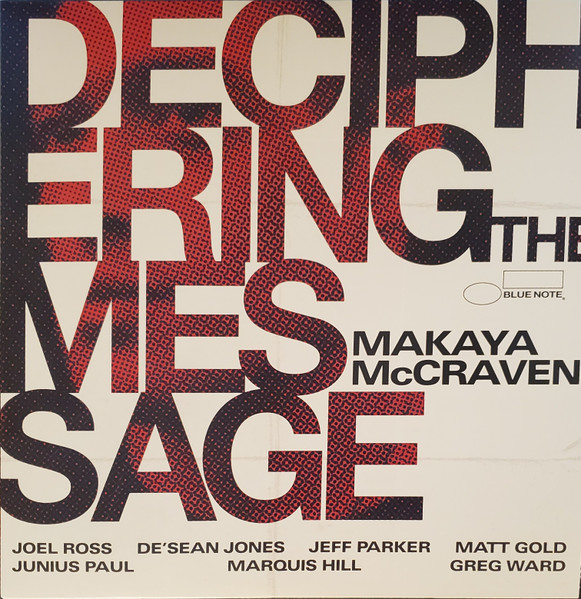
Deciphering the Message (Blue Note)
Makaya McCraven
Released November 19, 2021
Arts Fuse 2021 Jazz Critics Poll Top 20 New Album
70th DownBeat Annual Critics Poll Top 30 Album of the Year
YouTube:
https://music.youtube.com/playlist?list=OLAK5uy_nKX-Jaf1QsuSXbB-fcYZTifgqkJ_pPlEM
Spotify:
About:
With his new remix album, Deciphering The Message, the Chicago-based drummer, producer, and beat scientist Makaya McCraven digs through the vaults of the legendary jazz label Blue Note Records to put a modern bounce on classics by Art Blakey, Horace Silver, Hank Mobley, Kenny Burrell, and Eddie Gale, among others. The album’s lead single “Frank’s Tune” (AKA “De’Jeff’s Tune”) is available to stream or download today.
Across numerous albums and mixtapes, McCraven has proven his mastery of the loop akin to hip-hop’s most celebrated beatmakers like J Dilla and Madlib, both of whom also found inspiration in the Blue Note catalog. With acclaimed releases like In The Moment (2015) and Universal Beings (2018), McCraven created his own lane in jazz by sampling his band playing improvised sessions throughout the world, then molding the audio several times to pull contrasting moods from it. For his most recent project McCraven remixed Gil Scott-Heron’s final album I’m New Here into the equally emotive LP We’re New Again (2020).
McCraven has always been a collaborative artist and Deciphering The Message features newly recorded elements from vibraphonist Joel Ross, trumpeter Marquis Hill, alto saxophonist Greg Ward, guitarists Matt Gold and Jeff Parker, bassist Junius Paul, and De’Sean Jones on tenor saxophone and flute. In that way, Deciphering The Message connects the past and present, proving that musicians become legends by trekking the same roads with like-minded creators all moving toward the same goal.
That throughline is evident on the lead single in which Jack Wilson’s hard bop cut “Frank’s Tune” — from the pianist’s little-known 1967 album Easterly Winds — is remade into “De’Jeff’s Tune,” an ‘80s R&B-inspired arrangement with a two-stepping dance groove, wafting guitar chords courtesy of Parker, and delicate flute from Jones. The track opens and closes with the voice of Blue Note legend Art Blakey, the irrepressible bandleader of The Jazz Messengers, addressing his audience: “We want you to leave your worldly troubles outside and come in here and swing… So as the message is being delivered, ladies and gentlemen, you may pat your feet and have a ball.”
While Deciphering The Message collects songs from several years of Blue Note history, it plays like a continuous set taking place in one show at one venue. “When piecing everything together, I wanted to create a narrative that made the listener feel like they were falling into this space or a movement,” McCraven says. “I was really trying to make a record out of it, not just a series of tracks.”
McCraven hopes the album is both educational and an outright good listen. “I always want to make music that will connect with people in one way, where it makes them nod or feel something or transport them somewhere,” he says. “I also hope this makes them check out the source of this music if they have it. The music that we’re making now is part of the same route and is connected, so I want to honor tradition and release something that people can vibe to.”
Track Listing:
1. A Slice Of The Top (AKA “Sliced Off The Top”)
[from A Slice Of The Top by Hank Mobley] 3:11
2. Sunset (AKA “Son Set”)
[from Whistle Stop by Kenny Dorham] 3: 48
3. When Your Lover Has Gone (AKA “When You’ve Left Your Lover”)
[from A Night In Tunisia by Art Blakey & The Jazz Messengers] 2:11
4. Ecaroh (AKA “Revlis”)
[from Horace Silver Trio by Horace Silver] 2:57
5. Tranquillity (AKA “Corner Of The World”)
[from Components by Bobby Hutcherson] 3:39
6. Wail Bait (AKA “Wait Bail”)
[from The Memorial Album by Clifford Brown] 2:09
7. Coppin’ The Haven (AKA “At The Haven Coppin’”)
[from One Flight Up by Dexter Gordon] 2:35
8. Frank’s Tune (AKA “De’Jeff’s Tune”)
[from Easterly Winds by Jack Wilson] 3:37
9. Autumn In New York (AKA “Spring In Chicago”)
[from Blue Lights, Vol.1 by Kenny Burrell] 5:55
10. Monaco (AKA “Monte Negro”)
[from ‘Round About Midnight At The Cafe Bohemia by Kenny Dorham] 2:24
11. Mr. Jin (AKA “Mr. Gin”)
[from Indestructible by Art Blakey & The Jazz Messengers] 2:57
12. C.F.D. (AKA “D.F.C.”)
[from Something Personal by Jack Wilson] 3:17
13. Black Rhythm Happening
[from Black Rhythm Happening by Eddie Gale] 3:34
Personnel:
Makaya McCraven: drums (1-8, 10-13), bass (1, 8, 13), percussion (1-3, 5-8, 10-12), guitar (4, 6, 7, 12, 13), synthesizer (5, 7), keyboards (8), kalimba (12)
James Spaulding: alto saxophone, flute (1, 5)
Bob Crenshaw: bass (1, 8)
Billy Higgins: drums (1, 8)
Kiane Zawadi: euphonium (1)
McCoy Tyner: piano (1)
Hank Mobley: tenor saxophone (1, 2)
Lee Morgan: trumpet (1, 3, 8, 11)
Howard Johnson: tuba (1)
Pee Wee Marquette: voice (1, 5, 10)
Paul Chambers: bass (2)
“Philly” Joe Jones: drums (2, 6)
Jeff Parker: guitar (2, 8, 10)
Junius Paul: ceramic bird (2), bass (3, 6, 10-12)
Kenny Drew: piano (2, 7)
Kenny Dorham: trumpet (2, 10)
Joel Ross: vibraphone (2, 3, 4, 9)
Jymie Merritt: bass (3)
Art Blakey: drums (3, 4, 9, 11), spoken word (8, 10)
Matt Gold: guitar (3, 5, 7, 12)
Bobby Timmons: piano (3, 10)
Wayne Shorter: tenor saxophone (3, 11)
Curly Russell: bass (4)
Gene Ramey: bass (4)
Horace Silver: piano (4)
Greg Ward: alto saxophone (5, 6, 12)
Ron Carter: double bass (5)
Joe Chambers: drums (5)
Herbie Hancock: piano (5)
De’Sean Jones: tenor saxophone (5, 6, 9, 10, 13), flute (8, 9, 13)
Freddie Hubbard: trumpet (5)
Marquis Hill: trumpet (5, 9, 10)
Bobby Hutcherson: vibraphone (5)
Lou Donaldson: alto saxophone (6)
Percy Heath: bass (6)
Elmo Hope: piano (6)
Clifford Brown: trumpet (6)
Niels-Henning Ørsted Pedersen: bass (7)
Art Taylor: drums (7)
Dexter Gordon: tenor saxophone (7)
Donald Byrd: trumpet (7)
Jackie McLean: alto saxophone (8)
Jack Wilson: piano (8, 12)
Garnett Brown: trombone (8)
Sam Jones: bass (9, 10)
Kenny Burrell: guitar (9, 10)
Duke Jordan: piano (9)
Junior Cook: tenor saxophone (9)
Tina Brooks: tenor saxophone (9)
Louis Smith: trumpet (9)
Justin Dillard: hand drum (10)
Arthur Edgehill: drums (10)
J.R. Monterose: tenor saxophone (10)
Reggie Workman: bass (11)
Cedar Walton: piano (11)
Curtis Fuller: trombone (11)
Ray Brown: bass (12)
Varney Barlow: drums (12)
Roy Ayers: vibraphone (12)
Jimmy Lyons: alto saxophone (13)
Henry Pearson: bass (13)
Judah Samuel: bass (13)
Elvin Jones: drums (13)
John Robinson: african drums (13)
Jo Ann Gale Stevens: guitar (13), vocals (13)
Roland Alexander: soprano saxophone (13), flute (13)
Russell Lyle: tenor saxophone (13), flute (13)
Eddie Gale: trumpet (13)
Carol Ann Robibson, Charles Davis, Fulumi Prince, Paula Nadine Larkin, Sondra Waltson, Sylvia Bibbs, William Norwood: vocals (13)
Recorded and Engineered by Makaya McCraven, at Makaya Music Studios and Jerome James Studio
Additional Recording and Engineering by Greg Ward (at Avondale Studios), Joel Ross (at Good Vibes Inc.), De’Sean Jones (at Submerge Studios), Jeff Parker (at Sholo Studios), Matt Gold (at Catfish Recording), Marquis Hill (at Black Unlimited Music Group) and Dave Vettraino (at Palisade Studios)
Mixed by Dave Vettraino and Makaya McCraven
Mastered by Dave Cooley
Package Design by Todd Gallopo and Tory Davis
Photography by Michael McDermott
Produced by Makaya McCraven
Preview:
Look at the sources credited on Makaya McCraven’s Deciphering the Message—Hank Mobley, Kenny Dorham, Horace Silver, Art Blakey—and you could be excused for anticipating another younger Blue Note artist paying tribute to his predecessors at the label. But that’s not what McCraven (who prefers to be called a “beat scientist” rather than a drummer or producer) is doing here, at least not exclusively. As he’s done before in other ways, McCraven is excavating willfully, cherry-picking pieces from the past and reassembling them into new wholes with aid from other forward-thinking adventurers.
“A Slice of the Top,” which leads the program, lays out the concept convincingly. The spoken intro you hear is Pee Wee Marquette preparing us for “something special,” lifted directly from Blakey’s 1954 landmark LP A Night at Birdland Vol. 1. What follows isn’t Blakey, though; rather it’s McCraven’s drums and bass, married to music made by Lee Morgan, McCoy Tyner and others long before McCraven was born, grafted from a 1966 Mobley album. The crisp, contemporary production and beats recast the vintage recording—its vibe is classic Blue Note, but its sound is 2021.
McCraven’s reworking of Dorham’s “Sunset” tweaks the idea further: The base track, which appeared on the trumpeter’s 1961 Whistle Stop, hangs onto the contributions of original cast members Dorham, Mobley, Kenny Drew, Philly Joe Jones, and Paul Chambers. But to that, McCraven adds new guitar parts from Jeff Parker, vibraphone from Joel Ross, and more. A dub-like section mid-song, and the leader’s own twisty rhythms, transform the original into a considerably altered beast.
There are 13 such experiments in all here—from a trippy “Autumn in New York” that originated on a Kenny Burrell title to Clifford Brown as you’ve never imagined him—each an impressively reconfigured pastiche.
Jeff Tamarkin (JazzTimes)


