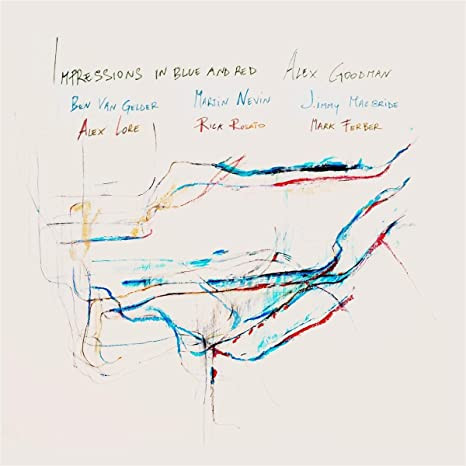
Impressions in Blue and Red (Outside In Music)
Alex Goodman
Released March 13, 2020
JAZZ FM 25 Best Jazz Albums of 2020
YouTube:
https://music.youtube.com/playlist?list=OLAK5uy_kr6cSe6pDHK9gNBGcQ1clgxlTDDW3e7us
Spotify:
About:
Toronto-born, New York City-based guitarist Alex Goodman has the gift of synesthesia, his mind keenly associating various sounds with particular colors. With the vivid double album Impressions in Blue and Red – to be released on CD and digitally via Outside In Music on March 13, 2020 – he explores this uncommon facility in depth. Goodman fronts two distinct quartets, each especially attuned to its material: The “blue” disc sets the leader alongside Ben Van Gelder (alto saxophone), Martin Nevin (double-bass) and Jimmy Macbride (drums); the “red” disc features the guitarist with Alex LoRe (alto sax), Rick Rosato (double-bass) and Mark Ferber (drums).
In addition to 15 evocative originals by Goodman, the album includes interpretations of Herbie Hancock’s “Toys” and the slow movement from a Baroque sonata by Johann Rosenmüller. Capping each disc is Goodman playing an impromptu solo version of a standard: “I’ll Never Be the Same” (Malneck/Signorelli & Kahn) on the “blue” disc and “If I Loved You” (Rodgers & Hammerstein) on the “red.” Impressions in Blue and Red is Goodman’s seventh album as a leader or co-leader, and his productivity in the studio has also included appearances on records by such notable peers as Remy Le Boeuf and Manuel Valera, as well as Mareike Wiening’s much-praised new Greenleaf release, Metropolis Paradise. That’s not to mention the guitarist’s performances as a sideman around New York with the likes of the Grammy-nominated Terraza Big Band, Lucas Pino Nonet, Roxy Coss Quintet and Mimi Jones. According to New York City Jazz Record, Goodman is a musician of “dazzlingly improvisational dexterity and engagingly smart composition.”
Reflecting on color and its associative powers for him, Goodman spent much time reading and in museums, investigating the way visual artists – from the Renaissance era to Van Gogh and Picasso – have used color and its shades to expressive ends, eliciting a range of emotions in a viewer. On the album package, he quotes such figures as Goethe (who characterizes blue as “a stimulating negation… a kind of contradiction between excitement and repose”) and Wassily Kandinsky (who describes red as “ringing inwardly with determined intensity – it glows in itself”), as well as the philosopher/psychologist and aesthetician John Dewey, who said: “If all meaning could be adequately expressed by words, then the arts of music and painting would not exist. There are values and meanings that can be expressed only by immediately visible and audible qualities, and to ask what they mean in the sense of something that can be put into words is to deny their distinctive existence.”
Goodman says: “What I like about that John Dewey quote is that it sums up how difficult it can be to capture in words the way music or painting – and their colors – can make you feel. I know it’s difficult for me. Music goes beyond language, certainly, and the way I associate color with music isn’t really something that I can explain – it’s based in mood, in feel. And that intuitive feel is the catalyst for the way I composed the music for Impressions in Blue and Red. The same goes for the interpretive material on the album. On the ‘red’ disc, for instance, the Rosenmüller piece’s Baroque harmony feels like a darker red to me, while Herbie Hancock’s ‘Toys,’ from his Speak Like a Child LP, implies a brighter tone.”
Goodman’s coloristic associations extended to his choice of musicians for the album. “The players that I chose for each of the bands on the record was also an intuitive thing, but a strong one,” he says. “I associated the sound and personality of each musician with either blue or red.” For eight of the tracks on Impressions in Blue and Red, there are extended improvised intros, two by Goodman and one for each of his bandmates in turn. “Those intros were something that I incorporated as a way for each musician to reveal their expressive voices more fully, but I also think they heighten the flow of the album.” As a conceptual double-album, Impressions in Blue and Red stands out as Goodman’s most ambitious recording to date. “I conceived the two discs of Impressions in Blue and Red to be coherently of a piece both internally and in relation to each other,” he says. “Although each half has dominant associations with the corresponding colors, the two are meant to complement each other through not only their differences but also, at points, their similarities.”
BLUE
“powerful, but it is on the negative side, and in its highest purity is, as it were, a stimulating negation. Its appearance, then, is a kind of contradiction between excitement and repose.”
Theory of Colours – Goethe
RED
“rings inwardly with a determined intensity. It glows in itself, maturely, and does not distribute its vigour aimlessly.”
Concerning the Spiritual in Art – Wassily Kandinsky
Track Listing:
Blue
1. No Man’s Land 04:48
2. Blue Shade (intro) 01:01
3. Blue Shade 04:56
4. Moods 05:13
5. Space Behind Eugene Boch (intro) (Jimmy McBride) 00:34
6. Space Behind Eugene Boch 05:33
7. Zen (intro) (Martin Nevin) 00:48
8. Zen 05:41
9. Cobalt Blue 04:44
10. Still Life With Skull (intro) (Ben Van Gelder) 00:44
11. Still Life With Skull 05:25
12. I’ll Never Be The Same (Malneck / Signorelli) 04:39
Personnel:
Alex Goodman: guitar
Ben Van Gelder: alto saxophone (tracks 1-12)
Martin Nevin: bass (tracks 1-12)
Jimmy Macbride: drums (tracks 1-12)
Recorded by John Bailey at Revolution Recording
Red
13. Choose 04:19
14. Circles in a Circle 05:11
15. Impending (intro) (Alex LoRe) 00:54
16. Impending 05:32
17. In Heaven Everything is Fine 05:01
18. Toys (Herbie Hancock) 06:01
19. Occam’s Razor 04:58
20. Like a Fire That Consumes All Before It (intro) (Rick Rosato) 01:02
21. Like a Fire That Consumes All Before It 06:08
22. E.T. 04:49
23. Sonata No. 12 Adagio (intro) 01:23
24. Sonata No. 12 Adagio (Johann Rosenmuller) 03:21
25. View In Perspective (intro) (Mark Ferber) 00:37
26. View In Perspective 05:08
27. If I Loved You (Rodgers / Hammerstein) 02:31
Personnel:
Alex Goodman: guitar
Alex LoRe: alto saxophone (tracks 13-27)
Rick Rosato: bass (tracks 13-27)
Mark Ferber: drums (tracks 13-27)
Recorded by Nolan Thies at Bunker Studio
All compositions by Alex Goodman except as indicated
Mixed and Mastered by David Darlington at Bass Hit Studios
Artwork by Mascia Manunza
Review:
One thing’s for sure: there’s a whole lot of music to be heard on Alex Goodman’s new double album Impressions in Blue and Red. At 27 tracks and a running time of over 100 minutes, the Canadian jazz guitarist has taken a stand when it comes to quantity on his newest album. Any concern that the quality could suffer as a result is extinguished after the first few bars into the opener. Divided over two different sets according to the colors red and blue, and two different corresponding casts of side-musicians, Goodman offers some of his most fierce playing to date and wraps it in carefully conceived instrumentation and meticulously wrought compositions.
More than half of the tunes are preambuled by short introductory improvisations, performed by each member of the cast and serving as elegant segues to the actual compositions. Goodman comments: “Those intros are something that I incorporated as a way for each musician to reveal their expressive voices more fully, but I also think they heighten the flow of the album.” And so they do. The playful concept on the colors blue and red traces back to how closely the guitarist associates color with music, and how both go beyond language. Goodman is joined by Ben van Gelder, Martin Nevin and Jimmy Macbride on the blue set, while Alex LoRe, Rick Rosato and Mark Ferber make up the band for the red one.
A lot of the music on Impressions in Blue and Red is spoken in post-bop tradition. In that spirit, Goodman’s earthy guitar tone is layered in soft reverb, so that the saxophone can comfortably swing on top and the two don’t have to worry about getting in each other’s ways. However, the structures aren’t always strictly linear. Some heads don’t really work as such à la bop-definition, but rather introduce refreshing harmonic concepts and melodic motifs that are then reproduced in altered forms or quotes. “Moods” and “Zen” are two examples of many songs on the album that share this progressive tendency and seem to live and breathe all on their own.
Another concept that becomes very apparent in the course of the album is the counterpoint technique. Not just the obvious nod represented by “Sonata Nr.12 Adagio,” but several exhibitions on the record and many of the twists and turns in Goodman’s solos demonstrate that the guitarist has been hard at work with baroque exercises and classical music in general. On “Blue Shade” the guitar is divided into two voices, bass and soprano, before the rest of the band joins in and restores a jazzier environment. This split mode resurfaces again later in the song, creating a layered effect that recalls fugues or inventions. On the sonata, Goodman plays with classical cadences, but resolves their progressions in uncharacteristic ways, thereby designing a space were classical music and jazz mingle.
It’s impossible to pick favorites here. No color outclasses the other, each quartet brings unique strengths and characters to the music and creates an engaging environment for Goodman to express himself. Quality trumps quantity, and Impressions in Blue And Red provides both. Here’s hoping the sheer volume of music here won’t scare off any potential adherents. There’s plenty of detail to discover, but it takes time, patience and repeated listens.
Friedrich Kunzmann (All About Jazz)