
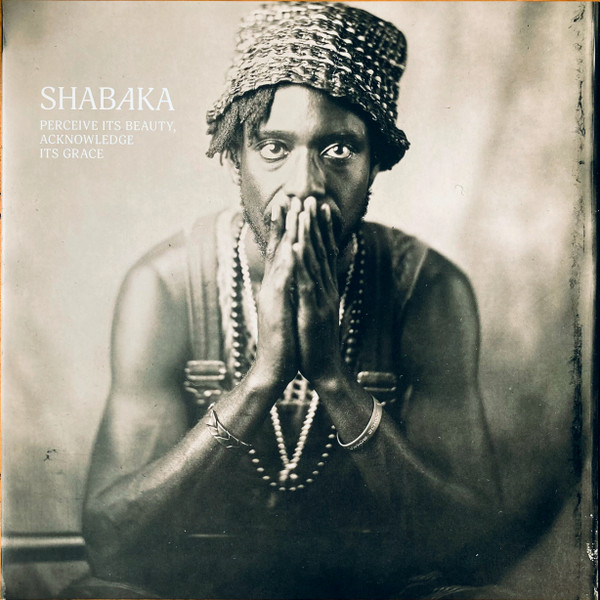
Perceive Its Beauty, Acknowledge Its Grace (Impulse!)
Shabaka
Released April 12, 2024
AllMusic Favorite Jazz Albums 2024
JazzTimes 2024 Year in Review
YouTube:
https://music.youtube.com/playlist?list=OLAK5uy_k96KD5Wh5hrIB2_qG5GsdilwyT2rOn5b0
Spotify:
About:
Perceive Its Beauty, Acknowledge Its Grace is the solo debut studio album of London jazz musician Shabaka Hutchings, working under the name Shabaka. The album follows Hutchings’s hiatus from the saxophone and the end of his bands Sons of Kemet and the Comet Is Coming, and sees him focusing on different types of flutes, including the shakuhachi and the svirel, as well as the clarinet.
Background
On 1 January 2023, Hutchings announced his intention to take an indefinite hiatus from playing the saxophone, explaining later in the year that his enthusiasm for the instrument had waned after years of intense touring. This also coincided with the end of his two bands, Sons of Kemet and the Comet Is Coming. Hutchings’s last live saxophone performance was on 7 December 2023, where he played John Coltrane’s A Love Supreme at the Institute of Contemporary Arts in London.
Hutchings’s new musical interests lied primarily with the flute and similar instruments, having started with them in 2019 after acquiring his first shakuhachi. Subsequent instruments Hutchings picked up include Mayan Teotihuacan drone flutes, Brazilian pifanos, Native American flutes, Slavic svirels, and South American quenas. The move coincided with an increase in attention on jazz flute following the release of André 3000’s 2023 album New Blue Sun, on which Hutchings contributed shakuhachi to one track.
Release
Hutchings announced the album on 28 February 2024, set for a release on 12 April by Impulse! Records. On the same day, he released its lead single, “End of Innocence”, along with a music video directed by Phoebe Boswell. “End of Innocence” sees Hutchings playing the clarinet, with a band consisting of pianist Jason Moran, drummer Nasheet Waits, and percussionist Carlos Niño.
The second single, “I’ll Do Whatever You Want”, was released on 21 March. Hutchings cowrote the song with Laraaji and Floating Points. It features Hutchings on shakuhachi, André 3000 on drone flute, Laraaji’s wordless vocals, Floating Points on Rhodes Chroma synthesizer and vibraphone, Esperanza Spalding and Tom Herbert on bass, Dave Okumu on guitar, Marcus Gilmore on drums, and Niño on percussion. Hutchings said the song is “about surrender and the intimate space we go to within the grasp of possession.” Other musicians on the record include Moses Sumney, Brandee Younger, Miguel Atwood-Ferguson, Saul Williams, Lianne La Havas, and Elucid.
Perceive Its Beauty, Acknowledge Its Grace is Hutchings’s solo debut studio album, following his 2022 solo EP Afrikan Culture, which also centered Hutchings’s woodwind play. The titles of both releases are connected; in Hutchings’s words, they’re mean to be read as “Afrikan Culture, comma, Perceive Its Beauty, Acknowledge Its Grace”, with his next album being “the next sentence in a long form poem that encapsulates, hopefully, all the solo records of my career.” The song names on the album were extracted from a poem written for the album.
Recording
The album was recorded over six days in Van Gelder Studio in New Jersey, starting in May 2022 and mostly taking place that year. Hutchings described the studio as having “informed the sound of so many seminal jazz albums that have shaped my musical aptitude”.
Players were not given music beforehand as Hutchings was less interested in creating songs than “liminal spaces” and “a sense of ‘suspended animation.'” Believing that anything past a basic level of composition could be a potential inhibitor to creating the atmosphere he was looking for, Hutchings had his musicians record without headphones and without being separated in the room, enabling them to “capture the atmosphere of simply playing together in the space without a technological intermediary.” He also told everyone to play as if they were playing the intro or outro of a song.
Subsequently, Hutchings took the raw recordings from those sessions and reworked them, adding alternate horn lines and composed melodies on top. He cited Flying Lotus’s production style as an inspiration toward this, saying:
I really like when it sounds like he’s gotten together a bunch of recordings, live recordings or studio sessions, but it’s the way that he finds the interesting bits of the material that’s recorded, how he programs them next to each other. What he decides to add, whether that’s like a kick drum, whether that’s other samples, and that’s the idea that I wanted to have with this album. Without it sounding like that kind of album, basically.
Closing track “Song of the Motherland” features a poem by Hutchings’s father, Orville Hutchings, also known as Anum Iyapo. Orville, who primarily worked as a graphic designer for albums by artists including King Tubby and Jah Shaka, recorded a reggae poetry album called Song of the Motherland in 1985. Hutchings picked the poem from one of his father’s poetry books and asked his father to record the recitation when he came to the studio for other reasons, having not told him of the plan ahead of time. After listening to the music for a couple minutes, Orville recorded the whole thing in one take, finishing exactly on the last note of the music. Song of the Motherland was reissued by Hutchings’s record label Native Rebel on 25 May.
Hutchings named influences such as Björk’s Vespertine, Antony and the Johnsons’ The Crying Light, and Joanna Newsom’s Ys.
Style
Perceive Its Beauty, Acknowledge Its Grace consists of a fusion of jazz and new age music. Compared to Hutchings’s “confrontational, staccato” saxophone playstyle, his flute is “more introspective and fluid”. Critics frequently made comparisons to Don Cherry and Alice Coltrane among other artists. Hutchings plays a variety of flutes on the album, including the shakuhachi and svirel, and also plays clarinet on three tracks and even returns to the tenor saxophone for the end of “Breathing”. Some tracks include vocals from singers including Moses Sumney, Lianne La Havas, and Laraaji, as well as rapper Elucid and spoken word poetry from Saul Williams. The music centers on a recurring seven-note figure.
Track Listing:
1. End of Innocence (Shabaka Hutchings) 02:36
2. As the Planets and the Stars Collapse (Shabaka Hutchings) 02:35
3. Insecurities (Moses Sumney) 04:39
4. Managing My Breath, What Fear Had Become (Saul Williams) 03:11
5. The Wounded Need To Be Replenished (Shabaka Hutchings) 02:44
6. Body To Inhabit (Chaz Jerome Hall) 07:28
7. I’ll Do Whatever You Want (Shabaka Hutchings / Laraaji / Sam Shepherd) 07:43
8. Living (Miguel Atwood-Ferguson / Eska Mtungwazi) 03:41
9. Breathing (Shabaka Hutchings) 04:27
10. Kiss Me Before I Forget (Shabaka Hutchings) 02:57
11. Song of the Motherlanda (Shabaka Hutchings) 04:45
Personnel:
Shabaka Hutchings: clarinet (1, 9, 10), shakuhachi (2, 3, 7), bamboo flute (4, 6, 9, 11), quena (5, 9, 11), svirel (6, 8, 9, 11), saxophone (9)
Nasheet Waits: drums (1, 10)
Carlos Niño: percussion (1, 5, 7, 10)
Jason Moran: piano (1, 10)
Brandee Younger: harp (2, 6, 8)
Charles Overton: harp (2, 3, 4, 6, 8, 11)
Miguel Atwood-Ferguson: violin, viola, cello (2, 8)
Moses Sumney: vocals (3)
Saul Williams: vocals (4)
Nduduzo Makhathini: piano (5)
Surya Botofasina: synthesizer (5)
Esperanza Spalding: bass (6, 7)
Chris Sholar: electronics (6)
Elucid: vocals (6)
Tom Herbert: bass (7)
Marcus Gilmore: drums (7)
Floating Points: Rhodes Chroma (7)
André 3000: Teotihuacan drone flute (7)
Dave Okumu: guitar (7)
Laraaji: vocals (7)
Eska: vocals (8)
Rajna Swaminathan: mridangam (9)
Lianne La Havas: vocals (10)
Anum Iyapo: vocals (11)
Produced by Shabaka Hutchings and Dilip Harris
Mixed by Dilip Harris
Recorded at Van Gelder Studio, Englewood Cliffs, New Jersey, by Maureen Sickler; The Church Studios, London, by Dilip Harris; RAK Studios and Dock Street Studios, London, by William Purton
Mastered by Guy Davie
Photography by Gareth Jarvis
Artwork by Shabaka Hutchings
Design by Ana Pryor
Review:
In 2023, jazzman Shabaka Hutchings shelved his saxophone for the foreseeable future. A consequential decision, it followed the end of Sons of Kemet, the Comet Is Coming, and South African jazz project, Shabaka and the Elders. In November 2022, he released Afrikan Culture, recorded on shakuhachi, flute, and clarinet. He followed in 2023 with the mysterious, ambient jazz/hip-hop offering Flowers in the Dark by Kofi Flexxx on Native Rebel Recordings.
Perceive Its Beauty, Acknowledge Its Grace was recorded by Maureen Sickler at Rudy Van Gelder’s New Jersey studio in 2022. Shabaka uses wits and intuition to summon this music up from the unconscious. He’s assisted by a studio cast that includes pianists Nduduzo Makhathini and Jason Moran, drummers Nasheet Waits and Marcus Gilmore, flutist Andre 3000, percussionist Carlos Nino, harpists Brandee Younger and Charles Overton, bassists Esperanza Spalding and Tom Herbert, multi-instrumentalist Miguel Atwood-Ferguson, Floating Points, vocalists, and rappers.
“End of Innocence” finds Shabaka playing clarinet with Moran, Waits, and Nino; the brief incantation sounds like a folk song. “As the Planet and Stars Collapse” places his lilting shakuhachi in lush company with both harpists and Atwood-Ferguson’s strings. On “Insecurities,” Moses Sumney’s elastic falsetto engages the flute in seamless improvisation with Overton’s harp. Shabaka uses a quena flute on the gently abstract “Managing My Breath, What Fear Had Become” with Nino and South Africans Makhathini on piano and Surya Botofasina on synth. New York rapper Elucid joins Spalding, the harpists — who all engage with Shabaka’s flute line by line — and electronicist Chris Sholar on the poignant “Body to Inhabit.” “I’ll Do Whatever You Want” is the closest thing to a fully improvised jam here. It showcases Andre 3000’s Teotihuacan drone flute alongside Shabaka’s shakuhachi, a Rhodes Chroma by Floating Points, Dave Okumu’s guitar, and Herbert’s and Spalding’s basses, with Gilmore’s drums and Nino’s percussion framing a wordless vocal from Laraaji. “Living” offers transcendent holism as Shabaka’s Slavic svirel (a Russian flute) and Eska Mtungwazi’s vocal entwine, ratcheting tension with Kate Bush-esque intensity while keenly interacting with harps and strings.
The saxophone does make an appearance on “Breathing” alongside the flute and clarinet. The tune is a virtuosic duet with Rajna Swaminathan’s mridangam in improvised call-and-response. Lianne La Havas joins Shabaka, Moran, Waits, and Nino on “Kiss Me Before I Forget,” the closest thing to a pop-jazz ballad here. Shabaka’s father, the Barbados-born singer Anum Iyapo — who worked with King Tubby — offers poetry on set-closer “Song of the Motherland,” a paean to the glory of Blackness amid overdubbed flute lines and Overton’s glissando harp playing. There isn’t anything incendiary or fiery about Perceive Its Beauty, Acknowledge Its Grace. Its gentle, warm production and unhurried playing are deceptive: These tunes, as rendered, are far more complex in arrangement and presentation than they appear. Combined, they reveal the artist’s pursuit of creative excellence as an aesthetic practice with a spiritual dimension.
Thom Jurek (AllMusic)


