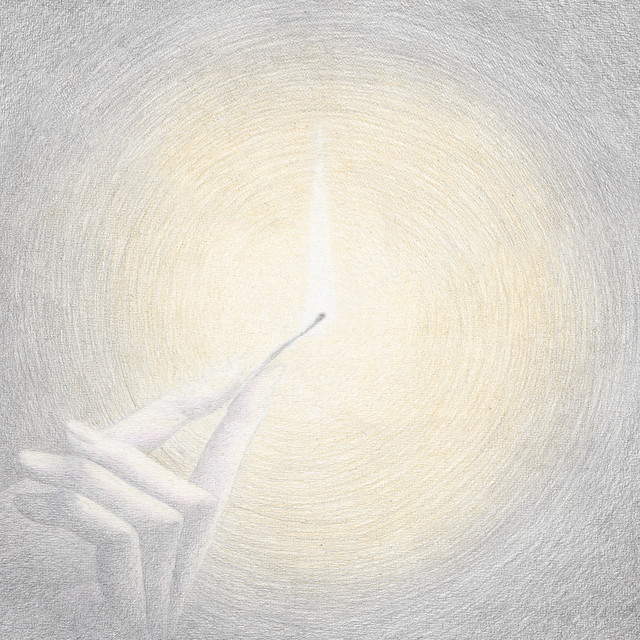
Slowly Forgetting, Barely Remembering (Warm Winters)
Martyna Basta
Released April 28, 2023
Pitchfork 30 Best Jazz and Experimental Albums of 2023
YouTube:
https://music.youtube.com/playlist?list=OLAK5uy_k8oYqAUHOtZbxPi0Dr_qPGoin71KhVxCc
Spotify:
About:
On her second release for Warm Winters Ltd., Polish composer Martyna Basta conjures scenes from the blurry edge of memory. An experience one attempts to repress, a lost sensation drawn back towards conscious possession: the images she renders are potent even as they flicker in and out of definition. Basta trained as a classical guitarist, which she exchanged for a multi-instrumental ambient approach on her label debut Making Eye Contact With Solitude. With Slowly Forgetting, Barely Remembering, Basta extends the diaristic impulses of her recent releases beyond fragments to bring listeners into a full-fledged world, albeit one draped in shadows.
Martyna Basta’s hallucinatory compositions here accumulate irregular layers of space and feeling such that we are drawn close while exposed to expanses beyond our grasp. The guitar motif—a return to Basta’s musical origins—that grounds the title track glimmers like candlelight while vocal samples introduce an undiscernible conversation accumulating nearby. Throughout the release, voice is layered with sparse field recordings and uncanny instrumental refrains—most affectingly, the zither. Basta plays with the voice’s limits and potential: hers interjects on a spectrum from pure, claustrophobic breath to tense muttering to an even hum. Guest autotuned vocals from Claire Rousay arrived tangled up with violin scrawl on “It Could Be As It Was Forever”; the voiceless, gently percussive clamor of “Speechless Lately” is a relief in its wake. Podszepnik is Polish for one who secretly whispers, an intimate confidant, and a pair of tracks by that name act as the album’s two-part centerpiece, between them tracing an arc from a child’s murmurs to a full-fledged chorus of open-throat singing that soars above the weight of an electric guitar.
Slowly Forgetting, Barely Remembering is a dynamic effort from a standout artist in Eastern Europe’s burgeoning ambient-experimental music scenes. Achingly precise in her sense of detail even as she approaches what remains lost or unknown, Basta here makes a strong case for the beauty of uncertainty.
Thea Ballard
Track Listing:
1. Presentiment 2:08
2. Podszepnik I 9:16
3. Slowly Forgetting, Barely Remembering 2:48
4. It Could Be As It Was Forever (featuring Claire Rousay) 6:50
5. Speechless Lately 5:34
6. Lullaby (for Iwo) 3:14
7. Back and Forth 3:57
8. Podszepnik II 8:32
Personnel:
Martyna Basta: guitar, vocals, electronics
Claire Rousay: vocals (4)
Composed and recorded by Martyna Basta
Mastered by Adam Badí Donoval
Cover and text design by Iwo Panasiewicz
Review:
Martyna Basta was trained as a classical guitarist. On YouTube, you can find videos of the Polish musician as a preteen, tackling her repertoire with uncommon skill and an expressive sensibility unusual for a player so young. But like many musicians torn between the pursuit of excellence and desire for creative freedom, she eventually quit her studies and turned her back on the instrument. “In music school, everything had to be perfect,” she has said. “There was no room for any margin of error or any room for experimentation.” Instead, she turned to photography and field recording, learning to embrace the world as it presented itself to her.
Over the last four years the Kraków musician has released a growing body of work that pushes back against conventional modes of beauty, flipping over the block of marble to see what lies squirming underneath: quivering microtonal dissonance, arrhythmic scraping, breathy sighs and guttural whispers. While Basta has tackled a range of formats—meditative standalone tracks, filmic longform works, audio “postcards” collaging together field recordings from friends and confidants—all of them feel charged by a profound sense of unknowing. Her music exists in a stygian netherzone: It is rarely clear where her sounds come from or where a given piece is going.
Basta’s new album, Slowly Forgetting, Barely Remembering, employs similar moods as its predecessor, 2021’s Making Eye Contact With Solitude: The volume is hushed, the approach oblique, the candle watts practically nil. She favors bristling tritones and spiky harmonics over more consonant harmonies and timbres; when she sings, she limits herself to staccato, monosyllabic coos. Omnipresent rustling and gurgling suggest ceaseless and vaguely ominous natural processes, as though she had recorded atop a melting glacier. But she also pushes into more conventional spaces on this album, at times seeming as though she is finding her way back to melodic instincts that she forced herself to unlearn when she gave up the guitar.
That journey plays out almost in real time in the nine-minute “Podszepnik I,” the album’s second track. It opens with a lattice of moans and murmurs, touch-tone signals, insectoid scuttling, and pitch-shifted whispers. Halfway through, however, a plucked zither pattern assumes vivid focus, like wind chimes ringing out in the night, offering a scale—dissonant and strangely tuned, but a scale nonetheless—for the rest of the elements to arrange themselves around.
Even at their most melodic, these are not straightforward songs. The Los Angeles ambient musician claire rousay makes an appearance on “It Could Be as It Was Forever,” her ASMR purr run through heavy Auto-Tune; in the song’s climax, her deceptively dulcet major-key intervals give way to a bracing explosion of dissonance, squeezing the equivalent of free jazz out of pitch-correction software and glancing bow strikes. And in “Back and Forth,” where flickering constellations of zither gradually give way to a gentle guitar melody, the background swarms with whispers and grunts. The sense of intimacy is unsettling; one might read these sounds as evidence of eros, but I hear them—particularly when combined with faint splashing noises that might be rowing oars—as signs of great exertion. It’s as though Basta were moving under a heavy load, pushing forward with great determination.
That implication of strained effort makes “Podszepnik II” all the more remarkable. Here, on the album’s eight-and-a-half-minute closer and highlight, all the intimations of disturbance melt away, leaving nothing but a simple guitar figure played on the low strings. It is a repetitive melody, reaching out and then folding back in upon itself, but every so often it stretches for a higher note, as though it were trying to express an emotion that words cannot. In its inky tone, it is almost goth, but without any hint of pastiche or posing. Basta’s voice swirls around the melody in gradually thickening layers of wordless mourning, the result sounding like a lament for an unfathomable loss. In its simplicity, coming at the end of this tangled, contorted album, her song also sounds like a celebration of freedom.
Philip Sherburne (Pitchfork)