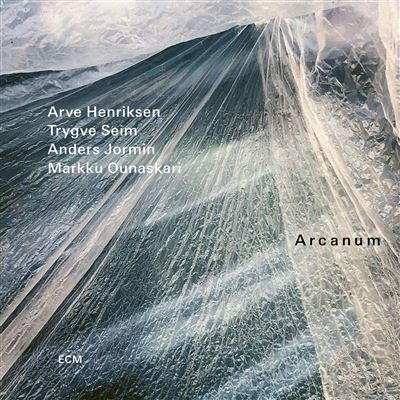
Arcanum (ECM)
Arve Henriksen / Anders Jormin / Markku Ounaskari / Trygve Seim
Released May 2, 2025
AllMusic Favorite Jazz Albums 2025
YouTube:
https://music.youtube.com/playlist?list=OLAK5uy_l9O9fIXrT9pF92xoyi39Kye5ti4ddaQjs
Spotify:
About:
The Scandinavian project Arcanum brings together four artists all well-known to followers of music at ECM: Arve Henriksen, Trygve Seim, Anders Jormin and Markku Ounaskari. They’ve played together in many permutations over the years, but this is their first album as a quartet. Already hailed as a “Nordic supergroup” in some quarters, the designation hardly conveys the thoughtful, reflective quality of the improvising and the sensitivity of the interaction here, whether playing music composed in real time or taking a written theme to new places.
Ounaksari, Jormin and Seim were all working with folksinger and kantele player Sinikka Langeland when the idea of a new band was first raised: “We’d often play as a trio during soundchecks, which was always very enjoyable, so I proposed booking a couple of concerts in Finland…”, Markku recalls. Trygve felt Arve Henriksen also had to be in the line-up, a suggestion easily agreed to. All four of the musicians had played together on Langeland’s Starflowers album in 2006 and on her later recordings including The Land That Is Not and The Magical Forest, and the Seim/Henriksen association stretched back still further, with Arve already a significant presence on Trygve’s ECM debut Different Rivers, recorded in 1998 and 1999. From the earliest days it was evident that there was something special in the way that Seim and Henriksen were able to bend and intertwine their sounds on saxophone and trumpet.
What, then, are the roots of Arcanum’s approach to music-making? Tryge Seim’s opening composition “Nokitpyrt” offers one clue. Anders Jormin calls it “a respectful bow to Scandinavian role models.” Read the song title backwards and you get close to Triptykon, Jan Garbarek’s seminal 1972 recording with Arild Andersen and Edward Vesala, which opened new perspectives for free balladry and found a spiritual affinity between post-Ayler improvising and Norwegian traditional music. The Arcanum quartet are similarly looking, through the prism of jazz creativity, at a broader scope of music and meaning.
This is evidenced in, for instance, their interpretation of the Finnish traditional tune “Armon Lapset”. Arve Henriksen: “This western Læstadian hymn was widely used in North Troms, Norway in the past. It helped to keep the Kven language alive, as a part of the Tornedal dialect and Finnish church language from the 1860s. We used this psalm as a starting point for a very free interpretation, quite far away from the original habitat.”
Anders Jormin’s tune “Koto” was composed in 1999 as part of a commission for Swedish Radio originally featuring Arve Henriksen and guitarist Marc Ducret, among others. Jormin’s fascination for Japanese traditional music was later intensified through his work with koto player Karin Nakagawa on albums including Trees of Light and Pasado en claro.
Jormin wrote “Elegy” with Arve, Trygve and Markku in mind “on the first day of the war in Ukraine”. It leads into a brief account of “What Reason Could I Give”, which Anders describes as “my favourite of Ornette Coleman’s many expressive and iconic pieces”. The beautiful ballad was included on Dona Nostra, Don Cherry’s final album – and the first ECM album on which Jormin appeared – in 1993, where it was played as a duet by Cherry and Bobo Stenson.
Collectively improvised pieces on Arcanum reveal an uncommon feeling for form. Exploration here is always highly focused, the musicians keeping things concise and to the point.
Track Listing:
1. Nokitpyrt (Trygve Seim) 02:57
2. Blib A (Arve Henriksen / Anders Jormin / Markku Ounaskari / Trygve Seim) 01:31
3. Armon Lapset (Traditional9 03:47
4. Folkesong (Arve Henriksen / Anders Jormin / Markku Ounaskari / Trygve Seim) 04:06
5. Trofast (Trygve Seim) 04:41
6. Lost in Vanløse (Arve Henriksen / Anders Jormin / Markku Ounaskari / Trygve Seim) 05:16
7. Old Dreams (Arve Henriksen / Anders Jormin / Markku Ounaskari / Trygve Seim) 03:48
8. Koto (Anders Jormin) 05:08
9. Polvere Uno (Arve Henriksen / Anders Jormin / Markku Ounaskari / Trygve Seim) 03:37
10. Pharao (Arve Henriksen / Anders Jormin / Markku Ounaskari / Trygve Seim) 04:32
11. Morning Meditation (Arve Henriksen / Anders Jormin / Markku Ounaskari / Trygve Seim) 01:41
12. Elegy (Anders Jormin) 04:14
13. What Reason Could I Give (Ornette Coleman) 01:35
14. La Fontaine (Arve Henriksen / Anders Jormin / Markku Ounaskari / Trygve Seim) 02:47
15. Shadow Trail (Arve Henriksen / Anders Jormin / Markku Ounaskari / Trygve Seim) 02:46
16. Fata Morgana (Arve Henriksen / Anders Jormin / Markku Ounaskari / Trygve Seim) 02:28
Personnel:
Arve Henrikse: trumpet
Trygve Seim: saxophone
Anders Jormin: double bass
Markku Ounaskari: drums, percussion
Recorded March 2023, at The Village Recording, Copenhagen
Produced by Manfred Eicher
Recording Engineer: Thomas Vang
Mixed by Manfred Eicher and Michael Hinreiner
Recording Supervisor: Guido Gorna
Cover Photo: Hubert Klotzek
Design: Sascha Kleis
Review:
Trumpeter/electronicist Arve Henriksen, saxophonist Trygve Seim, bassist Anders Jormin, and drummer Markku Ounaskari have worked together in various groupings since the late ’90s. Most notably, they worked collectively on three of vocalist/kantele player Sinikka Langeland’s albums — 2006’s Starflowers, 2011’s The Land That Is Not, and 2016’s The Magical Forest (the latter also with Trio Mediaeval) — convincing them of their collective creative potential. Arcanum is the quartet’s debut. These 16 cuts offer a seamless weave of avant-jazz and folk music that at times recalls early outings by Jan Garbarek and Bobo Stenson. That said, the ghosts haunting this outing include the Ornette Coleman Quartet with Don Cherry.
Seim’s “Nokitpyrt” is a case in point. While it’s noted as a “tribute to Scandinavian elders,” its backward spelling is eerily similar to Triptykon, the 1972 album by Garbarek. Under three-minutes long, its influence suggests the interplay of the Coleman band in its rendering of folk-esque lyric melody, ambient space, and improvisation. “Armen Lapset” is a traditional Finnish folk song. Its theme is introduced by Jormin playing the melody solo then improvising on it. He is joined by trumpet and soprano sax as Ounaskari offers painterly accompaniment on tom-toms. The four-minute “Folkesong” is collectively credited and is arguably composed in real time rather than improvised as set harmony and melody dictate rhythm until its midsection when Seim’s soprano takes a solo. His “Trofast” offers a Coleman-tinged performance of what sounds like a Scandinavian folk song. “Lost in Vanløse” is introduced by the rhythm section engaging in canny, unhurried interplay framed by natural echo and Henriksen’s subtle electronics for two-and-a-half minutes. When Seim enters, he reflects Jormin’s resonant improvising back to him while beginning to treat his tenor like a human voice. It’s breathtaking. “Old Dreams” is a group improv inspired by Cherry’s Old and New Dreams band (comprised entirely of Coleman alumni). Jormin’s “Koto” addresses the bassist’s decades-long fascination with Japanese music (including his two albums with koto master Karin Nakagawa). The hushed interplay between Ounaskari’s cymbals, bass, whispered trumpet, and soprano sax offers an elegiac melody punctuated by pregnant pauses. Led by the rhythm section, “Pharao” is an improv that balances modal blues and skeletal post-bop swing. Jormin’s “Elegy” was composed on the day Ukraine was invaded. The woven sax and trumpet entwine in a bittersweet lyric as bassist and drummer maintain a processional pace. It’s followed by a short, deeply moving Jormin arrangement of Coleman’s “What Reason Could I Give.” Three improvisations close the set. The two-minute “La Fontaine” offers a series of linked, unanswered harmonic questions. “Shadow Trail” offers droning soprano, trumpet, tenor, and arco bass underscored by bell-like cymbals and brushed snares. Closer “Fata Morgano” offers Eastern-tinged modalities in sparse, darkly tinged phrases and utterances from all four members with moaning tenor from Seim and Henriksen’s unintrusive yet illustrative electronics. Arcanum is worth sitting down to listen to. Its restraint and harmonic and rhythmic invention blended with textured space offer mystery, jazz sophistication, and mastery.
Thom Jurek (AllMusic)