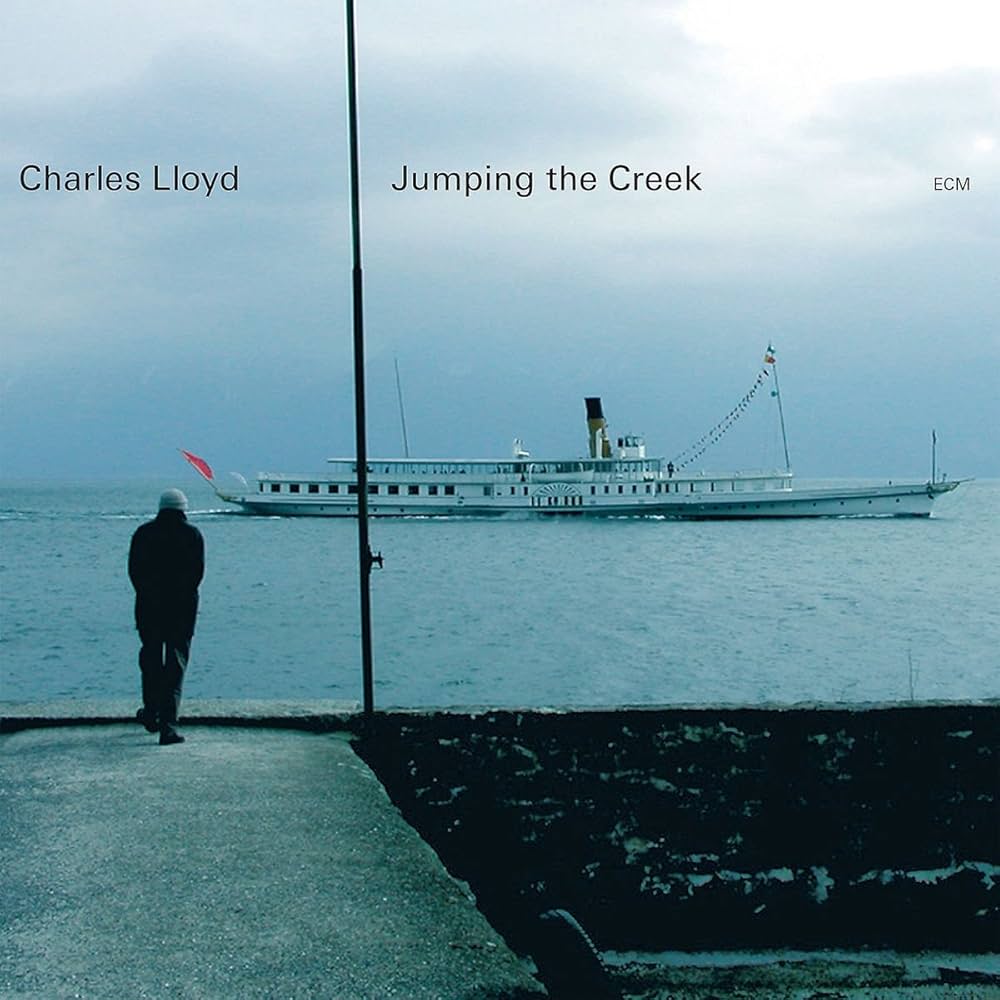
Jumping the Creek (ECM)
Charles Lloyd
Released April 4, 2005
New York Times Best Jazz Albums of 2005
YouTube:
https://music.youtube.com/playlist?list=OLAK5uy_lhtBEeXxAed3wYQCprR3bh-6PqsRfOM4w
Spotify:
About:
“Reasons you should connect with Charles Lloyd: He embodies all the best of jazz – the conception, the technique, the communication, the spirit. He always ignites a world class band…”
Greg Burk, in the LA Weekly
In his liner notes for Jumping the Creek, Stanley Crouch draws attention to the Charles Lloyd ensemble as well as its charismatic leader: “Since part of jazz composing is selecting musicians who can make up their own parts dependent on the kind of material played, we can judge Charles Lloyd not only through his playing, his writing, and the material he selects, but through the marvelous quality of his ensemble’s flexibility. Geri Allen and Bob Hurst are already masters and Eric Harland has the technique, taste and imagination to become one.”
Even before he became a ‘bandleader’ in the standard sense, Charles Lloyd revealed a special capacity for marshalling an ensemble’s resources, hence his job, in his early 20s, as musical director of Chico Hamilton’s groups. He has always had remarkable musicians around him. His very first album as a leader, 1964’s Discovery, found him flanked by Don Friedman, Richard Davis and Roy Haynes. Gabor Szabo, Ron Carter and Tony Williams formed his next recording band. The history-making quartet of the mid-to late 1960s introduced Keith Jarrett and Jack DeJohnette to the world at large. Extraordinary beginnings. In the 1980s his association with Michel Petrucciani, effectively another “discovery”, nudged him back toward active duty on jazz’s bandstands. The ECM recordings, starting with Fish Out Of Water in 1989 initiated a further run of exceptional ensembles, with Bobo Stenson as Lloyd’s piano man for five discs, frequently in the company of Billy Hart and Anders Jormin. Since 1998 the bands have been American again, and have variously included John Abercrombie, Brad Mehldau, and the late, great Billy Higgins.
If the bar is high for the Jumping the Creek quartet, they seem unintimidated by it, playing with a very welcome freshness, drive and sensitivity. Detroit born pianist Geri Allen has been working regularly with Lloyd since 2001 and brings to the band’s stylistic mix a sly rhythmic intelligence rooted in Monk, Bud Powell, Mary Lou Williams and Herbie Nichols, and a sense for post-free possibilities. She has always addressed the continuum of African-American music in a very open way, with gospel, the blues, Motown and Caribbean music also important influences. Allen has worked particularly effectively with saxophonists, starting with Joseph Jarman in her first years in New York, then as part of the “M-Base” circle of musicians around Steve Coleman. In the mid-1990s she made an important contribution to the music of Ornette Coleman, the first acoustic pianist in Ornette’s music in decades. Her angular way of playing never seems to limit a horn player’s choice of notes, and Lloyd clearly finds her contribution to the music inspiring. See especially the hypersensitive “Pythagoras at Jeckyll Island” which comprises the first part of the “Georgia Bright Suite”. The pianist first appeared on disc with Lloyd on the double album Lift Every Voice; it was also Geri Allen who encouraged Charles Lloyd to release the privately-recorded sessions with Billy Higgins issued in 2004, to worldwide critical acclaim, as Which Way Is East.
Bassist Robert Hurst has some performing history with Geri Allen, has made his own albums as a leader and has played with Tony Williams and the Marsalis brothers amongst many others. He currently works with Diana Krall. More relevant for the present project is his association with Pharoah Sanders: the pathways of eastward-looking modal jazz improvisation are routes he knows well, and he is clearly at home in the Lloyd ensemble. The same goes for Eric Harland, who has also played with Pharoah but performed much more extensively with McCoy Tyner, recently garnering much attention for his contribution to Tyner’s Telarc Land of Giants album. More than familiar with the language of post-Coltrane jazz, these are musicians who have played with its architects. (And Lloyd himself of course was one of the musicians looking for ways beyond the tyranny of the changes in his early Californian jamming and woodshedding with Billy Higgins, Don Cherry, Ornette Coleman, Eric Dolphy and others when he was still a teenager, way back in the 1950s.) Eric Harland also currently plays in Lloyd’s other group, an exhilarating trio with tabla drummer Zakir Hussain, which, by most accounts, blows the lid off every concert hall it plays.
The Jumping the Creek quartet deals with the whole history of jazz as experienced by Charles Lloyd and, as so often, looks beyond it. The CD booklet illustrations include a shot of Lloyd with Coleman Hawkins, Lester Young’s rival as the first of the great tenor men. Charles learned from both of them as he worked out how to sing his own song. Johnny Hodges was another early influence, and the Ellington song “Come Sunday” is forever associated with his bittersweet sound. Lloyd puts a personal, soulful spin on the tune. He too has become has become a master of nuance, able to wrest every shade of meaning and emotion from a melody.
The Which Way Is East duets with Billy Higgins revitalized Charles Lloyd’s interest in the alto sax – Higgins’s called it Lloyd’s “secret weapon” – which he is again playing publicly after a hiatus of decades, an increasingly important resource now. It seems to lead Lloyd to faster, “freer” playing, although as he also observes “the weird thing is, when I play tenor now, I take it over to the alto’s range” (interview with Ashley Kahn in Jazz Times). And the taragato (literally “Turkish pipe”), the wooden Hungarian reed instrument that is edging out the Tibetan oboe in Lloyd’s affections as instrument of choice for access to “oriental” colours, is once again most effectively deployed, this time in duet with Hurst’s percussive bass, on “The Sufi’s Tears”.
On tenor, Lloyd now has very few peers for expressive fluency. He is “one of the very best tenor saxophonists of our moment”, to quote Stanley Crouch In his hands Jacques Brel’s “Ne me quitte pas” (If You Go Away) – a dark tune favoured by singers from Nina Simone to Scott Walker becomes a genuinely smouldering torch song of anguished intensity…
The same power illuminates “Angel Oak Revisited”. Slow or fast, mining the deep feeling in ballads or skimming jubilantly over a roaring rhythm section (especially on an ecstatic “Sweet Georgia Bright”), “Jumping the Creek” finds Charles Lloyd in very strong form.
Track Listing:
1. Ne Me Quitte Pas (Jacques Brel) 13:28
2. Ken Katta Ma Om (Charles Lloyd) 05:44
3. Angel Oak Revisited (Charles Lloyd) 03:33
4. Canon Perdido (Charles Lloyd) 03:01
5. Jumping the Creek (Charles Lloyd) 05:56
6. The Sufi’s Tears (Charles Lloyd) 03:05
7. Georgia Bright Suite: I. Pythagoras at Jeckyll Island / II. Sweet Georgia Bright (Charles Lloyd) 13:32
8. Come Sunday (Duke Ellington) 05:51
9. Both Veils Must Go (Charles Lloyd) 02:59
10. Song of the Inuit (Charles Lloyd) 11:26
Personnel:
Charles Lloyd: tenor saxophone, alto saxophone, taragato
Geri Allen: piano
Robert Hurst: double-bass
Eric Harland: drums, percussion
Recorded January 2004, Cello Studio, Los Angeles, by Talley Sherwood assisted by Steven Rhodes
Mixed by Talley Sherwood and Dom Camardella (track 5)
Mixing Assistant: Ulysses Noriega
Photography by Dorothy Darr
Layout: Conni Lechner, Dieter Rehm
Producer: Charles Lloyd, Dorothy Darr
Executive-Producer: Manfred Eicher
Review:
While saxophonist Charles Lloyd made some memorable ensemble discs with the late, great drummer Billy Higgins—’99’s Voice in the Night, ’00’s The Water is Wide and ’01’s Hyperion with Higgins—there was always something a little safe about these recordings. When working with Higgins, with the exception of their last release together, ’04’s duet Which Way is East, Lloyd seemed to ground himself in more mainstream territory than he did on his more broadly-reaching ’90s albums with pianist Bobo Stenson and bassist Anders Jormin. With Jumping the Creek Lloyd returns to more experimental territory, delivering possibly the freest record of his career.
That’s not to say that Lloyd’s penchant for writing or finding lyrical material has gone by the wayside. But when Lloyd and his current quartet—featuring pianist Geri Allen, bassist Robert Hurst, and drummer Eric Harland—tackle even the most bittersweet romantic material, like the opening Jacques Brel piece “Ne Me Quitte Pas, it’s clear that they are approaching it from a more liberated place. And while the quartet comes more directly from the American jazz tradition, there are also distinct notions of the more European impressionism of Lloyd’s ’90s groups. The result is something of a consolidation and, as Stanley Crouch describes in the liner notes, summation of Lloyd’s forty-year musical and spiritual quest.
While Lloyd exploits the inestimable talent and power of the quartet, he also breaks it down into a mix of duo and trio pieces. “Ken Katta Ma Om starts as a loosely-formed duet between Lloyd and Harland—an intuitive drummer who, since emerging on the scene in the mid-’90s, has been garnering a growing reputation with artists including McCoy Tyner and Terence Blanchard—but resolves into a three-way conversation when Allen joins in. Allen, whose recent release The Life of a Song shows just how much she has grown as a player in the past few years, demonstrates the ability to wear many hats—from richly melodic and on form to abstract and unfettered. The title track is a largely free exchange that finds the group exploring the various permutations and combinations possible, all within a brief six-minute span.
Hurst, a bassist who emerged in the mainstream with Wynton Marsalis in the ’80s, has broadened his reach in recent years with artists as diverse as Lou Rawls, Keb’ Mo’ and Terri Lyne Carrington. On Jumping the Creek he is equally stylistically unencumbered, as comfortable on the Eastern-tinged “The Sufi’s Tears as he is the more swinging, yet still open-ended “Sweet Georgia Bright, which makes up the second half of the “Georgia Bright Suite.
Lloyd’s voice has never been better. While sometimes dismissed as a Coltrane knockoff, such direct comparisons miss the point. Truthfully, Lloyd is the sum total of a wider range of musical references that go much farther back. Still, his supple approach and robust tone are instantly recognizable, taking his influences to a more modern musical space; and Jumping the Creek represents a clear highlight in a career filled with memorable milestones.
John Kelman (All About Jazz)