
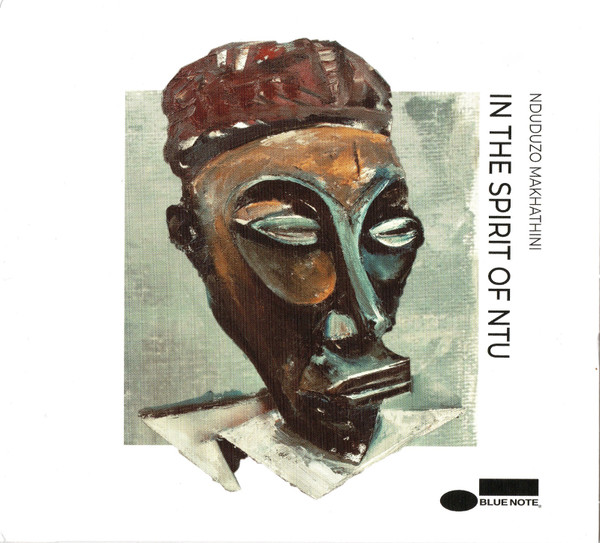
In The Spirit of Ntu (Blue Note)
Nduduzo Makhathini
Released May 27, 2022
Jazzwise Top 10 Releases of 2022
YouTube:
https://music.youtube.com/playlist?list=OLAK5uy_kPXky6B8ifxPSCpforMfsBV9imzzVZrUs
Spotify:
About:
On his milestone tenth studio album, In the Spirit of Ntu, the visionary South African pianist, composer, improviser, and healer Nduduzo Makhathini condenses the thematic, sonic, and conceptual notions explored over his catalog into a layered yet accessible 10-track album. “I really felt this need to summarize everything I’ve done this far and put it into ‘some’ context,” Makhathini divulges.
In the Spirit of Ntu is Makhathini’s second album to be released on Blue Note Records in partnership with Universal Music Group Africa, and the very first release on the newly formed imprint Blue Note Africa. A central figure of the country’s vibrant jazz scene, Makhathini assembled a band consisting of some of South Africa’s most exciting young musicians including saxophonist Linda Sikhakhane, trumpeter Robin Fassie Kock, vibraphonist Dylan Tabisher, bassist Stephen de Souza, percussionist Gontse Makhene, and drummer Dane Paris.
Folding a range of concepts such as ‘minor and major rhythms,’ ‘guided mobility,’ ‘active listening,’ and ‘ritualism’ into the project, Makhathini draws on his background in Zulu traditions and intellectual curiosities to inform his engaging articulations. “I’m grappling with these cosmological ideas as a way of situating jazz in our context,” he says. “I put out Modes of Communication: Letters from the Underworlds using the letter as a metaphor for the sounds coming from the underworlds. Previously, I had released Listening to the Ground which encored into this idea of listening as knowing. In the Spirit of Ntu is living in that paradigm of listening to the things that emerge from the ground. Ntu is an ancient African philosophy from which the idea of Ubuntu stems out. Ubuntu says: ‘I am because you are.’ It is a deep invocation of collectiveness.”
“The wise ones tell us that our essence is ‘force,’ what our ancestors called Ntu,” writes Makhathini in the album’s foreword. “Ntu is where our wholeness resides through-which we are connected to all. It is our spiritual essence that is untouchable for it is all and all is with/in it.”
In much the same way as Makhathini builds upon the sonic universes he has previously created within his own cannon; he utilizes the ideas, practices, and experiences of pre-colonial Africa to fashion new modes of hearing, feeling, or being. “I’m drawing from things that reside as part of memory – until they get to the point of revealing something new,” he says. “My improvisation is searching for that moment of revelation… or in the African context; a moment of divination.”
That notion of revisiting and refashioning is apparent on “Re-Amathambo,” a rework of a song from his critically acclaimed 2018 album Ikhambi, which features a stunning vocal performance by Anna Widauer. Here, Makhathini metaphorically employs the piano as the Sangoma’s bones – a tool for divination and a symbol of elephant tusks represented through the ivory. This analogous use of his instrument represents the synthesis Makhathini aims to achieve; constantly seeking out the echoes and parallels between ‘homegrown’ and ‘adopted’ practices. “I was brought up in a Christian family,” he shares. “We had the whole idea of God being in the sky and there was less attention paid to things that come from the ground.”
Managing to find a thread between the seemingly divergent positions of culture and religion, Makhathini employs fire as a motif on the album’s anchor track “Emlilweni,” which features a searing guest appearance by the American alto saxophonist Jaleel Shaw. “South Africans have always thought of sounds as residing outside of burning fires. They would say ‘during this particular time this was the soundtrack to this burning!‘ I started thinking what it means for sound to no longer conform to residing on the borders of this burning… what does it mean for sound to emerge out of these fires?”
Of course, Makhathini is delicately referencing the biblical tale of Shadrach, Meshach, and Abednego, whose faith saw them emerge from a fiery furnace with the son of God in tow. This symbolism of returning to our essence and recomposing ourselves continues on tracks like “Mama” featuring the mesmerizing vocals of Omagugu, and particularly “Senze’Nina,” which reappropriates an ‘anthem’ of anti-Apartheid protest and frames the lyrics through the lens of ‘revitalized essence.’
“‘Senzenina?’ [‘what have we done?’] is a slogan, which was a part of a protest song during Apartheid,” explains Makhathini. “Recently, this same slogan and song have been invoked as a way of questioning the current gender-based violence cases in South Africa. That’s when I started thinking, this is a question that women now, or Black people in the struggle, shouldn’t have been asking. We’ve sung this song enough to realize that we’ve not done anything wrong. This has nothing to do with them but the oppressor or the men causing pain to women. It is the perpetrators that have lost something in their being, something of their essence, that needs to be restored. Thus, I opened up another meaning of ‘Senze’Nina’ without a question mark, which translates as ‘remake us you mothers.’ In this sense, the song represents the making of a new man that is more kind, sensitive, and aligned to Ntu.”
Seeing that the notion of Ntu revolves around communal, interpersonal, and even interspecies relations; it’s at these moments that the album reveals its function: a soundtrack emanating from the crevices between multiple moments and spaces, seeking to redefine, recreate, and re-imagine through improvisational techniques.
Perhaps apart from Makhathini’s influences such as John Coltrane, Bheki Mseleku, McCoy Tyner, and Abdullah Ibrahim, In The Spirit of Ntu pulls his most foundational cultural Influences into a space where the sounds of the South African landscape are placed at the center of the nation’s evolving jazz songbook. The song “Nyoni Le” does exactly this by employing shades of Princess Magogo kaDinuzulu’s style, a songstress cherished for her use of traditional vocal techniques. “Amahubo are the sounds of our villages,” Makhathini shares. “These sounds are like sacred texts, documents, or books and I’ve been exploring ways to echo them in my work.” “This project was conceived at a difficult time in South Africa, a time of confusion and conflict,” says Makhathini. “It was, once more, a period of burning fires, riots and massacres. In this sense, the music that I have composed is not surrounding these fires as a backdrop or soundtrack—these sounds are part of the discourse. They project from the burning fires until the fires stop burning. What remains is what these sounds seek to restore. Ntu as a creative force that seeks to lead us to remember our essence.”
Track Listing:
1. Unonkanyamba (Nduduzo Makhathini) 9:10
2. Mama (Nduduzo Makhathini) 7:01
3. Amathongo (Nduduzo Makhathini) 6:26
4. Nyonini Le? (Nduduzo Makhathini) 6:02
5. Emlilweni (Nduduzo Makhathini) 6:33
6. Re-Amathambo (Anna Widauer / Nduduzo Makhathini) 7:02
7. Abantwana Belanga (Nduduzo Makhathini) 6:52
8. Omnyama (Nduduzo Makhathini) 8:32
9. Senze’ Nina (Nduduzo Makhathini) 5:48
10. Ntu (Nduduzo Makhathini) 4:45
Personnel:
Nduduzo Makhathini: piano, vocals (1, 2, 3, 4, 6, 7, 8, 9)
Stephen De Souza: double bass
Dane Paris: drums, cymbals
Gontse Makhene: percussion
Linda Sikhakhane: tenor and soprano saxophone
Robin Fassie Kock: trumpet, flugelhorn
Dylan Tabisher: vibraphone
Omagugu: vocals (2)
Jaleel Shaw: alto saxophone (5)
Anna Widauer: vocals (6)
Recorded at Penny Lane Studios, Cape Town, by Izan Greying
Assistant engineer: Dominique Adams, Kieran Cattell
Mixed by Peter Pearlson
Mastered by Todd Whitelock
Artwork by Martel Chapman
Design: Ezra Mokgope
Review:
This is the second album by Makhathini to be issued on the Blue Note imprint; the first – Modes of Communication: Letters from the Underworlds – was named one of the best jazz albums of 2020 by The New York Times. But In the Spirit of the Ntu is the first to be released on the newly-formed Blue Note Africa imprint, and suggests Universal is looking to give welcome exposure to some of the dynamic young musicians on the South African/African jazz scene.
This album is a good example, covering a wide emotional range, from the dynamic ‘Abantwana Belanga,’ to the reflective introspection of ‘Nyonini Le’ or ‘Senze’ Nina’. Makhathini – formerly a member of Shabaka Hutchings’ band Shabaka and the Ancestors appearing on their 2016 album Wisdom of Elders – speaks of how the album was conceptualised in a “time of confusion and conflict’ in his homeland, and on tracks such as the minor keyed ‘Amathongo’ he succeeds in implying darkness and mystery, despite the bright tempo, a feeling which persists in the ballad like ‘Omagugu’ with an Anna Widauer vocal and a thoughtful trumpet intervention by Robin Fassie Kock. Inspired by the symbolism and traditions of Makhathini’s background in Zulu traditions, his playing on the unbridled ‘Abantwana Belanga,’ is suggestive of McCoy Tyner, a formative influence, something he addresses below.
You have referred to formative influences – Abdullah Ibrahim, Bheki Mseleku, Coltrane, and McCoy Tyner. To what extent would you say US masters influence South African jazz today as opposed to ‘local heroes’ such as Ibrahim, Kippie Moeketsi, etc?
Historically, there has always been a connection. Jazz was born through a moment of displacement: geographic, cultural, religious and linguistic. So it is a music that came as a result of some form of victimisation. It came through the brutalities of Transatlantic exile and local forms of displacement. These are some of the shared memories both in Africa and in the diasporas. The masters you mention were in a constant dialogue over the Atlantic ocean. As a follower of all these people, I have always been interested in what connects this collective memory, so I draw from all of them equally. They offer different things at various points of my journey; I am attracted to both Mseleku’s sound and the underpinning conceptual frameworks. I could say something about each of the above, and there are connections between all of them.
You refer to the tension between ‘homegrown’ and ‘adopted’ practices but there are instrumentals where such referential meanings don’t appear to define the music, rather they seem to subjectively inspire it, such as the influence of McCoy Tyner…
Music in African cultures is often a result of experience, it is an expression of a locatedness; sounds emerge as gestures expressing a broader feeling of being. Sound does not occur outside of functionality. Our ancestors composed songs for every occasion that were linked to a cosmological calendar, and these were not uttered outside of their contextual settings. I am the people who were experiencing pain and needed to vocalise through the symbols of fire. Your reference to Tyner is evidence that he is not separate from those people too.
Does the influence of US jazz and the cultural values it implies contrast with the conflict and confusion you speak of ?
Sounds cannot be read outside of history… similarly Africa, as a point of origin, cannot be separated from ‘jazz’ – the ‘jazzy-ness’, a term I use to refer to pre-slavery sound approaches, has always been there in African music; improvisation, swing, form and syncopation – these are not new concepts in Africa.
Stuart Nicholson (Jazzwise)