
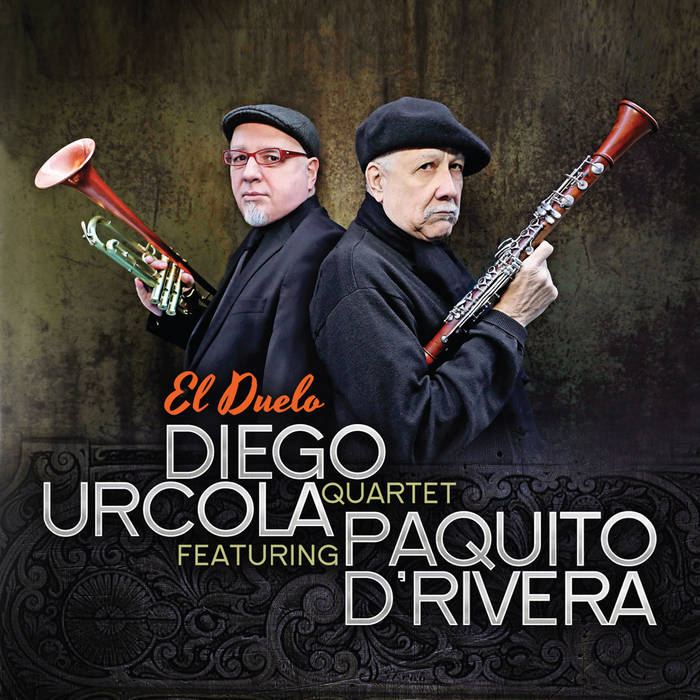
El Duelo (Paquito Records)
Diego Urcola Quartet featuring Paquito D’Rivera
Released September 2020
AllMusic Favorite Jazz Albums 2020
2020 NPR Music Jazz Critics Poll Top 10 Latin Album
YouTube:
https://music.youtube.com/playlist?list=OLAK5uy_ml8SFYd_M3gcbBpUABnJeuwTGGCqauzdE
Spotify:
About:
Specific reasons led to piano-less quartet becoming a vehicle for the more explorative jazz practitioners of the 1950s and 1960s, namely, directness of group sound and the increased interplay between ensemble members. Subtracting the piano from the typical jazz combo made it imperative that the musicians expand their roles to cover harmonic information lost. In doing so, the performers had to remain engaged and responsive, immediately amplifying their performance.
Trumpeter Diego Urcola has proven to be a player of incredible range and dexterity throughout his career, a large part of it playing alongside Paquito D’Rivera in the legendary saxophonist/clarinetist’s various eclectic projects. On Urcola’s new recording, El Duelo, the trumpeter recruits D’Rivera to join him in a very rare, and exposed, playing scenario, the piano-less quartet.
Originally from Buenos Aires, Argentina, Urcola has been a part of the New York City jazz scene since the 1990s. His work with D’Rivera, Guillermo Klein y Los Guachos, Enrico Pieranunzi, and as a leader has been celebrated by many, even garnering him a Grammy nomination for his album, Soundances.
Urcola’s almost thirty-year relationship with D’Rivera, one of jazz music’s true virtuosos, has been extremely valuable. The diverse projects and performance schedules have allowed the two musicians a deep intimacy in their musical partnership. Urcola’s goal on El Duelo is to feature the more uncompromised, freer side of D’Rivera’s improvisational abilities, which are rarely heard on his own recordings.
It was during a regular visit to Uruguay’s Punta Del Este Jazz Festival that Urcola was asked to present a musical tribute to the revered Gerry Mulligan Quartet that featured Chet Baker. During the quartet’s performance, Urcola invited D’Rivera to the stage, and the idea of recording in a piano-less quartet was cemented by the resounding performance.
Argentinean transplant and audio engineer Luis Bacque had long been encouraging Urcola to find a way to record with D’Rivera on one of the trumpeter’s own projects and, once Urcola was able to present the idea, Bacque produced and recorded their meeting in his fantastic home studio in New Jersey.
From the work of Mulligan to Ornette Coleman, quartets presented in this fashion have always relied on strong rhythm duos of bass and drums. The drum chair was filled by the fantastic Eric Doob, D’Rivera’s regular drummer for years and a player whose study of South and Latin American rhythms made him a perfect choice in this situation. New Zealand born Hamish Smith impressed D’Rivera during a teaching engagement at the Manhattan School of Music, where the young bassist continues to study. Urcola brought him in for the quartet’s initial Small’s Jazz Club performance (Smith’s club debut) and was impressed enough to bring him in for the recording (Smith’s recording debut).
Urcola was especially interested in capturing the ensemble with a contemporary sound, which Bacque was able to do expertly, making this compact ensemble sound driving and intense. The pieces that Urcola arranged for the group show the trumpeter’s diverse range of musical interests but also his fantastic ability to consider the ensemble by focusing on group counterpoint between the three melodic voices and providing strong written bass parts to ensure that the movement of the pieces really grooved.
The recording begins with the vibrant title track, a rarely heard Guillermo Klein composition that Urcola arranged from a two-trumpet feature into a wildly driving piece featuring alto sax and trumpet. Urcola’s gorgeous “Tango Azul” borrows its mysterious tone from early tango groups, which regularly featured clarinets, while the group’s take on Ornette Coleman’s “Una Muy Bonita” showcases Smith’s driving bass and the boisterous connection between the horns. The brilliant “La Yumba/Caravan” is an Ethan Iverson mash-up of Osvaldo Pugliese’s famous tango and Juan Tizol’s most well known Latin jazz number. The muted Asian inspired “Pekin” is a dramatic piece from Argentinean bassist Willy Gonzales.
Urcola’s upbeat tribute to Freddie Hubbard, “The Natural,” showcases Doob and D’Rivera’s rhythmic brilliance on adapted Afro Cuban clavé, while Urcola’s tantalizing tango, “Buenos Aires,” provides interesting melodic lines for the horns. Kenny Wheeler’s ECM sound is the basis for this quartet’s sound, so it was only natural to include the great trumpeter/composer’s “Foxy Trot,” which once again shows Smith’s advanced bass technique and some incredible counter melodies. Gerry Mulligan provided the spark for the recording, so his “I Know, Don’t Know How” is a welcome fit with its attractive mid-tempo swing. Astor Piazzolla’s “Libertango” provides a bass groove to move to and brilliant interplay between the dancing horns.
Urcola transposed and arranged pieces of a Wayne Shorter suite with elements of pianist Danilo Perez’s improvisations to create the powerful piece, “Sacajawea (Theme).” D’Rivera’s gorgeous clarinet and Urcola’s muted trumpet play off each other beautifully on Richard Nant’s “Leyenda,” while alto sax is back on Urcola’s reduction of a Slide Hampton Jazz Masters Big Band arrangement of Dizzy Gillespie’s “Con Alma,” with shout choruses and all. Inspired by trumpeter Marquis Hill’s take on Benny Golson’s “Stablemates,” Urcola transcribes the piece to fit the ballroom rumba rhythm perfectly. The recording concludes with Urcola’s transcription of recently departed trumpeter/congero Jerry Gonzalez’s famed interpretation of Thelonious Monk’s “Bye-Ya.”
It is easier to filter brilliance by paring down. Diego Urcola’s inspired idea to bring long-time collaborator Paquito D’Rivera into a piano-less quartet to record El Duelo focuses listeners onto two fantastic musicians performing at their musical peaks.
Track Listing:
1. El Duelo (Guillermo Klein) 05:08
2. Tango Azul (Diego Urcola) 05:55
3. Una Muy Bonita (Ornette Coleman) 04:48
4. La Yumba/Caravan (Osvaldo Pugliese / Juan Tizol) arrangements by Ethan Iverson 06:12
5. Pekin (Willy Gonzalez) 03:21
6. The Natural (Diego Urcola) 04:41
7. Buenos Aires (Diego Urcola) 05:32
8. Foxy Trot (Kenny Wheeler) 05:03
9. I Know, Don’t Know How (Gerry Mulligan) 04:38
10. Libertango (Astor Piazzolla) 06:45
11. Sacajawea (Theme) (Wayne Shorter) 04:53
12. Leyenda (Richard Nant) 05:01
13. Con Alma (Dizzy Gillespie) 04:53
14. Stablemates (Benny Golson) arrangements by Marquis Hill 05:02
15. Bye-Ya (Thelonious Monk) arrangements by Jerry Gonzalez 05:10
Personnel:
Diego Urcola: trumpet & flugelhorn
Paquito D’Rivera: alto saxophone & clarinet
Eric Doob: drums
Hamish Smith: bass
Recorded on December 10 & 11, 2019, at Bacque Recording Studios
Produced, Recorded, Mixed and Mastered by Luis Bacque
Executive Producer: Ana Lorena Camacho
Photography & Graphic Design: Cristopher Drukker
Review:
A collaboration between trumpeter Diego Urcola and the acclaimed clarinetist/saxophonist Paquito D’Rivera, 2020’s El Duelo finds the longtime bandmates combining their cross-pollinated musical backgrounds in a pianoless quartet. Technically, the album showcases Urcola’s group with bassist Hamish Smith and drummer Eric Doob, but the trumpeter has been a member of the Cuban-born D’Rivera’s ensemble since the early ’90s, and El Duelo feels like a celebration of that creative partnership. Born in Argentina, Urcola came to wider recognition in his twenties while studying at Berklee School of Music in Boston and Queens College in New York. He picked up Grammy nominations for two of his early solo albums (2003’s Soundscapes and 2006’s Viva), both of which displayed his knack for mixing progressive modern jazz with Latin and Argentine traditions. El Duelo continues in this vein as Urcola and D’Rivera bring all of their varied influences together, dipping into introspective modal jazz, dusky tango grooves, and propulsive Latin rhythms. Interestingly, while the choice to work without a chordal instrument like a piano or guitar here evokes a spare, classical chamber group aesthetic, it also opens up the sound of the quartet, allowing more harmonic freedom for the soloists. It’s a sound that has taken precedence across the jazz spectrum, and Urcola’s group touch upon much it, drawing inspiration from the straight-ahead style of the classic Chet Baker and Gerry Mulligan group of the ’50s on the breezy “I Know, Don’t Know How,” and leaping toward the spritely, free jazz harmolodics of the Ornette Coleman and Don Cherry groups of the ’60s on “Una Muy Bonita.” Primarily, the album falls right in between these paradigms as Urcola and D’Rivera push the boundaries of their global sound as on the declamatory Afro-Latin groover “The Natural” and the middle eastern-influenced “Pekin.” Elsewhere, Urcola’s harmon-muted sensuality is nicely contrasted by D’Rivera’s bright alto sax asides on moody, flamenco-tinged “Libertango.” We also get several inventively arranged standards, including a tango-inspired reworking of Juan Tizol and Duke Ellington’s “Caravan” (titled “La Yumba/Caravan”), a supple, flugelhorn-accented reading of Dizzy Gillespie’s “Con Alma,” and a wry, ballroom dance-friendly take on Benny Golson’s “Stablemates.” Throughout El Duelo, Urcola and D’Rivera display their improvisational bravura, taking extended solos and sparring with a warm intensity.
Matt Collar (AllMusic)