
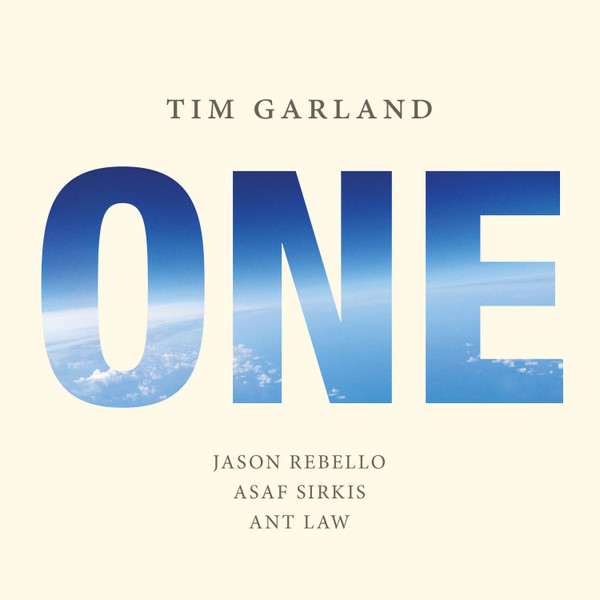
One (Edition Records)
Tim Garland
Released May 6, 2016
Jazzwise Album of the Year for 2016
YouTube:
https://music.youtube.com/playlist?list=OLAK5uy_nK2GNwO2TYWJN8qvo4TWrCH10lK1EHG7Y
Spotify:
About:
With One Tim explores many of the influences that have guided him from the beginning, such as jazz-rock (his Canterbury roots); saxophone players from both sides of the Atlantic; the Celtic guitar music from long running project Lammas; the Latin and Spanish inflections that are so deeply a part of Chick Corea’s music; and a variety of rhythmic patterns learned from drum maestros Bill Bruford and Asaf Sirkis.
Asaf taught Tim the ten beat, Middle Eastern Sama’i. On ‘Sama’i For Peace’, Hossam Ramzy adds Egyptian percussion. He’s also on ‘Colours Of Night’, and ‘Foretold’ where the groove he sets up on the karkabu (giant metallic finger cymbals) and doholla (deep darbouka drum) is mesmeric.
One is a studio album and Tim’s taken the opportunity to add occasional keyboard colours with Asaf layering Udu and Darbouka, and vocals, over his own drumming. One theme features six layered saxophones rather than just one, and, as this is his most percussively driven album to date, a little percussion of Tim’s own (as he does on stage).
Jason Rebello and Tim have worked together for 25 years, and his always unforced, honest improvisation extends to keyboards as well as to piano; the Rhodes is quite a feature in this project, providing a wonderful fat bass end, a register Jason shares skillfully with the lower end of Ant Law’s mighty eight string guitar. Ant Law is a relative newcomer to the group, but plays all four types of guitar on this disc with balanced beauty, accuracy and youthful passion and like the (slightly) older ones, he is drawn to different meters and rhythms that have their origins around the globe.
London is home to a fairly frequent arms fair and in 2015, among the countless reports of refugees and bombed out cities in the news, there was scant mention of this huge and lethal profiteering opportunity going on at the very same time. ‘Pity The Poor Arms Dealer’ was written in a state of almost breathless disbelief as the media busied itself distracting the population from the connections that are most certainly there, well nurtured by our governments. Dionne Bennett’s powerful, unique vocal illuminates this song in a singular, colourful way: part campfire protest song, part soapbox lament.
Track Listing:
1. Sama’i for Peace (Tim Garland) 5:37
2. Bright New Year – dedicated to Geoff Taggart (Tim Garland) 7:05
3. The Eternal Greeting (Tim Garland) 5:59
4. Colours of Night (Tim Garland) 6:45
5. Prototype – dedicated to Bill Bruford (Tim Garland) 5:48
6. The Gathering Dark – dedicated to Don Paterson (Tim Garland) 7:19
7. Pity the Poor Arms Dealer (Tim Garland) 4:30
8. Foretold (Tim Garland) 4:20
9. Youkay (Tim Garland) 8:44
Personnel:
Tim Garland: soprano and tenor sax and additional keyboards and percussion
Asaf Sirkis: drums, percussion
Jason Rebello: piano, Fender Rhodes, Hammond B3 organ and keyboards
Ant Law: nylon string, 12 string, 8 string and semi-acoustic guitars
Guest Personnel
Hossam Ramzy Doholla: egyptian tabla & karkabu (tracks 1, 4 & 8)
Dionne Bennett: vocals (track 7)
Recorded between June 2015 and January 2016 at Masterchord Studio by Isa Khan, Woodworm Studio by Stuart Jones and Eastcote Studio by George Murphy.
Mixed at Candle On The Moon Studio by Anis Finn.
Mastered by Andrew Tulloch at The Blue Studio London
Produced by Tim Garland
Review:
A new group and a new beginning for Tim Garland in what is the finest album by a British jazz musician for quite some while. First, a word about Garland’s virtuoso playing on tenor and soprano saxes, which has reached a level of excellence and maturity that is truly world class. On soprano he offers an evenness of tonal density throughout the registers of the instrument; nothing sounds pinched or forced, and while his articulation is precise and accurate, each note rings through with remarkable clarity even in legato passages. Expressing himself in melodic, rather than pattern-based, improvisation, his playing is virtually cliché free, often using ‘compositional’ devices such as the use of the rising line to create a feeling of tension. This feeling is also reinforced by the occasional use of side-slipping.
On ‘Bright New Year’ he plays with such freedom within form it represents a striking example of exemplary contemporary jazz improvisation. Equally, on ‘Colours of Night’ he exhibits a degree of both technique and taste (the two rarely go hand in hand) that few in jazz can equal. On tenor saxophone he retains this melodic lucidity, evenness of tonal density (from bell tones to false-fingered high notes at the extreme of the saxophone’s range) and on ‘The Eternal Greeting’ he gives a virtual master class in manipulating the rising line to potent and dramatic effect.
Garland has developed the story-telling privilege that is the province of the great jazz improvisers – a Garland solo is not a breakneck bunch of notes thrown at listeners for them to try and make sense of, but solos of architectonic construction that have a beginning, a middle and an end and take the listener on an absorbing journey. But even mastery of your chosen instrument at the level Garland has achieved (and which few in jazz can match) is not enough in jazz today. The challenge is to create an effective context to give expression to the improvisers art. Here again Garland scores, with an ensemble that has done away with the traditional piano-bass-drums role of the jazz rhythm section and placed the rhythmic role in the hands of keyboards, Ant Law’s eight-string guitar which covers the bass notes and Asaf Sirkis’ innovative drums/ percussion. This fresh approach – a development of the rhythmic approach adopted by his previous group Lighthouse – is integral to Garland’s compositional ingenuity with pieces written in a way that shows this unusual approach to rhythm to best advantage. Here, Asaf Sirkis emerges as an unsung hero with a performance that is surely world class. Rebello and Law are exemplary too, offering maturity and flair in both ensemble and solo that contribute significantly in making this album special.
Stuart Nicholson (Jazzwise)