
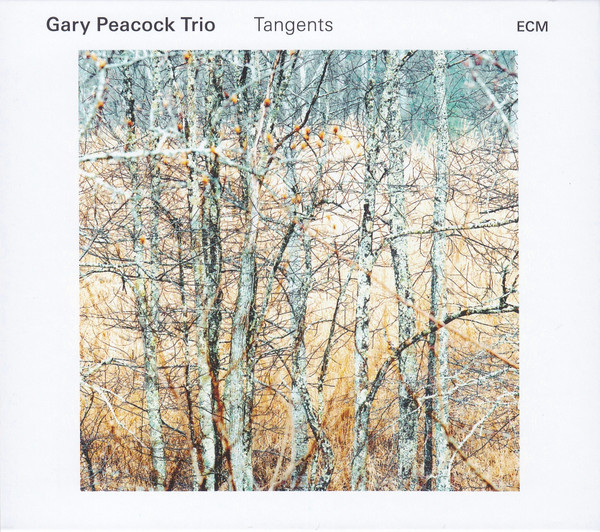
Tangents (ECM)
Gary Peacock Trio
Released August 25, 2017
DownBeat Four-and-a-Half-Star Review
YouTube:
https://music.youtube.com/playlist?list=OLAK5uy_m-0Ew-S2u-bKmkkaKC6PpTLhPw38ipS8E
Spotify:
About:
Some of Gary Peacock’s finest music has been made in the context of piano trios. Early in his career, he helped to establish a fresh role for the bass as an independent melodic voice, an evolution carried forward in history-making groups led by pianists Paul Bley, Bill Evans and Keith Jarrett. Peacock made his leader debut on ECM in 1977 with Tales of Another, featuring the trio with Jarrett and Jack DeJohnette before it recorded famously under the pianist’s leadership. In the 21st century, one of Peacock’s most striking vehicles has been his trio with pianist Marc Copland and drummer Joey Baron. The group earned just praise on both sides of the Atlantic for its initial ECM release, Now This, in 2015. The Guardian called it “captivating,” while All About Jazz said: “These players are always in the present: listening, reacting, knowing when to play and when not to play.” These words apply just as aptly to Tangents, the group’s exceptional follow-up. This trio’s tensile strength – its muscular virtuosity tempered by poetic restraint – animates five originals by Peacock, one by Copland and two by Baron, along with a darkly atmospheric free improvisation and ravishing versions of two classics associated with Bill Evans: “Blue in Green” and “Spartacus.”
Peacock has been collaborating with Copland since the early 1980s. “I felt a compatibility with Marc right away, a sensation of being on the same page,” the bassist recalls. “That’s only developed and deepened over the years as we’ve worked in duo, trio, quartet and quintet formats. As a composer, his harmonies offer real possibilities, as with ‘Talkin’ Blues’ on the new album. Marc and I have a kinship in that we both aspire to something that can’t be conceptualized – something more intuitive. We’re out to surrender to the muse.” For his part, Copland has said: “Taking chances is the essence of playing jazz. This is something I always felt, and when I started playing with Gary Peacock, I knew I’d met a musical soul who believed this as much as I did.”
Along with his detail-rich work behind the kit, Baron – a veteran of many ECM sessions – penned one of the album’s highlights, “Cauldron,” a pouncing number filled with apposite runs by Copland. About the drummer, Peacock recalls: “I played with Joey previously in a quartet with Lee Konitz and Bill Frisell about five or six years ago, so I knew that he was always there for the music, always listening. Marc and I played with several different drummers, but when we got Joey for a week at Birdland, we knew right away that this was the guy for our trio. Like Roy Haynes, Joey has this sensitive touch. He can swing brilliantly even at a low volume. After that Birdland run, I called Manfred to say that we just had to record this band. There’s a real sense of freedom with this trio, but also a lack of me, me, me. Everyone is listening for what the music tells you to do.”
Tangents opens with Peacock’s melody-rich “Contact,” with its solo bass intro offering an alluring entrée into the album. The 82-year-old bassist’s sound remains as individual as a fingerprint: rich and powerful, but also lithe and conveying a seemingly inexhaustible flow of ideas. Regarding the beautiful way his instrumental tone is captured on ECM recordings, the bassist says: “Manfred Eicher and his engineers are masters at capturing the sound of the bass. Manfred isn’t thinking about frequencies as much as he is the personality of the instrument, and the player. Also, it’s not just about the sound of the bass but how it fits in with the other instruments. And I have to say that the radio studio in Lugano where we recorded the new album is special – it’s a small auditorium, with the trio set up onstage. The ambience was fantastic, and that has such a positive effect – you can feel it.”
Another album highlight is Peacock’s Ornette Coleman-evoking “Rumblin’,” which features his bass singing and dancing ebulliently throughout the track. Peacock is quick to credit his early influences as a bassist. “For the melodic aspect, an early inspiration was Red Mitchell,” he says. “Red was a real mentor for me, even if it was just on records. Ray Brown was another inspiration, but for his uncanny ability to swing no matter what. Those were my guiding lights when I was a teenager just starting to play. Later, I discovered Jimmy Blanton and Oscar Pettiford, then Scott LaFaro and Paul Chambers – all were important for me. But there was also the influence of horn players – especially Miles Davis and Stan Getz – as well as a slew of pianists, particularly Bill Evans. Bill was such an inspiration melodically, harmonically, dynamically, through his choice of voicings. There was also a sense of vulnerability in his playing that drew you in – a very human feeling. He was definitely the sort of player who had a realization of the music being more important than him. One should never forget that the music is more important than you.”
Peacock, who recorded the classic album Trio 64 with Evans, underscores his affinity for the pianist’s legacy on Tangents with the inclusion of both the impressionistic “Blue in Green” (recorded famously in 1959 by Miles Davis on Kind of Blue, then by Evans on Portrait in Jazz just months later) and the emotive “Spartacus” (a deeply lyrical film theme by Alex North). The bassist says: “These are pieces that we’ve played often as a trio and that are always inspiring for me. The tendency when someone records a piece by a master is to attempt to re-create it, but that process just makes the piece less than what it was. Rather than emulating someone, if you just play the music and let the inspiration come through that – then you might have something.”
On Now This, Peacock, Copland and Baron reinterpreted some key compositions from the bassist’s songbook: “Moor,” “Gaia,” “Vignette,” “Requiem.” For Tangents, the trio revisited the tumbling tunefulness of “December Greenwings,” which the bassist first recorded on the 1978 ECM LP December Poems with Jan Garbarek and then again on the 2000 ECM album Amaryllis with Marilyn Crispell and Paul Motian. “The piece takes on a different quality with different instruments and personalities – you could say that each recording is a new view of similar terrain,” Peacock says. “One thing that appeals to me about it is the lack of a fixed tempo. I’m more and more drawn to music like that. A tune like ‘Gaia’ demands that you play in time – it’s important for the piece. But ‘December Greenwings’ is something else. I first really got into playing without tempo while working with Albert Ayler and Don Cherry, in the ’60s – we didn’t play time. No chords, no going back over the melody, no time – it was truly free.”
Asked about “Empty Forest,” the seven-minute free improvisation on Tangents, Peacock says: “Who knows where that comes from? It was just: ‘start.’ Marc, Joey and I are ideally suited to free playing together, the three of us. We’re having the same experience in the moment, feeling the music together. It doesn’t mean it’s always perfect what we do – sometimes, it’s more mud than a beautiful, flowing river. But that’s where the trust comes in – that we’ll search together and eventually find the muse, find the music.” Peacock is increasingly drawn to “the unknowable,” he says, “something beyond conception. Conceptualizing can put a limit on what you can do as an improviser – you’re limited to what you can preconceive, instead of just surrendering to the music as it’s happening, tapping intuition. Theory and technique are essential, but they’re not enough – they just provide a sort of milieu. It’s not easy to find the muse. You can’t grab it, you can’t summon it – and lord knows, I’ve tried every route to that. I’ve realized that you can only get out of the way and listen. It’s there, if you really listen.”
Track Listing:
1. Contact (Gary Peacock) 06:39
2. December Greenwings (Gary Peacock) 04:50
3. Tempei Tempo (Gary Peacock) 04:10
4. Cauldron (Joey Baron) 02:29
5. Spartacus (Alex North) 05:10
6. Empty Forest (Gary Peacock, Joey Baron, Marc Copland) 07:11
7. Blue In Green (Miles Davis) 04:42
8. Rumblin’ (Gary Peacock) 04:07
9. Talkin’ Blues (Marc Copland) 04:04
10. In And Out (Joey Baron) 02:53
11. Tangents (Gary Peacock) 06:50
Personnel:
Gary Peacock: bass
Marc Copland: piano
Joey Baron: drums
Recorded May 2016, Auditorio Stelio Molo RSI, Lugano
Engineer: Stefano Amerio
Cover Photo: Eliott Peacock
Design: Sascha Kleis
Produced by Manfred Eicher
Review:
As a bassist, Gary Peacock has always been a stealth virtuoso. What he plays often requires phenomenal speed and facility, but the power and originality of his music invariably draw the listener’s attention away from Peacock’s technical prowess. Even though it opens with a remarkable solo statement that stretches from thumb position down to the lowest reaches of the fingerboard, Tangents is unlikely to change that notion. “Contact,” which opens the album, starts off as if Peacock’s bass were the focus, with pianist Marc Copland and drummer Joey Baron accompanists at best. But about halfway through, Peacock’s line begins to focus on a rhythmic cell, and the center of gravity shifts; by the time they’ve played the tune out, all three are locked in a lithe, intertwining groove. And for all the skittering brilliance of Peacock’s playing, it’s that groove that stays with you. Where Now This, the trio’s previous outing, often opted for a plain-spoken, folkish approach to melody, Tangents is more invested in the allusive, discursive character of the blues. That’s particularly true of “Rumblin’,” which deftly evokes Ornette Coleman’s blues excursions, and somehow Peacock and company even manage to find the blues thread running through the Alex North movie theme “Spartacus.” But the group’s defining characteristic remains the all-in equality of its interplay, maintaining a creative balance between piano, bass and drums regardless of whether the music is conventionally structured, like Miles Davis’ “Blue In Green,” or as open-ended as Peacock’s title tune.
J.D. Considine (DownBeat)


