
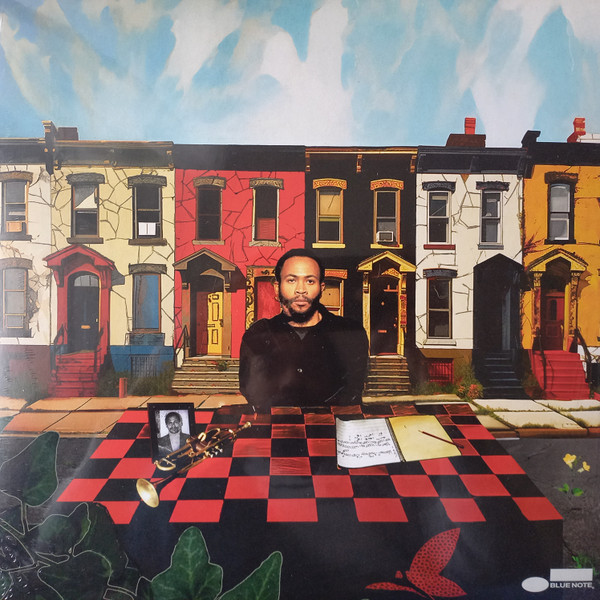
For the Love of It All (Blue Note)
Brandon Woody
Released May 9, 2025
AllMusic Favorite Jazz Albums 2025
YouTube:
https://music.youtube.com/playlist?list=OLAK5uy_kyk_T5tR8x5_Yrs3DyaXhkzwAYb30X8EI
Spotify:
About:
For The Love Of It All is more than trumpeter and composer Brandon Woody’s recording debut; it is a manifesto, a ritual, a hymn to the enduring power of love. Joined by his band Upendo — Troy Long (piano, organ, Rhodes, keyboards), Quincy Phillips (drums), and Michael Saunders (bass) with special guests Imani-Grace (vocals), Vittorio Stropoli (aux synth) — Woody extends an invitation into communion.
Borrowing from the scene of a Sunday morning service and extracting from Woody’s childhood, “Never Gonna Run Away” employs elements of gospel music in a thematic tribute to the song’s core message: faith. The track opens in the embrace of Long on piano and organ — an angelic intro that seems to float off his fingers, cascading in the world around us. Phillips, on drums, adds texture, tactile but tender. Michael Saunders, on bass, provides a heartbeat, grounding the composition. Grace’s delicate vocals offer a guiding hand as listeners traverse nearly seven minutes of introspection.
Over the years, the phrase never gonna run away has become a mantra for Woody — a recurring motif in his life. It is a vow unspoken but woven in every note and affirmed in the aura of every performance. When listening to For The Love Of It All, it is undeniable that Woody does not take lightly the commitment each band member makes in showing up, being present and vulnerable. Through every high and low, Brandon, Troy, Quincy, and Mike remain rooted, bound by love.
“Never Gonna Run Away” is even more reflective of Woody’s affinity for his hometown, Baltimore. In its early stages, Woody and Charles Wilson worked on this song together. It illustrates the magnetic pull Baltimore exerts on its native artists. It asks them to anchor the city at the shores of their hearts, to carry it with them in all their travels, high tide or low.
“Baltimore is in me, whether I am there or not.”
This ethos aligns with the Akan principle of Sankofa, which translates to “go back and get it.” Many African Americans reference Sankofa in search of themselves as it represents a return to one’s roots. Woody is a product of that reclamation. He picked up the trumpet at eight years old in a program at Eubie Blake National Jazz and Cultural Center, where saxophonist Craig Alston introduced him to the building blocks of music. Under Alston’s mentorship, the world of Black music unfolded before Woody, a world in which he would one day build boulevards, imprinting every avenue. Sankofa is reflected in his decision to go back to Baltimore after dropping out of college.
“Beyond the Reach of Our Eyes” and “Wisdom; Terrace on St. Paul St.” awaken listeners to the row-homed horizon of Woody’s purview when he first returned home after dropping out. Both songs, written by Woody, seek to unveil what exists beyond our vision, pursuing memory, legacy, and futures unseen.
Woody used to start his mornings on the porch of his East Baltimore home, absorbing the neighborhood’s soundtrack before retreating to his roommate’s piano to practice — a piano passed down from a grandmother. And it was through that morning ritual that “Beyond the Reach of Our Eyes” found him. During its development, Woody sought to untangle the invisible threads that connect people across time and distance; grappling with how his own existence has rippled through the lives of others by the bell of his trumpet. Note after note, he wondered how many lives he’d really touched.
“There is energy moving that we can’t see.”
Musically, the seven-minute song channels this flow of energy that transcends physical boundaries. Its unconventional structure dances between odd and even meters while maintaining a patterned pulse — a reminder that energy carries on, even when we can’t see where it’s headed. And at six minutes and eight seconds, Woody directs this energy into a wail that seems to dispense itself, sending vibrations across the ether, before melting down and clearing a path for the outro. In this space, the music lingers, existing in multiple dimensions — future and past intertwined in one breath.
“Wisdom; Terrace on St. Paul St.” evokes the sensation of tuning into a distant memory. During the intro, Woody and Long materialize in a muffled melody, as if transmitted through a clock radio lost in time. And at the thirty-sixth second, the static sharpens, and we are transported to 2020, standing on a St. Paul Street terrace, witnessing an earlier version of the quartet unravel the chords before us. This sound design imitates the fragmentation and restoration of memory African Americans often encounter, as systems have left historical records, events, and stories scattered and scorched. Only having seen one photograph of his grandfather, Woody fills these fractures in familial history through the activation of inner wisdom provided by ancestors both known and unknown to him. Gazing at the photo often, Woody can sense the gravity of his grandfather’s presence and is certain that love has steered his life’s direction.
This transition also acts as a prophetic meditation on the fruits of wisdom. The static-laden radio dissolving into crystalline compositions reflects the slow revelation of understanding — proof that what feels like defeat now is merely a prelude to alignment. Woody himself has lived this truth. He describes dropping out of school once feeling like “rock bottom,” but it became his ascension.
Woody and Long share a dynamic artistic and brotherly bond that finds its fullest expression in their collaborations. Their connection runs deeper than words, allowing them to communicate and see one another through the music. This synergy is especially evident in “Perseverance,” a track that lays bare the grueling yet cathartic process of pushing through obstacles. The song emerged in one of their studio sessions, where ideas are often broken down and polished into something resonant.
Over the past seven years, the quartet has lived within the music, performing together across the country and becoming innately attuned to its every mood and contour, rehearsed and improvised. What listeners encounter on this album is the sound of music ripened by the waters of perseverance by way of love and the radical decision to survive — a fitting gateway into “We, Ota Benga.”
It is through the composition of “We, Ota Benga” that Woody’s musical genius is realized as a tool that deepens his capacity to empathize with and wholly experience the complex spectrum of human emotion. For almost nine minutes straight, the band builds a soundscape that does not shy away from discomfort but makes room for its truth. In this work, Woody pushes the boundaries of musicality, toying with the tension between structure and freedom. He fuses emotionally driven improvisation with a meticulous, highly technical framework, forcing us to grasp both the power and fragility of the human condition. From beginning to end, the music is both an act of destruction and a rebirth, a portrait of Ota Benga’s story.
In 1904, a young man named Ota Benga was stolen from Congo and brought to the U.S., where he was paraded in a Bronx Zoo exhibit alongside monkeys. His story, often flattened to his hollow years as a spectacle, has been denied its depth. In writing “We, Ota Benga,” Woody attempted to provide a musical representation of his life, beginning in the Congo when Benga still belonged to himself. The opening melody is characterized by that wholeness. Woody insists on this foundation, demanding that we see Ota Benga in all his complexity before the exploitation is ever mentioned. Buried in an unmarked grave, Benga’s life story has been forgotten by many, but Woody sets out to honor him. The title, “We, Ota Benga,” connects his pain to all of us, reminding us that his story is a reflection of the world we live in.
Woody describes “Real Love, Pt. 1” as “the essence of the group.” Co-written by Long, this track is where they empty themselves entirely, leaving traces of their humanity — sweat, laughter, and tears — pressed into the sound. It is a bold testament to the trust, interplay, and love that binds them. The song opens with conviction, each instrument claiming its space with a distinct and purposeful voice. Stropoli joins the quartet on aux synth, an electrifying layer that expands the piece. Woody’s trumpet rises, fierce and unyielding, as Long and Phillips fold in rhythmic spirals beside him—delicate yet deliberate.
“We understand each other because we come from the same thing.”
“Real Love, Pt. 1” is a rare piece that balances individuality and community, leaving listeners with a visceral sense of what For The Love Of It All really means.
For The Love Of It All surges with love, not as a fleeting sentiment but as an elemental force channeled through sound. Each song emits a lineage of perseverance, an inheritance of resilience passed down through intuitive memory. This project sews a tapestry of music that holds space for the unseen — love in its purest form: communal, generational, and radical. It is a reckoning with history and a strong gesture toward the future, where the boundaries between emotion and sound dissolve, leaving only the raw, unmediated truth of connection.
With his debut on Blue Note Records, Woody positions himself as both an innovator and a griot, balancing technical mastery with a reverence for his roots. This album anchors itself in the past while reverberating forward, tethering listeners to something larger than themselves. In every track, love is palpable, not idealized, but complex, textured, and human. This is music that carries, uplifts, and insists that survival is its own form of artistry, powered by the knowledge that love, in all its dimensions, is what binds us across generations and geographies.
Track Listing:
1. Never Gonna Run Away (Brandon Woody / Troy Long) 06:51
2. Beyond The Reach Of Our Eyes (Brandon Woody) 07:14
3. Wisdom; Terrace on St. Paul St. (Brandon Woody) 06:50
4. Perseverance (Brandon Woody / Troy Long) 07:36
5. We Ota Benga (Brandon Woody) 08:41
6. Real Love Pt. 1 (Brandon Woody / Troy Long) 07:36
Personnel:
Brandon Woody: trumpet
Troy Long: piano, organ
Michael Saunders: bass
Quincy Phillips: drums
Imani-Grace: vocals (1)
Vittorio Stropoli: synthesizer (6)
Recorded at Tonal Park, by Don Godwin
Mixed and Mastered by Dave Darlington at Bass Hit Recording, New York, NY
Creative Consultant: Akea Brionne
Photography: Jamie Sandel
Package Design: Tory Davis at Meat and Potatoes Ine.
Produced by Brandon Woody
Review:
Trumpeter Brandon Woody crafts a heartfelt and soulful homage to his hometown of Baltimore with his 2025 Blue Note debut, For the Love of It All. The album features his close-knit band UPENDO with pianist Troy Long, drummer Quincy Phillips, and bassist Michael Saunders. The group, whose name is a Swahili word for love, have been playing together since at least 2017, the year Woody moved back home to Baltimore after dropping out of the Manhattan School of Music. Prior to that, the trumpeter had been on an artistic ascent, beginning with his early years studying jazz at the Eubie Blake National Jazz Institute and Cultural Center, the Baltimore School for the Arts, and the Peabody Institute at Johns Hopkins University. He also spent a year mentoring with trumpeter Ambrose Akinmusire at the University of the Pacific’s Brubeck Institute in Stockton, California, before making the move to New York. If leaving school was a symptom of any creative burnout, you wouldn’t know it based on the soul-stirring anthems on For the Love of it All. Here, evocatively titled tracks like “Beyond the Reach of Our Eyes” and “Wisdom: Terrace on St. Paul St.” feel like they embody the vitality and emotional strength of a historic urban city like Baltimore — one beset by tragedies, including the 2015 death of Freddie Gray while in police custody and the 2024 collapse of the Francis Scott Key Bridge. It’s a sentiment he underscores with the opening “Never Gonna Run Away,” an effusive, spiraling love song whose repeated melody sung by vocalist Imani-Grace works as the album’s mantra. That the band also all strike an assured balance between harmonically daring modal jazz and groove-based contemporary fusion speaks to potent influences at play in Woody’s work. In interviews, the trumpeter often extols the influence of local Baltimore players like trumpeter Theljon Allen and saxophonist Craig Alston, both of whom he studied with. Yet his warm tone and throaty, far-reaching lines also brings to mind the bluesy, gospel-infused style of Roy Hargrove, of whose later-career quintet drummer Phillips was a member. Woody conjures Hargove’s vibrant spirit throughout, especially on the shimmering “We, Ota Benga” and the R&B-inflected closer “Real Love, Pt. 1.” There’s an explosive, burn-out quality to Woody’s playing that also feels Hargove-esque, as on “Perseverance,” where he erupts into a frenzy of motivic screams before pulling back into the song’s moody, nocturnal atmosphere. That said, one of the surprising and compelling aspects of the album is how much it doesn’t sound like the work of an artist working through their influences. With For the Love of It All, Woody has made an album that stands on its own, a passionate love letter to the music, culture, and persevering spirit of the people of Baltimore.
Matt Collar (AllMusic)


