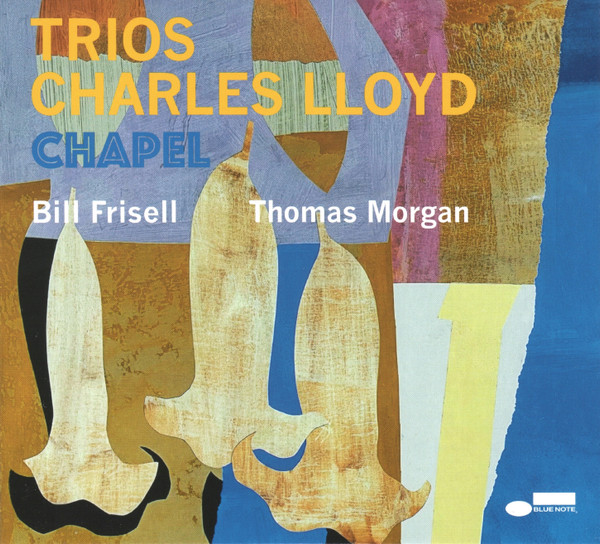
Trios: Chapel (Blue Note)
Charles Lloyd
Released September 27, 2022
Jazzwise Top 10 Releases of 2022
All About Jazz Best Jazz Albums of 2022
YouTube:
https://music.youtube.com/playlist?list=OLAK5uy_mrlRdtW7eeFBdZ_-yf-vjh69ZBv2UBV6s
Spotify:
About:
Charles Lloyd has long been a free spirit, master musician, and visionary. For more than six decades the legendary saxophonist and composer has loomed large over the music world, and at 84 years old he remains both at the height of his powers and as prolific as ever. Early on Lloyd saw how placing the improvised solo in interesting and original contexts could provoke greater freedom of expression and inspire creativity. And while he has recorded many classics of jazz in a piano, bass, and drums combination — the latest Passin’ Thru from 2017 — all the while he has been open to, and has searched for, alternative ways to frame his improvisational skills.
This has formed a fascinating counterpoint to his work with his quartet; a few examples might include his early days in Memphis when he regularly jammed with pedal steel guitarist Al Vescovo. Later, during his period as music director for the Chico Hamilton Quintet he used flute (and tenor), trombone, guitar, bass, and drums. More recently there has been an album in duet with drummer Billy Higgins, while the configuration of one of his current groups, The Marvels, has both guitar and pedal steel guitar with bass and drums.
As a sound seeker, Lloyd’s restless creativity has perhaps found no greater manifestation than on his latest masterwork, an expansive project that encompasses three individual albums that are connected by an overarching theme with each presenting him in a different trio setting—a Trio of Trios. The first, Trios: Chapel, features Lloyd with guitarist Bill Frisell and bassist Thomas Morgan. The second, Trios: Ocean, with guitarist Anthony Wilson and pianist Gerald Clayton. The third, Trios: Sacred Thread, with guitarist Julian Lage and percussionist Zakir Hussain.
It should come as no surprise that each of the configurations that feature in the Trio of Trios set involve a deft change of musical context. Borrowing author Antonio Di Benedetto’s apposite term, these trios of expectation open with the Chapel Trio, named after its inaugural performance in December, 2018, at Coates Chapel in San Antonio.
Frisell had already cemented his relationship with Lloyd as a charter member of The Marvels when he was invited by Lloyd to join him in a special concert at Coates Chapel on the Southwest School of Arts campus in San Antonio. Lloyd was already familiar with the acoustic properties of the chapel, and knew it would not support drums or percussion. He was also aware that Frisell had recorded in a duo context with Morgan, with whom he had developed a close musical rapport, and suggested they might all come together as a trio.
Recorded live, for a while it seemed as if the Coates concert would become maiden voyage and farewell tour all in one. The global pandemic brought the world to a standstill for the best part of two years, but in December 2021 the trio were reunited for a concert at the Pierre Boulez Saal in Berlin, suggesting they may continue to sprinkle their magic into the future. Even so, the Coates concert left an indelible impression on Lloyd, who later said, “Our first performance has always had a magical place in my memory bank.”
And magical it was. Opening with Billy Strayhorn’s “Blood Count,” originally a feature for the late Johnny Hodges with the Duke Ellington Orchestra, it is a performance that can only be described as heartfelt. Lloyd’s mother ran a rooming house in Memphis, and Lloyd’s childhood memories are filled with impressions of musicians from the touring big bands who stayed there — the Jimmie Lunceford Orchestra, and Duke Ellington’s Famous Orchestra especially. His memories of meeting Johnny Hodges as a youngster are particularly vivid. While the present thinks it knows it all, the past — here in terms of memories, dreams, and reflections — had a casting vote in shaping the destiny of this performance.
Frisell’s accompaniment is perfect for this trio setting; the essence of his unique sound signature lies less in what he does, more the manner in which he does it. He introduces “Song My Lady Sings,” a Lloyd original dating from 1966, allowing Morgan to share the foreground before Lloyd’s entrance outlining the graceful melody that mutates into a series of eloquent musical arabesques that culminate in a double-time coda and the realization this has been Lloyd’s finest performance of the song. “Ay Amor” is by the Cuban singer, songwriter, and pianist Bola de Nieve, born Ignacio Jacinto Villa Fernández (1911-71), who was a top cabaret singer and a composer fluent in many languages. His version of “Ay Amor” was recorded in Spanish as a rhapsodic lament. Lloyd obliquely acknowledges the composer’s intent in his exposition of the melody before re-imagining it in new contours, subtly implying the exotic in terms of melody and rhythm as he claims the song as his own.
The unspoken rule about the trio’s collective improvisation seems to be that no-one refuses what another proposes, so that “Beyond Darkness,” featuring Lloyd on flute, begins as a fractured melodic line, but as it is embellished, extended, and developed it grows into a pinnacle of dramatic possibilities, climaxed by a flute cadenza as coda. “Dorotea’s Studio” is the workspace of Lloyd’s partner and soul mate, Dorothy Darr. Introduced by Frisell, Lloyd’s exposition of the melody to an implied Latin rhythm is developed through a series of motifs, inversions, and inter-connecting phrases that are here, perhaps, richer and more varied, forming the basis of a graceful climax to a memorable concert.
If culture is devalued through overproduction, and a throwaway society is a sure sign of this, then this music, indeed this Trio of Trios, provides the perfect riposte — it is music that, quite simply, is enduring and will stand the test of time.
Track Listing:
1. Blood Count (Billy Strayhorn) 7:24
2. Song My Lady Sings (Charles Lloyd) 9:00
3. Ay Amor (Villa Fernandez Ignacio Jacinto) 7:20
4. Beyond Darkness (Charles Lloyd) 9:49
5. Dorotea’s Studio (Charles Lloyd) 12:20
Personnel:
Charles Lloyd: tenor saxophone, alto flute
Bill Frisell: guitar
Thomas Morgan: bass
Produced by Dorothy Darr and Charles Lloyd
Supervised by our Tone Poet, Joe Harley
Recorded live at Elizabeth Huth Coates Chapel, Southwest School of Art, San Antonio, TX, by Adam Camardella
Mixed by Dom Camardella
Mastered by Kevin Gray
Cover Art, Photos and Design: Dorothy Darr
Package Layout]: Meat And Potatoes, Inc.
Management: Dorothy Darr
Review:
Last year’s Tone Poem album by his Marvels band was always going to be a tough act to follow, being Jazzwise critics’ annual poll topper. But Lloyd, an elder reedsman-flautist with shamanic powers, hasn’t become one of jazz’s few remaining living legends by sitting on his laurels, even at 84. He shifts, by shades, yet astutely in a new direction for the first of three trio CDs to be released in 2022.Trios: Chapel is titled after Coates Chapel, San Antonio, the setting for the ‘live’ recording and sonically it’s of exceptional quality. The iconic contemporary guitarist Bill Frisell, a lynchpin of the Marvels, is the common denominator. The close relationship he and Lloyd have fostered is built on a shared musical DNA of homespun, black-rooted popular Americana and a certain spiritual, some might say spaced-out, vibe. It’s superbly grounded by the addition of the elegantly responsive bassist Thomas Morgan, a close collaborator of Frisell’s. The absence of drums is key to the recording’s airily intimate feel and the looser ties to guitar-led retro stylings. On an early Lloyd composition ‘The Song My Lady Sings’ Frisell adds a warm glow of country-ish standards-jazz guitar while Morgan’s jauntily walking bass motors things along; Lloyd wraps his horn amorously around Cuban Bola de Nieve’s ‘Ay Amor’ with Frisell playing out with something reminiscent of the iconic bolero-like guitar hook from ‘My Girl’. Saving the best until last though ‘Beyond Darkness’ sees Frisell in more garage-y downtown mood with Lloyd’s butterfly-like flute offering deep shade as well as light, and ‘Dorotea’s Studio’ dedicated to Lloyd’s artist wife Dorothy is a charming, playful diversion. Three is absolutely a magic number here.
Selwyn Harris (Jazzwise)