
Of the Near and Far (Pyroclastic Records)
Patricia Brennan
Recorded October 24, 2025
AllMusic Favorite Jazz Albums 2025
All About Jazz Best Jazz Albums of 2025
YouTube:
https://music.youtube.com/playlist?list=OLAK5uy_lYOyb0SGa4egWDAbawvJFPgGsinSx7mPc
Spotify:
About:
I’ve always been captivated by the night sky, endlessly wondering about what lies beyond. Amidst the vast expanse of stars, there is a sense of balance and symmetry that fascinates me—an order within the chaos. The innate patterns of the constellations sparked my curiosity, prompting me to explore how these celestial forms might be translated musically.
In the summer of 2024, I developed a process that allowed me to collect pitch and numerical data from constellations. I overlaid the shapes of constellations onto a circle of fifths, intrigued by whether the symmetry of the constellations could translate into musical symmetry—whether harmonic or melodic. The circle of fifths is already a highly symmetrical structure that organizes pitches in a sequence. By mapping the constellations’ shapes onto this circle, I discovered new relationships between pitches, chords, and even key signatures. These relationships emerged purely from the constellations’ symmetry, not from traditional music theory.
To my surprise, many of the pitch collections I gathered were harmonically consonant and “made sense” from a theoretical standpoint. The material I collected became raw material for my compositional process. Most of the pieces on this record are entirely based on the data I gathered, with each composition drawing from the unique patterns of the stars. I also explored the mythology behind each constellation—some well-known, others less so—but all rich with history and inspiration for generations of artists.
Since it was summer, I was naturally drawn to the constellations surrounding the Summer Triangle, often observing them through my telescope. Some of the constellations featured on this record share stars that form part of this iconic stellar pattern.
The five constellations explored on this record are: Antlia (The Air Pump), Aquarius (The Water Bearer), Andromeda (The Chained Woman), Lyra (The Lyre), and Aquila (The Eagle). Also included is a composition inspired by the essence of this work, rather than any specific constellation: “When You Stare Into The Abyss.” As part of the compositional process, I created two graphic scores: “Citlalli I” and “Citlalli II.” During the recording process, the ensemble improvised a version of each score, and this material was used to shape the electroacoustic track “Citlalli.”
The sonic palette for this record is inspired by my background in classical music and in new music, combined with the sonic possibilities of jazz rhythm section instruments. My musical education was shaped significantly by my roles in orchestras, percussion ensembles, and chamber music groups. My first professional job as a musician was as the timpanist for a state-funded orchestra in Mexico. This path led to other orchestral positions, eventually bringing me to the U.S.
Although I later shifted toward improvised music, I continue to draw inspiration from orchestral works, including compositions by Brahms, Debussy, Dvořák, Stravinsky, Copland, and more. As a percussionist, I had the opportunity to lead my own percussion ensemble and also explored contemporary chamber music. These experiences introduced me to groundbreaking composers such as John Cage, Karlheinz Stockhausen, and Paul Lansky. Additionally, I draw inspiration from the popular music that influenced me growing up, particularly rock bands and other groups from the mid-to-late 90s, most prominently Radiohead and Soundgarden.
The instrumentation of this ensemble reflects these inspirations. It features a jazz quintet—piano, bass, drums, guitar, and mallet percussion—along with a standard string quartet and also includes an electronic musician. The electronic components take on different roles throughout the record. Sometimes, they function as interstitial elements, while at others they take a more prominent role within a composition, adding another textural layer. On the track “Citlalli,” the electronics take center stage. The piece features improvisations by the ensemble members, based on the graphic scores of the same name. These improvisations merge into a single track, which is then electronically manipulated to create a new narrative.
Although the ensemble blends different styles and traditions, I wanted to treat it as a unified whole. Each instrument plays an indispensable role in the compositional fabric.
As on my previous records, I aimed to challenge conventional expectations of each instrument’s role and expand their sonic palette. For example, the strings might adopt a melodic role, which is more traditional, or they might take on a textural role, creating layers of sound. Ultimately, the sonic possibilities of the ensemble are shaped by the needs of each composition and my overall vision for this project.
As you listen to this music, I invite you to free your imagination and encourage you to look not only inward and upward, but also to seek the light of hope amidst the darkness of the abyss.
Patricia Brennan (Brooklyn, May 12, 2025)
Track Listing:
1. Antlia (Patricia Brennan) 07:31
2. Aquarius (Patricia Brennan) 07:31
3. Andromeda (Patricia Brennan) 04:00
4. Citlalli (Patricia Brennan) 04:19
5. Lyra (Patricia Brennan) 07:27
6. Aquila (Patricia Brennan) 07:13
7. When You Stare Into the Abyss (Patricia Brennan) 06:55
Personnel:
Modney: violin
Pala Garcia: violin
Kyle Armbrust: viola
Michael Nicolas: cello
Sylvie Courvoisier: piano
Miles Okazaki: guitar
Kim Cass: bass
John Hollenbeck: drums and percussion
Arktureye: electronics
Patricia Brennan: vibraphone with electronics, marimba
Eli Greenhoe: conductor
Produced by David Breskin
Recorded December 8 & 9, 2024 at Sear Sound, New York , NY, by Chris Allen
Mixed by Owen Mulholland at 35th Street Studio, New York, NY
Mastered by Scott Hull at Masterdisk, Peekskill, NY
Design & layout by Spottswood Erving and July Creek for Janky Defense
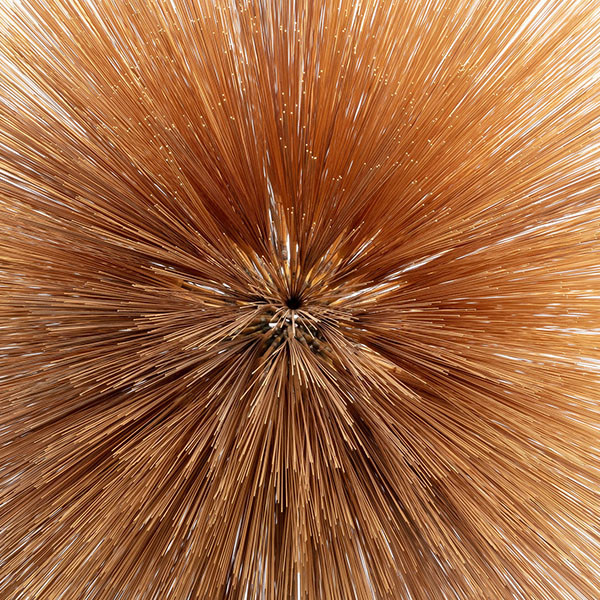
Sculpture photography by Kevin Todora. Sculptures by Harry Bertoia: Untitled (Sunburst), polished bronze wire and rod, 1960, 76”x 32”x 32”, Nancy A. Nasher and David J. Haemisegger Collection and Untitled (Dandelion) 1960s, 74”x 34”x 34”, gilded stainless steel, collection of Dr. Charles B. Key
Constellation notebook drawings by Patricia Brennan
This recording supported by a grant from The Shifting Foundation
Review:
Vibraphonist and composer Patricia Brennan spent a decade developing her chops as an improviser and composer with John Hollenbeck, Michael Formanek, Matt Mitchell, and Tomas Fujiwara. After her acclaimed 2021 solo album Maquishti she released 2022’s More Touch with drummer Marcus Gilmore, bassist Kim Cass, and percussionist Mauricio Herrera. Brennan had joined Mary Halvorson’s band and also worked with drummer Dan Weiss. 2024’s Breaking Stretch employed the quartet and trumpeter/electronicist Adam O’Farrill, revealing intricate compositions and deft collective improvisation. Of the Near and Far’s lineup offers a sextet and string quartet. The band is made up of Cass, who plays alongside drummer Hollenbeck, pianist Sylvie Courvoisier (Brennan’s Halvorson bandmate), guitarist Miles Okazaki, and electronicist Arktureye. The ensemble is conducted by Eli Greenhoe and produced by David Breskin.
A lifelong night sky obsessive, Brennan sought to explore how the constellations and celestial forms might translate musically. She developed a process that allowed her to collect pitch and numerical data from constellations. She overlaid their shapes onto a circle of fifths seeking possible symmetry between constellations and music. She discovered new relationships between pitches, chords, and keys. The album explores five constellations in individual titles, plus the electroacoustic “Citali” and the expository closer “When You Stare Into the Abyss.” In “Antila,” each musician plays distinct phrases that interlock, transforming them into a mesmerizing beat as Brennan and Okazaki exchange phrases that when collected, become compelling interpolations of the theme. Brennan’s solo employing descending chords creates an effect akin to a sonic kaleidoscope. The airy, ethereal “Aquarius” establishes a near ambient frame with gentle electronics, soothing piano, arco bass, and plucked strings. Cass, Okazaki, and Brennan add sublime cascading phrases before the guitarist and vibraphonist offer a mysterious motif leading the way in duo improv. The fleet-footed “Andromeda”emerges from a percussive center as bass guitar and drums channel indie rock as Brennan pushes band, sound, and form that illuminate harmonic undercurrents moving in different but simultaneous directions. “Citali” emerges from two distinct graphic scores. The band improvised a version of each before boiling them down into an electroacoustic configuration that loosely channels flamenco. “Lyra” commences with an 8+5 opening meter. It eventually settles into a chamber music-esque 3/4, offering lyrical counterpoint and striated harmonic consensus before resolving in a 4/4 with hovering guitar and strings. Courvoisier offers darker, edgier even funky harmonic coloring that is balanced in brightness by Brennan. To call “Aquila” kinetic is an understatement. In knotty interplay, Brennan and Okazaki spark and smolder before the string quartet balances them with buoyancy and exuberance. Closer “When You Stare Into the Abyss” employs a bed of ambient electronics creating space and tension. The rest of the band creates warm interrogation bordering on speech before the cinematic conclusion.
Despite the high quality of Brennan’s previous records, none quite match the vision, ambition, discipline, and creativity Of the Near and Far. It showcases her exceptional development as a conceptual composer, arranger, and soloist.
Thom Jurek (AllMusic)


