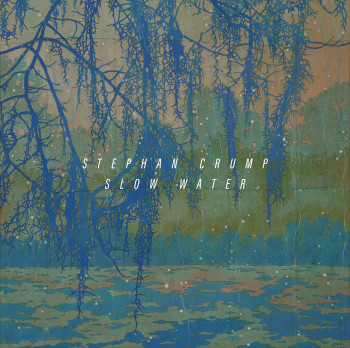
Slow Water (Papillon)
Stephan Crump
Released May 3, 2024
JazzTimes 2024 Year in Review
YouTube:
https://music.youtube.com/playlist?list=OLAK5uy_lpnOhdWbL3Gt2hmS9UGZyOYxiytPsPF1w
Spotify:
About:
We prefer to control our rivers—to dam them for power, to wall them with levees, to funnel them into canals or aqueducts to supply farm or city, to reroute them entirely to keep cities in good standing. It’s true for all bodies of water, really, from the ways we drain wetlands for housing or wall off the ocean for much the same. But most rivers of our world have been here much longer than our species; in extreme cases, they’ve run through the same channels for 2,000 times longer than we have walked the planet, fostering and feeding ecosystems for actual epochs. Water knows how to handle itself. Our dominion, though, has ruined or at least damaged its patterns, whether depleting groundwater, increasing pollution in waterways, or depriving adjacent land of the minerals that might make it fertile. We prefer to control our waters, and they, in turn, suffer in our hands.
All this has been on the mind of vaunted bassist and composer Stephan Crump for decades. He grew up near the banks of the Mississippi in Memphis, playing on, around, or in our Great (and wounded) River as a child. Other transformative experiences with other bodies of water followed: the Puget Sound off the coast of Washington, the wild Missinaibi beneath the Hudson Bay, the Onyar in Spain, the Gowanus Canal in Brooklyn, where he has lived for 30 years. He long contemplated a musical project that would honor those relationships with water, that would allow him to consider both his personal and our societal connections to that lifeforce.
His poignant and immersive Slow Water does exactly that. A continuous 67-minute piece rendered by a stellar sextet of new music and jazz ringers, Slow Water uses science, natural philosophy, and empathy to imagine the secret life that water leads, from its creatures and chemistry to its sense of near-magical motion. Crump’s work with Mary Halvorson, Tyshawn Sorey, Ingrid Laubrock, Vijay Iyer, and Borderlands Trio long ago confirmed his place at the vanguard of modern jazz. But the wondrous Slow Water, a piece that will lead you to reconsider your relationship with something that surrounds you, puts him in league with John Luther Adams, Wadada Leo Smith, and Ashley Fure, fellow composers who have given sound to the endangered glory of the natural gifts around us.
When Crump began researching this idea, the news wasn’t very good. He read report after report about those bodies of water he loved, mostly to find they were imperiled by the consequences of our control and choices. But then he stumbled upon Water Always Wins, a surprising 2022 book by science journalist Erica Gies that functioned as a kind of hopeful testimonial to water’s perseverance. Gies took a multidisciplinary approach to water, working with scientists, activists, and indigenous communities to understand how water, allowed to run its own slow course, could fend off drought and even sea-level rise. Crump read about beavers and how, left to build their dams, they once helped to create the abundance of arable North America. These lessons became instructions for Crump, both as a composer and ensemble leader: Allow the music to flow where it wants. Let it meander. Relinquish control. Create conditions, as he often says, for a “fertile wonderland.”
Crump methodically assembled a new group for Slow Water, choosing each member for fluidity and instinct. With the exception of sterling vibraphonist Patricia Brennan, he’d worked with the rest of the ensemble rarely or not at all: exploratory trombonist Jacob Garchik, empathetic trumpeter Kenny Warren, impulsive violist Joanna Mattrey, and inquisitive violinist yuniya edi kwon. Crump first through-composed eight pieces for this sextet, taking care to include space for each player to add their imprint. He also devised eight conceptual prompts—each based on assorted states of water—from which the group would compose spontaneously. That is, of course, Crump wanted both band and its pieces to flow together, to move as water would and to enable, as water also does, a larger ecosystem.
This surprising hour is full of delights and worries, of joys and anxieties. During “Bogged,” for instance, Crump and company seem to collectively marvel at the way water works, the ensemble oozing outward from the tune of Brennan’s melodic vibraphone and Crump’s steadying bass. “Eager” is industrious and charming, like the streamside workshops to which it is indebted, while “Euphotic” is a tizzy of motion and intersecting layers, a portrait of lively aquatic biomes. The instruments breathe as if through water during “Pneumatophore” and drift as if suspended in the slow, permanent motion of “Strata.” Crump typically works in smaller ensembles, and that shows in just how much textural, technical, and emotional range these six elements cover. You get the sense that you’re exploring a body of water from above and below, inside and out, learning the intricacies of how it exists and operates. It’s inspirational, even, this imaginative transcript of the life of the thing that lets us live in turn.
Slow Water is not blindly optimistic about the state of our world. If it seems to end with a flicker of hope, with harmonies twinkling softly through elegiac horns and strings that circle upward toward something different and new, that is less for us than for water. It was here before, and it will be here after, coursing through some of the same channels it has cut and navigated for nearly half a billion years. If only we could stop, understand, and internalize its lessons, just as Crump has on the remarkable Slow Water, a compelling testament to another way of being.
Track Listing:
1. Sound (Brackish) (Stephan Crump / Patricia Brennan / Joanna Mattrey / yuniya edi kwon / Jacob Garchik / Kenny Warren) 03:11
2. Bogged (Stephan Crump) 08:30
3. Strata (Stephan Crump / Patricia Brennan / Joanna Mattrey / yuniya edi kwon / Jacob Garchik / Kenny Warren) 03:45
4. Eager (Stephan Crump) 05:57
5. Hyporheic (Stephan Crump / Patricia Brennan / Joanna Mattrey / yuniya edi kwon / Jacob Garchik / Kenny Warren) 03:15
6. Dusk Critters (Stephan Crump) 06:14
7. Accrete (Stephan Crump / Patricia Brennan / Joanna Mattrey / yuniya edi kwon / Jacob Garchik / Kenny Warren) 02:00
8. Mire (Stephan Crump) 03:33
9. Pneumatophore (Stephan Crump / Patricia Brennan / Joanna Mattrey / yuniya edi kwon / Jacob Garchik / Kenny Warren) 02:21
10. Euphotic (Stephan Crump) 06:14
11. Fen (Stephan Crump / Patricia Brennan / Joanna Mattrey / yuniya edi kwon / Jacob Garchik / Kenny Warren) 02:36
12. Pooling (Stephan Crump) 04:34
13. Sediment and Flow (Stephan Crump / Patricia Brennan / Joanna Mattrey / yuniya edi kwon / Jacob Garchik / Kenny Warren) 02:51
14. Outflow (Stephan Crump) 04:34
15. Meiofauna (Stephan Crump / Patricia Brennan / Joanna Mattrey / yuniya edi kwon / Jacob Garchik / Kenny Warren) 00:50
16. Bend (Stephan Crump) 06:48
Personnel:
Patricia Brennan: vibraphone
Joanna Mattrey: viola
yuniya edi kwon: violin
Jacob Garchik: trombone
Kenny Warren: trumpet
Stephan Crump: acoustic bass
Produced by Stephan Crump
Recorded September 21-22, 2023, at Big Orange Sheep, Brooklyn, NY, by Chris Benham with Cat Evers
Mixed by Eli Crews at Figure 8 Recording, Brooklyn, NY
Mastered by Scott Hull at Masterdisk, Peekskill, NY
Cover Art is a detail from “Fugitive Sky” © 2023 Maysey Craddock
Design by Yesim Tosuner
This project was inspired by the book Water Always Wins, by Erica Gies, and the movement to redefine how we live with water in an era of rapid change.
It was made possible by support from The Shifting Foundation.
Review:
Memphis-raised, Brooklyn-based Crump was the Vijay Iyer Trio’s bassist for 20 years, branching out into deeper explorations of his instrument’s capacity in intimate outfits such as Secret Keeper, his duo with Mary Halvorson. Early days in the intensely competitive 1990s West Village jams scene confirmed his bass faith, as well as a dislike of guarded jazz egos and the hierarchy of bandleaders.
Slow Water harks back to childhood evenings by the Mississippi, and ponders water’s endemic abuse by humans and scientific hope that it will if necessary survive us, recovering from our civilisation’s temporary, poisonous bend in the river. As British waterways shockingly and visibly turn brown, this intricately plotted suite is variously inspired by bogs and beavers, insectile chitters and the euphotic zone where light penetrates water sufficiently for photosynthesis, the latter represented here by stabbing funk strings and miasmic swirls.
Crump’s compositions prompt contemporary classical and jazz players’ improv, with New Orleans-style brass warming modernist, staccato slashes, in an album which mirrors liquid bodies in its stratified sound, and brims with scholarly, idealistic ambition.
Opener ‘Sound (Brackish)’ coheres from the swamp which is this album’s natural habitat – a mysterious, prehensile zone, fertile and forbidding to humans. ‘Bogged’ begins with breaths of wind and pizzicato droplets of strings, the vibes tolling evenly as if representing nature’s resilience, till trumpet and trombone pierce then drolly sink into the murk. The brass drawls in ‘Eager’, absorbing the strings into its Louisiana languor. ‘Bend’ concludes with calm, melodic Americana recalling Copland, Crump’s bass coolly dancing as the brass becomes the music’s inviting, embracing voice. Jazz’s birth and endurance in the South’s swampy, sometimes deadly wetlands makes it the ideal redemptive vehicle for this hopeful finish, as the vibes pick out a soft, raindrop phrase, and the music sinks back beneath the water.
Nick Hasted (Jazzwise)