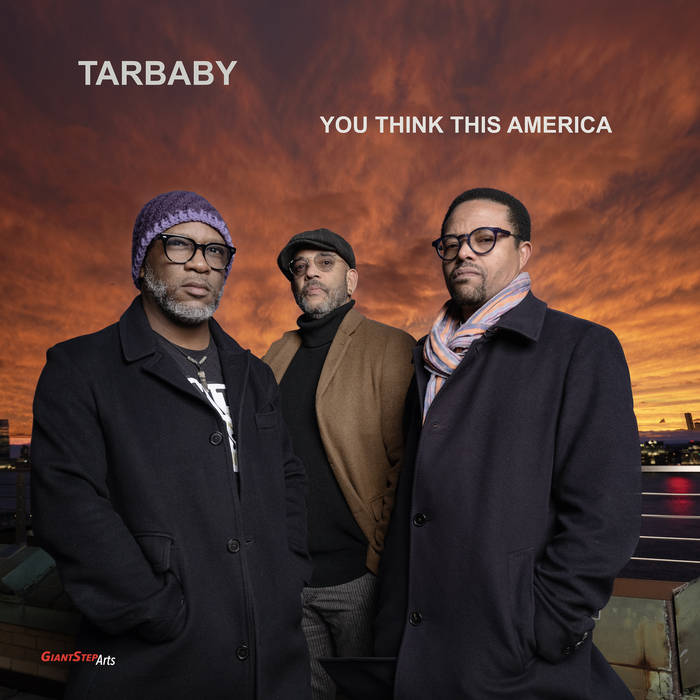
You Think This America (Imani Records)
Tarbaby
Released June 25, 2024
New York Times Best Jazz Albums of 2024
YouTube:
https://music.youtube.com/playlist?list=OLAK5uy_nwTxysG3leHeCfYNT2e1OOciQljK07JrQ
Spotify:
About:
The three members of Tarbaby – pianist Orrin Evans, bassist Eric Revis, and drummer Nasheet Waits – share a long history together, dating back to well before the formation of the trio. They share core beliefs about acknowledging the over-arching tradition of the music while being true to one’s own story; they’re an ensemble of serious intentions and riotous humor, fervid spirit and fierce intellect, passion and purpose. All of that melds and collides in their provocative and risk-welcoming sound.
The New York Times has hailed the trio as, “a strong postbop collective with plenty of moves at its command: advanced rhythmic calculus, sly harmonic implication, [and] cohesive elasticity.” Lucid Culture described Tarbaby as, “Intense, enigmatic, often very funny… Darkly melodic, fearlessly spontaneous and bristling with combustible energy.”
2024 will see two bold new releases from the eclectic power trio. For the first time in a career marked by collaborations, You Think This Is America marks the first time that Tarbaby has recorded an entire album strictly in piano trio format. Recorded live at New York’s Hunter College for photographer/engineer Jimmy Katz’s Giant Step Arts imprint, the confrontational date mixes originals with wide-ranging covers by Ornette Coleman, David Murray, Andrew Hill, Sunny Murray, and The Stylistics.
A yet-to-be-titled studio release will follow later in the year with a number of special guests: Philadelphia spoken word artist Ursula Rucker, the powerhouse tenor saxophonist JD Allen, the exploratory, tightrope-walking saxophonist Bill McHenry, and the pseudonymous “Prometheus Jenkins” (a few notes will suffice to identify the sax master behind the alias).
“The story has its roots in Africa and then traveled across the ocean – just like we did.” – Nasheet Waits, drums
“I don’t want to hug the tar baby.” – Tony Snow, White House Press Secretary 2006-07
Nearly two decades later, the controversy that greeted the late Tony Snow’s use of the term “tar baby” remains indicative of the uncomfortable discourse around race in the country – a point that, ironically, is well illustrated by the very metaphor that he unwisely chose. Co-opted as a racial slur, the term “tar baby” has its roots in a folk tale that depicts the wily Br’er Rabbit becoming increasingly mired in a tar dummy the more he struggles with it – a vivid depiction of the sticky discussions involving race in 21st century America.
Tarbaby fully intended every one of those associations to arise, in all of their uneasiness, combativeness and contradictions, when they decided to adopt the name for their collective trio. “We knew the name would be controversial and misconstrued, but that it would ultimately encourage some discourse. That intent took precedence over any notions of ‘commercial’ success,” says Revis.
The scare quotes that Revis places around the word “commercial” reflects the fact that such value judgments can be elusive, but it’s undeniable that all three bandmates have achieved considerable recognition and acclaim.
Evans has released more than 25 albums without the support of a major label, becoming the model of a fiercely independent artist while making a habit of rattling the jazz world’s confining cages. That determination has paid off in such accolades as a pair of Grammy nominations for his raucous Captain Black Big Band. His ever-expanding “Village” of collaborators has recently included the likes of Nicholas Payton, Kevin Eubanks, Immanuel Wilkins and Kurt Rosenwinkel, among others.
In addition to manning the bass chair in Branford Marsalis’ revered quartet since 1997 (scoring a Grammy in the process), Revis has also recorded eight brilliant and wildly diverse albums as a leader, teaming him with visionary artists like Jason Moran, Ken Vandermark, Kris Davis and Andrew Cyrille, and appeared on the soundtracks to the Netflix features Ma Rainey’s Black Bottom and Rustin.
Waits, whose mentors include such pioneers as Max Roach and his esteemed father, percussionist Freddie Waits, has propelled such era-defining ensembles as Jason Moran’s Bandwagon, Andrew Hill’s bands and the Fred Hersch Trio. More recently he’s been an integral part of bands led by two renowned bassists: Christian McBride’s adventurous New Jawn and Dave Holland’s New Quartet with Kris Davis and Jaleel Shaw.
Tarbaby’s self-titled 2008 debut on Imani was recorded as a quintet with saxophonists JD Allen and Stacy Dillard and vocalist TC III. Their 2010 follow-up, The End of Fear (Posi-Tone), invited trumpeter Nicholas Payton and iconic saxophonist Oliver Lake into the fold. The latter has remained a frequent collaborator, returning alongside trumpeter Ambrose Akinmusire for 2013’s Ballad of Sam Langford (Hipnotic), for Fanon (Rogue Art) in 2014 with guitarist Marc Ducret, and for 2022’s Dance of the Evil Toys (Clean Feed) with trumpeter Josh Lawrence.
On stage, creative partners have also included poet Sonia Sanchez and saxophone legend David Murray, while inspiration has come from sources as far flung as Don Cherry, Fats Waller and Bad Brains.
“We’re just three cats that believe there are certain truths to this music that should be held sacred.” – Orrin Evans, piano
Tarbaby didn’t set out to become a band. It arose from a conversation, one that in many ways had been going on for decades and continues to this day. That dialogue centers on the respect, or lack thereof, with which “jazz” (in these discussions, that word is often voiced tenuously if at all) is regarded by those who claim to uphold its traditions. The music’s origins are a key factor, especially as they are so intimately tied to uncomfortable facts that many, even those who reap its benefits, would prefer to ignore.
“There are aspects of American history that are intertwined with the music that we play that most people don’t want to touch,” Waits asserts. “That’s the function the Tar Baby plays in that story: initially Br’er Rabbit doesn’t want to touch the Tar Baby, and when he finally does he can’t shake it off.”
Track Listing:
1. Dee Dee (Ornette Coleman) 4:07
2. Mirror Of Youth (David Murray 5:47
3. Red Door (Orrin Evans) 7:29
4. Blues (When It Comes) 6:50
5. Reconciliation (Andrew Hill) 6:00
6. Betcha By Golly Wow (Linda Creed / Thom Bell) 2:57
7. Kush (Nasheet Waits) 4:52
8. Nobody Knows When You’re Down And Out (Jimmy Cox) 5:54
9. Comme Il Faut (Ornette Coleman) 5:34
10. Treetops (Sunny Murray) 4:46
Personnel:
Eric Revis: bass
Nasheet Waits: drums
Orrin Evans: piano
Recorded live August 15 & 16, 2022, at Ida K. Lang Hall at Hunter Collage NYC, by Jimmy Katz with James Kogan
Mixed & Mastered by Jimmy Katz and Dave Darlington
Photography & Design: Jimmy & Dena Katz
Review:
The pianist Orrin Evans, the bassist Eric Revis and the drummer Nasheet Waits have each been indispensable to 21st-century jazz, both as bandleaders and sidemen. But despite a near-20-year history, their collective trio, Tarbaby, has flown under the radar. With “You Think This America,” the first Tarbaby album without any additional musicians, they stake their claim as an elite group capable of conveying the most guileless tenderness (on a version of the Stylistics’ “Betcha by Golly, Wow”), the deepest blues feeling (on the 1920s standard “Nobody Knows You When You’re Down and Out”) and the hippest sort of post-bop looseness (on the Evans original “Red Door”). They did it all while cultivating a refreshingly non-hierarchical approach, where moment to moment each member has an equal sonic stake.
Hank Shteamer (New York Times)