
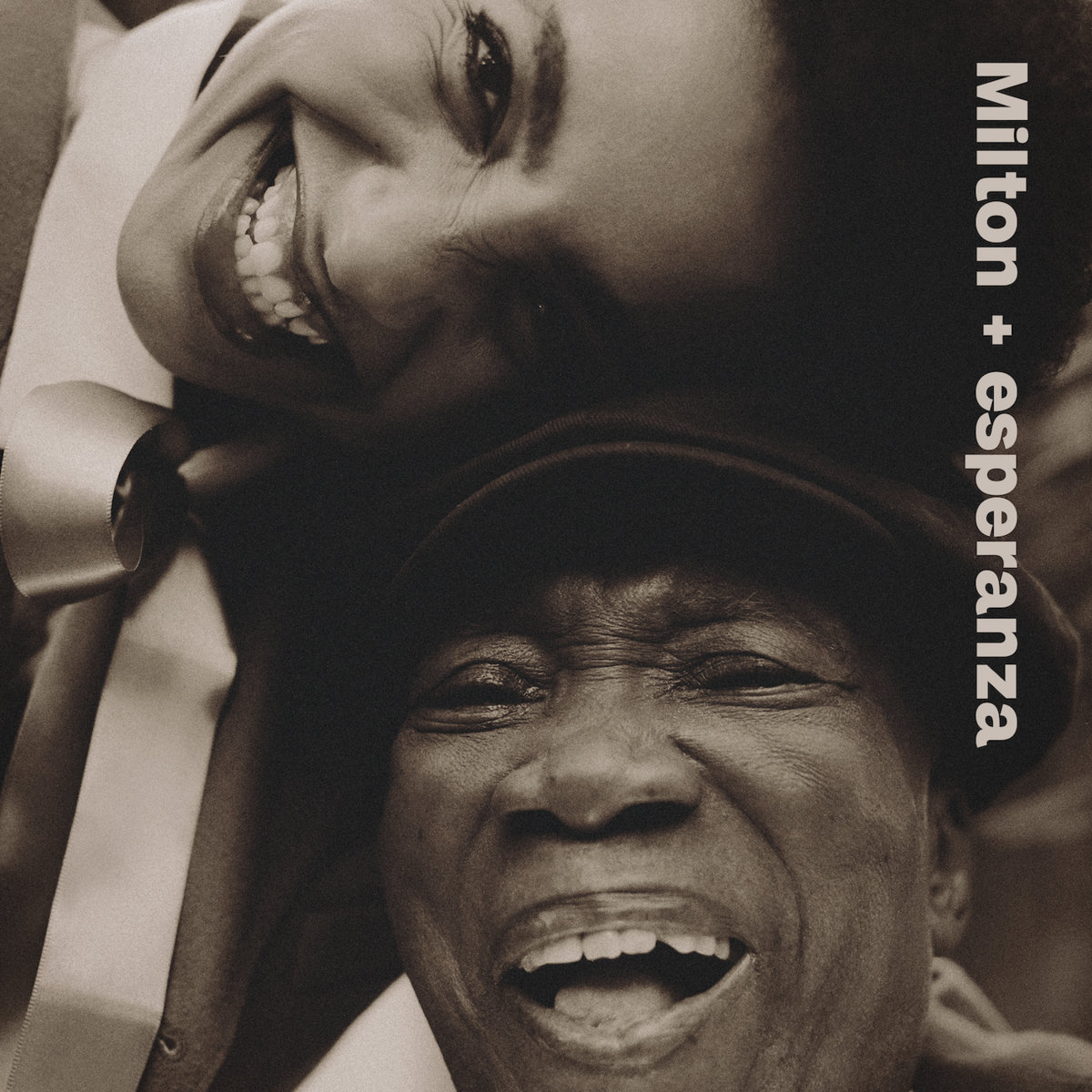
Milton + esperanza (Concord)
Milton Nascimento / esperanza spalding
Released August 9, 2024
Grammy Nominee for Best Jazz Vocal Album 2025
Jazzwise 10 Best New Jazz Albums of 2024
AllMusic Favorite Jazz Albums 2024
All About Jazz Best Jazz Albums of 2024
YouTube:
https://music.youtube.com/playlist?list=OLAK5uy_lQ7SDq7MGxxJvTZesd82mkypu1SKLBIuk
Spotify:
About:
For years, esperanza spalding dreamed about making music with Milton Nascimento, the revered Brazilian singer-songwriter. spalding first heard Nascimento as a student at Berklee College of Music, in Boston, in the early 2000s. The evening lives vividly in her memory. Crammed into her bedroom in the apartment she shared with four other musicians, she hosted a group of friends from Brazil for a dinner of inexpertly made sushi rolls. One of them put on Native Dancer, Nascimento’s collaboration with saxophonist and composer Wayne Shorter, released in 1975. The first sound on the album is Nascimento’s otherworldly falsetto, accompanied by gentle piano. “I get chills even thinking about it,” she says now. The music is pastoral, beatific; but she recalls feeling almost angry: “How could I have not known about this before?”
Milton + esperanza, out on August 9 (Concord Records), is the moving culmination of spalding’s long-held admiration. A mixture of classics from Nascimento’s catalog, new songs from spalding, and covers from other artists, including The Beatles and Michael Jackson, the album is a portrait of their creative relationship. “Ninety percent of things I write,” she says, “I’m thinking of him. I’m thinking of his voice. I’m imagining singing it with him. He’s a very present part of my creative imagination.” But, she clarifies, that doesn’t mean she’d gone so far as to imagine a collaborative album; that existed beyond her fantasies.
The seeds of their connection were planted by Herbie Hancock, who first told Nascimento about spalding’s music. The endorsement primed Nascimento to accept the invitation to duet on the “Apple Blossom,” from spalding’s 2010 album Chamber Music Society, and in that recording session they acknowledged an affinity (once upon a time, Nascimento played bass in a jazz trio when he was a teenager) and fondness between them. They shared the stage together the next year, at the annual Rock in Rio festival, and from then on, any time she traveled through Brazil, she would try to stop in at Nascimento’s home in Rio De Janeiro to jam and talk. That might have been the whole story, had it not been for Nascimento’s son suggesting, out of the blue, that spalding produce a record for his father. This was at a bar in 2022, after one of the performances on Nascimento’s farewell tour, and she felt “sideswiped.” This golden opportunity was here—and the clock was already running. Because of the tour, Nascimento’s son explained, Milton’s voice was in particularly good shape, so it would be best to begin as soon as possible.
She set to work, recalling words from one of her other elders, Wayne Shorter, whom she has collaborated on the opera Iphigenia with. “A few times Wayne had said to me, ‘You got to keep some of what you don’t want, so that nothing’s wasted.’ And I didn’t want the element of feeling pressed for time.” But of course she pressed forward.
The album opens with Nascimento and spalding in conversation; he recalls waking from a dream to music. What follows is a dream realized. “Cais,” from Nascimento’s expansive, Beatles-inspired masterpiece Clube Da Esquina (1972), is the first song proper, and if the listener had any doubts about the strength of the 81-year-old’s voice, all concerns are set aside by the colossal note spalding and Nascimento hold together midway through the performance. Across the album’s 16 songs and interludes, the contrasting textures between their voices evokes exquisite poignancy; you can’t help but reflect on the passage of time, why art endures, and the indefatigable spirit of human creativity.
Joined by her core band of Matthew Stevens (guitar), Justin Tyson and Eric Doob (drums), Leo Genovese (piano), Corey D. King (vocals, synths), spalding and Nascimento together reimagined five of his beloved songs, along with four spalding originals, and covers from The Beatles, Michael Jackson, the Brazilian guitarist Guinga, and Shorter. Though she did some arranging and other work in the States, much of the recording happened in Rio; authenticity and connection are crucial to the project.
“Outubro,” from 1969, is the oldest song of Nascimento’s on the album, and like “Cais” it’s another towering entry in his catalog. (It’s also one of spalding’s personal favorites; she says that just recording those two songs would have been enough to leave her satisfied.) From Nascimento’s album Courage, “Outubro” is one of his most emotionally forceful songs. The narrator of the song describes feelings of loneliness and despair, but chooses to search for love and reawaken a new desire for life anyway. As a duet, the song soars and unfurls, with an extended outro that features brilliant flute playing from Elena Pinderhughes.
Nascimento’s influences are many, but he has long drawn inspiration from the Beatles and the natural world. Thus, they boldly reinterpret “A Day in the Life” as well as Michael Jackson’s apocalyptic warning “Earth Song” on Milton + esperanza. The fab four were in their 20s when they recorded the magisterial, experimental closing number of Sgt. Pepper’s Lonely Hearts Club Band, and hearing it from Nascimento at this stage in his life gives it renewed import. “Earth Song,” with its images of ecological disaster and children killed during war, is as timely as ever, a harrowing account of a planet on the brink.
Paul Simon drops in for a duet (“Um Vento Passou”), along with the Brazilian guitarist Guinga (“Saci”), the American jazz vocalist Dianne Reeves (“Earth Song”), British vocalist Lianne La Havas (“Saudade Dos Aviões Da Panair”), Shabaka, and Carolina Shorter, Wayne’s wife, among others. The album concludes with a cover of Shorter’s stunning “When You Dream,” bringing the album back to where it began, by dwelling in possibility and the unconscious. It is a stunning, satisfying piece of work.
spalding can conjure Nascimento’s home, where most of his vocals were recorded, from memory. Outside the three-tiered home, in the courtyard, is a small outdoor amphitheater outside, named for Shorter; inside, on the main floor, you pass by a portrait of Nascimento as a child, dressed in a clown suit (“Adorable,” spalding says), before arriving at the grand piano. When working on the project, she would sometimes arrive while Nasicmento was doing physical therapy or resting; making this album a success required understanding Nascimento’s life and schedule as an octogenarian. “His ideal recording day would be: watch novelas from 8 a.m. to 3 p.m., record for an hour and a half, then go back to watching novelas,” she says, laughing.
Working with her engineer, they even set up recording equipment in the room where he liked to watch television. “The only way I could have made the album more authentic is if I had included an excerpt of his favorite novela theme songs.”
“In ways I did choose and did not choose, my life has brought me into close proximity and care and collaboration with elders,” spalding explains. She is the rare artist who has successfully made art with a number of the elders who came before her.
She’s possessed this inclination since she was a child. “My mother used to work in adult foster care homes,” she says, “and I was homeschooled at that time, so I would hang out with elders all day long, other people’s grandmas and grandpas. It was weird, wonderful, and incredible. I found that it’s a joy to be kicked out of my preference for relating, and get into another being’s rhythm. Yes, I’ve heard this story six times, but on the sixth time, I’ve heard something I hadn’t heard before, and it means something different today.”
More than celebrating Nascimento’s gifts and long artistic journey, Milton + esperanza is a warmly considered argument for connecting with our elders. It does not shy away from how discursive conversation can be with our elders, making room between songs for spoken recollections and wisdom from Nascimento; it gazes with love at how age changes the body, capturing his voice as it is now, without using studio technology to smooth out any perceived imperfections or stretch it beyond its current ability. The album invites you to spend time with a person who is a repository of knowledge—80-plus years of lived experience exists in his mind and voice. Milton + esperanza shares this simple miracle with you. It models for the listener a tender embrace of mentor and disciple, each gazing with mutual admiration towards what’s come before, and the future of music ahead.
Track Listing:
1. The Music was there (Justin Tyson) 00:57
2. Cais (Milton Nascimento / Ronaldo Bastos) 03:41
3. Late September (Esperanza Spalding) 01:26
4. Outubro (Milton Nascimento) 05:17
5. A Day in the Life (John Lennon / Paul McCartney) 04:36
6. Interlude for Saci (Corey D. King) 01:41
7. Saci (Guinga / Paulo César Pinheiro) 03:29
8. Wings for the Thought Bird (Esperanza Spalding) 03:06
9. The Way You Are (Esperanza Spalding) 00:43
10. Earth Song (Michael Jackson) 06:42
11. Morro Velho (Milton Nascimento) 05:15
12. Saudade Dos Aviões Da Panair (Conversando No Bar) (Milton Nascimento / Fernando Brant) 05:24
13. Um Vento Passou (Para Paul Simon) (Milton Nascimento / Márcio Borges) 04:36
14. Get It by Now (Esperanza Spalding) 02:24
15. outro planeta (Justin Tyson) 02:06
16. When You Dream (Wayne Shorter / Edgy Lee) 09:26
Personnel:
Milton Nascimento: vocals
Esperanza Spalding: bass, vocals, producing, liner notes
Justin Tyson: drums, additional vocals
Eric Doob: drums
Leo Genovese: piano
Corey D. King: vocals, synths
Matthew Stevens: electric guitar (2, 4, 5, 7, 9, 10, 13, 14, 16), background vocals
Shabaka Hutchings: saxophone (3), flute (6, 12, 13)
Guinga: guitar (7)
Elena Pinderhughes: flute (8)
Dianne Reeves: vocals (10)
Lianne La Havas: vocals (12)
Maria Gadú: vocals (12)
Tim Bernardes: vocals (12)
Lula Galvão: guitar (12)
Kainã Do Jêje: drums (12)
Ronaldinho Silva: percussion (12)
Paul Simon: vocals (13)
Carolina Shorter: vocals (16)
Orquestra Ouro Preto
Rodrigo Marques Toffolo: conductor
Lucas Martins de Barros dos Santos, Glaikson Luiz Marques Nogueira, Victor Alves Rocha, Rodrigo de Oliveira, Mara Reis Toffolo, Márcio José Vale Valladão, Mariana Alves Furtado, Mariana Pardinho Reis, Marina Reis Toffolo, Leonardo Lobão Lacerda, Rodolfo Marques Toffolo, Sara Oliveira Alves, Wesley Prates Lima, Wagner Mateus Pereira de Oliveira, Daniel Fernandes Mendes Junior: violin
Kamila Anna Druzd, Katarzyna Marta Druzd, Marcos Paulo Gonçalves de Amorim, Gabriel Teodoro de Andrade: viola
Breno Cruz, Camilla Cristina Ribeiro Santos Lima, Robson Fonseca Ferreira, Talitha Debora Gomes Marinho: cello
Andre Geiger, Pablo Eduardo Guinez Vergara: acoustic bass
Recorded in 2023, in Rio de Janeiro, Brazil
Producer, Arranger and Executive-Producer: esperanza spalding
Additional Producers: Leo Genovese, Matthew Stevens, Justin Tyson, Corey D. King, Arthur Luna, Eric Doob,
Recorded by Arthur Luna
Additional Recording by Fernando Lodeiro and William Luna Jr.
Assistant Engineers: Raphael Rui Castro, Enzo Menegazzi
Mixed by Fernando Lodeiro
Mastered by Oscar Zambrano
Assistant Mastering Engineer: Piotr Garbaczonek
Associate Producers: Héloïse Darcq, Augusto Nascimento, Arthur Luna
Package Design: LADdesign, Lawrence Azerrad Inc.
Photography by Pedro Napolinário, Reva Santo, Lucas Nogueira, Goathi Diniz
Creative Director: Khaleb Brooks
Review:
Esperanza Spalding and Milton Nascimento mark their 15-year friendship on their sublime 2024 collaboration Milton + Esperanza. Spalding, an acclaimed singer and bassist, was first introduced to Nascimento by Herbie Hancock when she was visiting Brazil in the 2000s. She had long appreciated the Brazilian legend’s work, steeped as it is in folk, jazz, and the homegrown MPB that he helped to define in the ’60s and ’70s. Out of their initial meeting came Nascimento’s guest appearance on Spalding’s Grammy-winning album Chamber Music Society in 2010. Musically, Spalding has long evinced the influence of artists like Stevie Wonder and Wayne Shorter. Both of those artists also serve as comparable touchstones for Nascimento, who famously collaborated with Shorter on their classic 1974 album Native Dancer. Similarly here, Spalding and Nascimento are kindred musical spirits, dueting on almost every track; her bright vocal smile a perfect foil for Nascimento’s hushed baritone; one that’s only gained subtle textures over the decades. 81 years old at the time of recording, Nascimento had already embarked on a farewell tour when he decided to join Spalding in the studio, and their work together often feels like a celebration of his life. Produced by Spalding, the album features potent instrumental backing from her group with guitarist Matthew Stevens, pianist Leo Genovese, singer and keyboardist Corey King, and drummers Justin Tyson and Eric Doob. There are also vibrant contributions by singer/flutist Elena Pinderhughes, singer Lianne La Havas, Brazil’s Orquestra Ouro Preto, percussionists Kainã Do Jêje and Ronaldinho Silva, and guitarists Lula Galvão and Guinga, among others. We get ebullient readings of fan favorite Nascimento songs like “Outboro” and “Cais.” Spalding also contributes “Wings for the Thought Bird” and “Get It by Now,” ambitiously melodic and poetic Baroque jazz-pop songs that nicely evoke the sun-baked and far-eyed lyricism of Nascimento’s classic albums. Adding to this sense of warm appreciation are a handful of guests, including Paul Simon who jumps on board for a heartfelt duet with Nascimento on “Um Vento Passou,” singer Dianne Reeves on a bittersweet cover of the Beatles’ “A Day in the Life,” and Carolina Shorter (Wayne Shorter’s widow), who joins in on a lyrical and poignant nine-minute rendition of “When You Dream” off Shorter’s Atlantis. At the center of all this are Nascimento and Spalding, whose smiling interplay helps make Milton + Esperanza feel like both a capstone to a monumental career and continuation of a musical legacy.
Matt Collar (AllMusic)


