
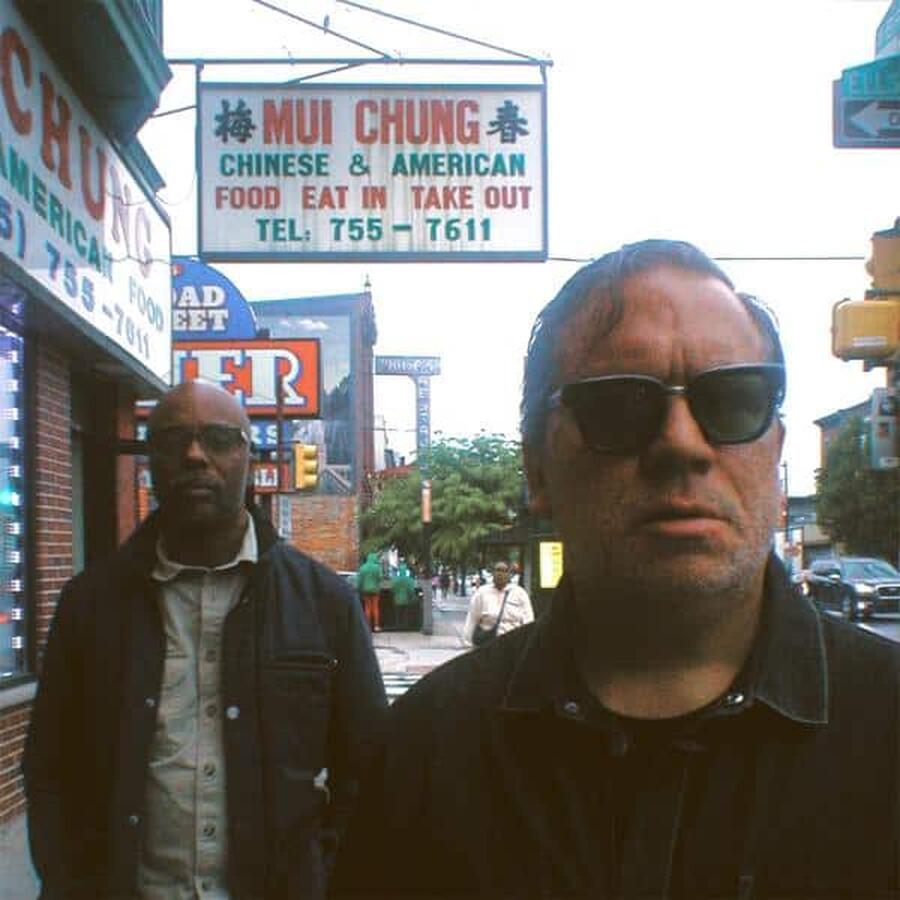
Hyperglyph (International Anthem)
Chicago Underground Duo
Released August 15, 2025
AllMusic Favorite Jazz Albums 2025
YouTube:
https://music.youtube.com/playlist?list=OLAK5uy_lFsqFG4maeZn4RlzESW3awe5pbxy0DJQ0
Spotify:
About:
Chicago Underground Duo is the long-running collaborative project of composer/trumpeter/electronicist Rob Mazurek (Exploding Star Orchestra, Isotope 217, New Future City Radio with Damon Locks) and composer/drummer/mbiraist Chad Taylor (jaimie branch’s Fly or Die, Marshall Allen’s Ghost Horizons, Luke Stewart’s Silt Trio). Hyperglyph is their first album in 11 years, and 8th in the absolute cabinet of wonders that is the Chicago Underground Duo.
The pair have played music together in a multitude of formations over nearly three decades, including their ongoing partnership in Mazurek’s large-format-skyward-expressionism vehicle Exploding Star Orchestra, in the expanded Chicago Underground Trio & Quartet (with guitarist Jeff Parker), and in a plethora of other assemblages. The early albums by the Duo have proven to be embryonic blueprints for the avant-jazz / electronic / indie rock hybridizations of the time, making them majorly important moments in the articulation of the “jazz” dimensionality of the then-burgeoning “post rock” sound. That sound, of course, was being transmitted far and wide due to the success of these groups as well as Mazurek’s Isotope 217 project with Jeff Parker, and the Chicago Underground’s frequent collaborators in Tortoise.
But the sounds being created by this extended family are and were far from static. Just as most of the still-working artists born of that Chicago era have evolved, reconfigured, and grown, Chicago Underground Duo has undergone a number of musical moltings, with the project always in the background of disparate individual aural investigations — always an option, always an outlet. As the project drops off and picks back up, the concurrent personal evolutions of Mazurek and Taylor make the Duo a true reflection of their own lives and friendship.
“Rob is my longest collaborator and also one of my best friends,” says Taylor, who first performed with Mazurek at a club in Chicago in 1988, aged 15.
“When it feels right we do it,” says Mazurek of the gaps in duo activity. “We have worked together and have been friends for a long time. This creates a kind of continuity not only in the music, but in our lives.”
Musically, there are certainly internalized nods here to AACM composers like Wadada Leo Smith, or albums like Don Cherry & Ed Blackwell’s “Mu” and El Corazon, but the songs of Hyperglyph exemplify Mazurek and Taylor’s individualities while also addressing another longtime influence on the Chicago Underground Duo sound — the Father, Son, and Holy Ghost of extreme studio editing in jazz-adjacent music, Miles Davis and Teo Macero’s Bitches Brew, In A Silent Way, and Get Up With It.
“Post production has always been a big part of our process,” says Taylor.
“Sometimes it just flows and we one-take a thing,” Mazurek elaborates. “Other things take time to ferment. We hit those hard in the post production.”
International Anthem engineer Dave Vettraino was indispensable as part of this process, recording and mixing the entire album at IARC HQ in Chicago. “We are very open and free in the studio,” says Mazurek. “Working with Dave is a joy because he is so intuitive and open with his approach as well. We can try anything with him. In this way it is more like a trio than a duo.”
Couple this trio’s take on the now classic cut-and-recut production techniques of Davis/Macero with Mazurek and Taylor’s longtime interest in deep electronic sounds (think Bernard Parmegiani, Morton Subotnick, Xenakis, Eliane Radigue, Plux Quba), transformative processing (think Autechre, King Tubby, Mouse On Mars, Carl Craig) and we can finally get close to understanding just where the duo lands in this lineage — this ongoing narrative each individual finds themselves in whether they see it or not. The Chicago Underground Duo, it seems, sees it.
While the musical language of Mazurek and Taylor can certainly be clocked in the slew of projects that they participate in together, the sound of a Chicago Underground Duo album is singular among them. Hyperglyph is no exception and could even be considered a distillation of that intuitive yet complex sound. A key can be found in the title of the album itself: highly complex geometric structures which can seem overly complex at first but, when thousands are arrayed in 3D space and with user training and adaptation, can significantly enhance perception and information assimilation and lead to new knowledge and insights.
The album opener “Click Song” kicks off with a blown-out horn chant from Mazurek, doubled by tuned bells and nestled into a muscular and symmetrical stereo-overdubbed polyrhythm from Taylor. Synthesized bass pulls our ears along cyclically, dropping in and out to almost severe dynamic effect while Mazurek and the subtle-yet-persistent bells elaborate upon the melody before ultimately departing from their repetitive psalm in favor of improvisation. It’s all held together by the steady, deep, chest-thump boom of Taylor’s kick drum pattern.
“There has always been a lot of African influence in the rhythms we play,” says Taylor. “With this record, specifically, we utilize rhythms from Nigeria, Mali, Zimbabwe, and Ghana.” Taken as a whole, spiritually, this introductory three-minute stomper lives somewhere between a Tuareg wedding and the most hypnotic moments of the click songs of Northern Africa.
Title track “Hyperglyph” follows, and begins with a chromatic moving harmony played by Mazurek on the RMI electric piano, an instrument famously utilized on Miles Davis’ groundbreaking Filles de Kilimanjaro. The vibe here, though, is one of unyielding, trancelike repetition. The trumpet introduces the time, with Taylor’s chunky smacking rhythm hitting hard from the get go. Eventually, the tune undergoes a transformation, with the back and forth of melody and rhythm hitting a fever pitch. A pitch-shifted trumpet becomes a New Orleans march baritone. Dennis Bovell-style dub sounds enter (or, maybe, reveal themselves) at the start of the song’s final movement, followed by wordless incantations. Swelling and saturated, the track sounds as if it’s about to tear itself apart. Static pulsing merges and overtakes the recorded percussion to present a new rhythm of hissing electronics — the harnessed wailing of the unleashed ghost in the machine. A spiritual awakening from the bowels of the earth.
“Hemiunu”, a Chad Taylor composition, is a waltz based around a simple piano figure repeated throughout. A folk melody from anywhere, the kind that’s been in the air for as long as anyone can remember. One might imagine the melody played clawhammer on an Appalachian afternoon, bowed somberly on the Chinese erhu, or hummed nonchalantly on the factory line. From the jump, Taylor’s percussion threads itself into the sound of a well-worn upright piano as the high register is haunted in wide stereo by that roiling RMI electric piano in octaves, alternately dubby and harplike. Enter Mazurek with another folk-like melodic phrase. Pause. Again. Pause. Leaving room for the now densely waltzing bouquet to bloom before diving deep into laser-sharp Lee Morganesque territory with a wildly vibrating high trumpet cry, but with a tone Mazurek owns completely.
The deeper reference for Mazurek’s most untethered emotional playing is his late friend and mentor Bill Dixon, an extraction most apparent in the three-part “Egyptian Suite.” At the start of part one (“The Architect”) a cyclical pattern from Taylor becomes a bed for Mazurek’s repeating, descending, synthetic-Egyptian scaled theme. This call to action dissolves into the second movement, “Triangulation of Light,” where Taylor’s bowed cymbals set the stage for an exploration of microtonal color with and against the occasional joining and un-joining of tones that stretch the frequencies to their limits from Mazurek’s open and half muted trumpet. Like a tornado siren in the distance, breaking through the membrane of storm clouds on the horizon, in search of another siren.
The third and final movement, “Architectonics of Time,” announces itself with free rolling swaths of percussion from Taylor à la Robert Frank Pozar’s mind-bending percussion on The Bill Dixon Orchestra’s classic Intents and Purposes. Here, though, the lineup is limited to two, with no overdubs or post-production. Taylor’s singular style and Mazurek’s tonal painting coalesce into a maelstrom of intervallic tone and beat before the final repeat of the lead melody from the suite’s first movement. It truly feels like reaching the summit. It’s pure and free duo interaction, the symbiosis of 30 years.
“Succulent Amber,” the final track on Hyperglyph, could fit just as easily on side two of Autobahn. After a brief modular synth-induced pan-harmonic melody shift, a steady kalimba is joined by the gentle intermittent raindrop-melodicism of the RMI electric piano in this understated final duo performance, unadorned by further studio arrangement. It’s a full-on comedown moment after the intensity of “Egyptian Suite,” though rather than winding down or petering out, here the Chicago Underground Duo still manage to point toward some kind of incoming mystery with four sudden-yet-patient ascending chords on the low-register of the RMI electric piano just before the curtains close. The piano notes end on a leading tone, leaving the resolution to the listener.
Once we’ve climbed the mountain, they remind us, we have to deal with what’s on the other side.
Track Listing:
1. Click Song (Rob Mazurek / Chad Taylor) 03:02
2. Hyperglyph (Rob Mazurek / Chad Taylor) 04:51
3. Rhythm Cloth (Rob Mazurek / Chad Taylor) 01:14
4. Contents of Your Heavenly Body (Rob Mazurek / Chad Taylor) 02:40
5. The Gathering (Rob Mazurek / Chad Taylor) 07:06
6. Plymouth (Chad Taylor) 01:42
7. Hemiunu (Chad Taylor) 05:08
8. Egyptian Suite, Pt. 1: The Architect (Rob Mazurek / Chad Taylor) 03:42
9. Egyptian Suite, Pt. 2: Triangulation of Light (Rob Mazurek / Chad Taylor) 05:19
10. Egyptian Suite, Pt. 3: Architectronics of Time (Rob Mazurek / Chad Taylor) 03:41
11. Succulent Amber (Rob Mazurek / Chad Taylor) 03:26
Personnel:
Chad Taylor: drum kit, percussion, Mbira, Kalimba
Rob Mazurek: trumpet, piccolo trumpet, RMI electric piano, modular synths, samplers, voice, flutes, bells
Recorded May 6th-9th and September 25th-27th, 2024, at International Anthem Studios, Chicago
Engineered & Mixed by Dave Vettraino
Sequenced by Scott McNiece
Mastered by David Allen
Front cover photo by Mikel Patrick Avery
Design by Aaron Lowell Denton
Review:
Multi-instrumentalists, improvisers and electronicists Rob Mazurek and Chad Taylor have been playing together since 1994, inside and outside their Chicago Underground Duo project. The 11-track Hyperglyph marks their International Anthem debut, and their first outing in 11 years. With engineer Dave Vettraino assuming the role of a Teo Macero-esqe presence in the studio, these men — always creative in recording situations–employed the recording studio as an instrument. Post-production, always as an important part of their process, is on another level here.
On opener “Click,” Taylor’s drumming offers evidence of his many years studying African music and its percussion techniques. Mazurek’s multi-tracked trumpet is playful and strident; his playing echoes Don Cherry’s, one of his primary influences. It segues into the title cut, with layered electric piano, muscular trumpet, triple-tracked percussion, and atmospheric urgency. They give way to a synth bass breakdown before the pair engage in furious improvisation and chanting. Taylor seldom plays this aggressively, one would have totrackk his albums with James Brandon Lewis for comparison. But he is furious in ranging across his kit and percussion instruments. “The Gathering” is introduced with low, open, chord guitar and piano drones, appended by nearly ambient reverb. Mazurek plays a fractured modal melody, hovering alongside the sonics until Taylor enters with rippling tom toms, and heavily reverbed cymbal work. Halfway through, the entire proceeding falls away and we’re left with a truly gorgeous kalimba solo from Taylor, amid unintrusive, pillowy electronics. “Hinunu,” titled after the architect of the Great Pyramids, offers a collision of Middle Eastern modes played around a circular pattern of drums, electronics and keys. The three-part Egyptian Suite is offered as a tribute to the late Bill Dixon, trumpeter, bandleader and Mazurek mentor. Other than subtle reverb, the duo eschew electronics in “Architect.” Their furious interplay delivers illuminating improv, around and through circular patterns, before they wipe it all away in “Triangulation of Light.” Taylor’s bowed cymbals and whispering electronics claim the entire first half before Mazurek enters, playing microtonal drones and extended notes that meet the shimmering cymbals and atmospherics to create dynamic tension. Taylor’s kick drum, snare and cymbal solo introduces final section, “Architetctonics of Time,” before Mazurek’s horn cries like a muzzein’s wail, bridging post bop, modal jazz and trumpet his lines with furious accents and rolls. Closer “Succulent Amber” is a folkish ballad wherein synths and kalimba play in duo, embellished by subtle electronics, seemingly creating a hypnotic melody out of ether.
Chicago Underground Duo’s catalogue releases are all impressive in different ways. That said, the interplay, canny collaborative post production, and attention to sonic and musical detail here benefit from the pair’s longstanding collaboration inside and outside the Chicago Underground universe. This set reveals their mature, fully developed musical language expanded by sonic and harmonic invention.
Thom Jurek (AllMusic)


