
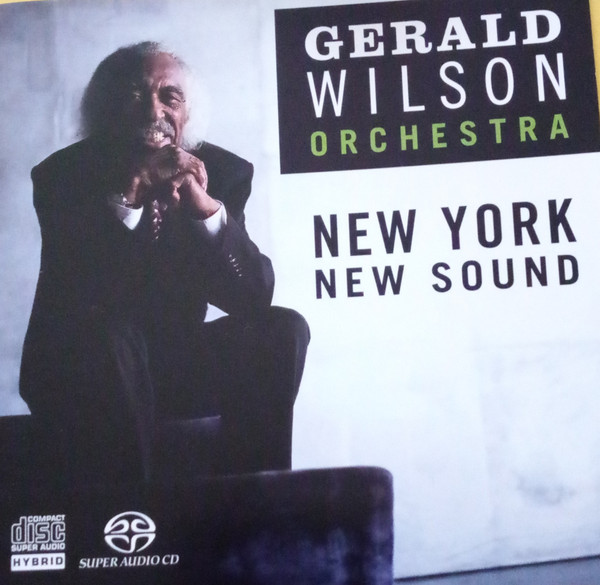
New York New Sound (Mack Avenue)
Gerald Wilson Orchestra
Released August 26, 2003
Grammy Nominee Best Large Jazz EnsembleAlbum 2004
YouTube:
https://music.youtube.com/playlist?list=OLAK5uy_kwNLYle1Rx9toaAC6pG0GqN5idNDjIeAY
Spotify:
About:
Gerald Wilson, jazz’s reigning composer/orchestrator pays homage to his adopted hometown, Chicago on his fifth Mack Avenue Records release, Legacy. Composers Igor Stravinsky and Giacomo Puccini also receive Wilson’s musical tips of the hat. Wilson’s son, guitarist/composer Anthony Wilson, and grandson Eric Otis are also represented by a composition/orchestration apiece, thus extending Gerald’s musical legacy.
The Gerald Wilson Orchestra assembled for Legacy comprises many of the great jazz artists who’ve been Gerald’s collaborators for the lion’s share of his Mack Avenue canon. A first-class rhythm section of pianist Renee Rosnes, guitarist Anthony Wilson, bassist Peter Washington and drummer Lewis Nash anchors the group. Trumpeters Sean Jones, Jeremy Pelt, Tony Lujan and Mike Rodriguez and trombonists Dennis Wilson, Douglas Purviance, Luis Bonilla and Alan Ferber stud the brass section. Antonio Hart Dick Oatts, Kamasi Washington, Ron Blake, Jay Brandford and Gary Smulyan comprise the reeds. Al Pryor continues as Wilson’s producer for this collection of tributes and portraits.
His new suite “Yes, Chicago Is…” is an affectionate series of sketches—what Wilson calls a “romantic ballad”—that delineates one of his favorite cities. (He wrote and recorded “State Street Suite,” an earlier civic valentine, in 1993.) Commissioned by the Chicago Jazz Festival, it recalls some key personal junctures. Wilson lived in the Windy City for a better part of a year at the age of fifteen, when the Chicago World’s Fair was there. Later on, as a member of the Jimmie Lunceford Orchestra (which he joined in June of 1938), he used the town as his home base. And while stationed at the Great Lakes Naval facility (1942-’44), Wilson took advantage of the fact that he didn’t have to live on the base and moved into town.
The suite begins appropriately with “A Real Jazz Mecca.” “I always loved Chicago,” the 92 year-old Wilson says. “It’s such an exciting city, and it’s one of the great jazz cities—a real ‘jazz mecca.’ I tried to capture some of the flavor of the Chicago I’ve known: the wonderful Regal Theatre, the great sports teams and the El Grotto nightclub, where I played six weeks with my band in 1946.”
Wilson’s fans won’t be surprised that he’s an admirer of 20th Century musical giant Igor Stravinsky. One of his mentors, the late Phil Moore, brought the Russian composer to Wilson’s attention. Italian opera great, Giacomo Puccini, however, might raise a few eyebrows. “They’re both dedicated to Wynton Marsalis,” he relates. “He’s been so good to me, playing my music at Lincoln Center. I took a small excerpt (just a couple of bars) from ‘Nessun Dorma’ from Puccini’s opera, Turandot—and wrote the ‘Variations on a Theme by Giacomo Puccini.’ I did the same with Stravinsky. I write short pieces these days so I don’t need much material for inspiration.”
“Variations on Clair De Lune” fulfills a childhood desire: Wilson’s first musical studies were on piano; he always liked the piece and wanted a chance to do something with it. The twist is that Wilson had pianist Avery Parrish, composer and player of the bluesy “After Hours,” in mind. “Avery was a brilliant pianist,” he reminds us. “He could play as much piano as Art Tatum or Earl Hines.”
Wilson clearly revels in his working relationship with Mack Avenue Records. His previous releases for the label are: New York, New Sound (2003), In My Time (2005), Monterey Moods (2007) and Detroit (2009). “They’re so nice to me and our arrangement is so comfortable,” he says. His albums receive maximum exposure—in the press, on radio and on Internet sites like YouTube. “I love working with Al Pryor and Gretchen Valade has given me carte blanche to do what I want.”
Legacy lives up to its name in offering a forum for the composing and orchestration talents of Wilson’s progeny: his son, guitarist Anthony Wilson, and his grandson, Eric Otis. “Anthony has been writing for quite a while now,” Gerald points out. “He’s well aware of how I work but he’s got his own point of view. That number of his, ‘Virgo,’ was commissioned by the Hollywood Bowl for a concert that my band was on, sharing the bill with pianist Hank Jones in 2008. He’s taken that piece and added more material to it for this album.”
Eric Otis—grandson of Wilson and rhythm and blues pioneer Johnny Otis and son of guitarist and musical auteur Shuggie Otis—is also a guitarist. (“So many young people play and write their music on the guitar these days,” Gerald muses.) Eric has been Wilson’s transcriber for quite some time and, as such, he’s had a unique insight into his grandfather’s musical methodology. “It’s been an educational process,” Otis offers, “and a very practical education. I’ve watched how he works, how he sketches out his compositions, and how he voices his chords; that’s something I couldn’t have gotten from a classroom. I’m at the point where I can now use all the things that I’ve learned.”
“September Sky,” Otis’s first orchestration, was midwifed by his grandfather. “I began writing it on the guitar in 1999 and for some reason I put it away. Last year I pulled it out of the drawer and I completed it; I finished it to my satisfaction and then orchestrated it. It’s an accumulation of everything he’s taught me over the years.”
For Wilson’s part, he couldn’t be prouder of his offspring. “I’ve had a very fulfilling career,” he maintains. “I’ve reached all of my goals. I’ve played and written for all of the greatest jazz orchestras (Lunceford, Ellington, Basie, and Benny Carter among them), I’ve written for movies and television, I’ve written for concert orchestras and I’ve maintained my own band for many decades. But it goes beyond my accomplishments to see that members of my family are carrying on the music in their own ways.”
“Everything I write,” Wilson asserts, “from here on in, is going to be jazz. It’s the language I speak and it’s my music.”
Track Listing:
1. Milestones (Miles Davis) 7:28
2. Blues for the Count (Gerald Wilson) 9:55
3. Equinox (John Coltrane) 6:42
4. Viva Tirado (Mucho Mas) (Gerald Wilson) 9:14
5. Teri (Gerald Wilson) 3:37
6. Blues for Yna Yna (Gerald Wilson) 8:08
7. Theme for Monterey: Romance/Carmel by the Sea/Seventeen Mile Drive (Gerald Wilson) 14:51
8. M Capetillo (Gerald Wilson) 4:53
9. Josefina (Gerald Wilson) 5:16
10. Nancy Jo (Gerald Wilson) 6:08
Personnel:
The New York Gerald Wilson Orchestra
Trumpets: Clark Terry – fluegelhorn & trumpet (2)/trumpet (6); Jon Faddis (1, 2, 5, 6, 8, 9, 10); Jimmy Owens; Eddie Henderson; Frank Greene (3, 4, 7); Sean Jones
Trombones: Benny Powell Luis Bonilla, Dennis Wilson, Douglas Purviance
Reeds/Saxophones: Jimmy Heath – tenor sax; Frank Wess – tenor sax (all tracks)/flute (2); Jesse Davis – alto sax; Jerry Dodgion – alto sax (all tracks)/flute (2, 8); Jay Brandford – baritone sax
Piano: Kenny Barron (1, 2, 5, 6, 8, 9, 10); Renee Rosnes (3, 4, 7)
Guitar: Anthony Wilson, Oscar Castro-Neves (8)
Bass: Larry Ridley (1, 4, 6, 8 and 10); Trey Henry (5, 7 [Romance], 9); Bob Cranshaw (2, 3, 6)
Drums: Lewis Nash (1, 5, 6, 8, 9, 10); Stix Hooper (2, 3, 4, 7)
Percussion: Lenny Castro (4, 8)
Recorded February, 2003, at Clinton Recording Studio, NY
Produced by Stix Hooper
Review:
Of all of the historic big bands of the ‘40s, none has been more perennially overlooked than that of Gerald Wilson. For those of us on the left coast who wear insecurity on our sleeves like epaulets, the fact that Wilson’s career has primarily been associated with the Los Angeles jazz scene seems explanation enough for this slight. Although little known by the public, however, Wilson’s talent and contributions are well recognized within the jazz community. During his life in music, Wilson has created distinctive arrangements and compositions (both jazz and symphonic) that ensure him a lasting place in the panoply of legendary American musical communicators.
With New York, New Sound, Wilson at age 85 belatedly makes his triumphant return to the Big Apple, a city he left at the peak of his popularity and commercial success in 1947. His debut album for Mack Avenue Records is crisp, fresh, and lively, with that ebullience that Wilson followers have learned to expect. At the same time, the CD has the comfortable familiarity of the latest edition of your favorite car: you know it’s new, but the seat is so deep and cozy, it feels as if it were fashioned just for you; handling is predictable, and all the controls are recognizable and in their familiar places.
The CD is sprinkled with jazz standards (such as Miles Davis’ “Milestones,” John Coltrane’s “Equinox,” and Wilson’s own “Viva Tirado”), but even the original tunes (like “Teri,” “Blues for Yna Yna,” and “Theme for Monterey”) are so inevitable, you wonder why no one ever thought of them before. The album is nicely paced, with good variety; opening and closing bookends pursue a feverish pace, while ballads (mysterious, poignant and lush), several blues, a jazz waltz, and two Latin delicacies are tucked neatly in between. All bear the hallmark of Wilson’s identifiable arranging genius.
As much as composer, arranger, and bandleader, Wilson has distinguished himself as music educator, having taught in multiple locations and formats for more than 30 years, most recently at UCLA. Those interested in learning more about the true artistry of big band jazz need look no further.
J. Robert Bragonier (All About Jazz)


