
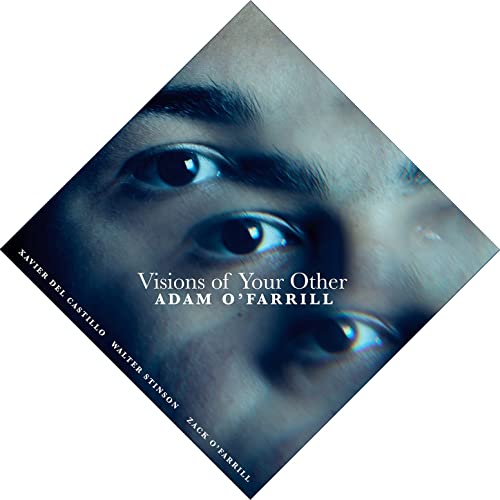
Visions of Your Other (Biophilia Records)
Adam O’Farrill
Released November 12, 2021
Arts Fuse 2021 Jazz Critics Poll Top 30 New Album
YouTube:
https://music.youtube.com/playlist?list=OLAK5uy_nNPtFH_B4n3bVBumxPgBTipkI0oIB62LA
Spotify:
About:
After garnering high acclaim for his previous outings Stranger Days (2016) and El Maquech (2018) — plus sideman credits with trailblazing artists Mary Halvorson, Anna Webber, Rudresh Mahanthappa, Kevin Sun and more — Adam O’Farrill (#1 Rising Star trumpeter, 2021 Downbeat Critics Poll) is proud to release the third album from his quartet Stranger Days, Visions of Your Other. The group’s musical language continues to evolve with a new member as of 2019: tenor saxophonist Xavier Del Castillo, filling the formidable shoes of tenorist Chad Lefkowitz-Brown as he joins bassist Walter Stinson and drummer Zack O’Farrill in the fold. “Xavier is deeply inquisitive, as an artist and a person,” O’Farrill says. “Walter, Zack, and I had built a strong foundation on principles of rawness and spontaneity, and Xavier brings a slightly more analytical approach, revealing to me layers of the music I didn’t even know were there.”
Visions of Your Other highlights the band’s creative growth with a set of four O’Farrill compositions (“Blackening Skies,” “Inner War,” “Ducks,” the D.H. Lawrence-inspired “Hopeful Heart”), an abstractly funky reading of Ryuichi Sakamoto’s “stakra,” and a piece by Stinson (“Kurosawa at Berghain”) that “merges the propulsive rigidity of house music with the amorphous sound of the chord-less quartet,” O’Farrill notes. The album title stems from a line of dialogue in Paul Thomas Anderson’s 2012 film The Master (starring Joaquin Phoenix and Philip Seymour Hoffman) that O’Farrill found seductive: “The visualization of potential scenarios — past, present and future — is a very powerful current in all of us. It can motivate us just as easily as it can delude us. This theme of juxtaposition has been at the core of my work thus far, and this album is no exception.”
On the opening “stakra,” from Sakamoto’s evocative 2017 album async, O’Farrill builds texture and mood with a 20-second electronic sample of the quartet’s performance fed through Paulstretch, a sound design software application used by Sakamoto and other composers. “It’s no exaggeration to say that Sakamoto’s async album changed my life,” declares O’Farrill. “It made me rethink all of the elements of music and the way they’re prioritized. I realized that melody can involve many possibilities, and that texture is not just that — it can actually be the musical protagonist. It’s fair to say it will take a long time to fully process the impact that async has had on me.”
“Blackening Skies,” accompanied by an animated film short from German artist Elenor Kopka, is “both apocalyptic and humorous,” says O’Farrill, who composed the song after a brutal New York heat wave and an experience of summer monsoons in Los Angeles. “I told Elenor all this and she showed me the work of Hieronymus Bosch, using that as a reference point for the tone of the piece.” The staggered staccato rhythms in the horns as they play slightly out of sync is “a concept that Xavier and I have explored in previous projects, such as my large ensemble piece ‘Bird Blown Out of Latitude.’ It’s inspired by electronic music, trying to humanize something very mechanical. There’s a perfection to a lot of electronic music that allows for its ideas to be flexibly interpreted by live instruments, which opens up an exciting and endless world of sound.”
Track Listing:
1. stakra 04:01
2. Kurosawa At Berghain 07:40
3. Inner War 06:54
4. Ducks 05:34
5. Hopeful Heart 07:36
6. Blackening Skies 07:11
Personnel:
Adam O’Farrill: trumpet
Xavier Del Castillo: tenor sax
Walter Stinson: bass
Zack O’Farrill: drums
Produced by Curtis Macdonald and Adam O’Farrill
Recorded at WNYC Studio, by Curtis Macdonald
Mixed by Chris Krasnow
Mastered by Eivind Opsvik, Greenwood Underground
Artwork: Janelle Jones
Review:
This thoroughly original, often moody recording features the 27-year-old leader Adam O’Farrill on trumpet, Xavier Del Castillo on tenor saxophone, Walter Stinson on bass, and brother Zack O’Farrill playing drums. The family connection seems inevitable: the O’Farrill brothers are the grandsons of the great Cuban musician Chico O’Farrill, an innovator in Latin jazz whose recordings go back to the late ’40s: he arranged and conducted Machito’s famous “Afro-Cuban Jazz Suite.” They are the sons of pianist Arturo O’Farrill, who has recorded dozens of his own compositions along with numbers as varied as John Coltrane’s “Moment’s Notice” and Carla Bley’s “Walking Batterie Woman.” Adam’s recording career goes back at least to 2009, when he appeared on his father’s disc Risa Negra (Zoho): its opening piece is entitled “One Adam, 12 Mambo.” Many of us will have first heard the trumpeter in other contexts: he toured with saxophonist Rudresh Mahanthappa’s band for three years and he plays on Mahanthappa’s Bird Calls. He’s also on Mary Halvorson’s Code Girl and last year’s Artlessly Falling, as well as Anna Webber and Angela Morris’s big band recording Both Are True.
According to the leader, the six numbers of Visions of Your Other are partly designed “to humanize something very mechanical.” The mechanism used in the opening number, “stakra,” is the Paulstretch, and it has the ability “to slow down … even draw out … music without changing its pitch.” The rock group Bear in Heaven used the device to make a 44-minute work play for “nearly four months.” “Stakra” is a piece by Japanese composer Ryuichi Sakamoto that appeared on his album asynch. Thankfully, O’Farrill is not as extravagant in his use of the Paulstretch as Bear in Heaven. (The trumpeter’s taste and sense of proportion are evident throughout the disc.) This piece starts with high-pitched, seemingly electronic held notes that create a tense background for O’Farrill’s entrance, which is at first heard over the drums in a deliberately overresonant space. The band seems to emerge from this background gradually until O’Farrill and saxophonist Del Castillo are freely improvising together and against each other, sometimes with echo effects. Now in a realistic sound stage, O’Farrill repeats a twisting descending phrase that is probably the focus of the track. Then about three minutes in, “stakra” suddenly quiets down, and O’Farrill and Del Castillo play long tones together until the end. Like the five other performances on this disc, “stakra” is designed to create a coherent mood in varying textures — there is no interest in showing off anybody’s chops. It’s also not about running chords: as with all of the pieces on Visions of Your Other, its chord changes are minimal. The articulate freedom of the soloists and of the group improvisations are what “humanize” the performances.
“Kurosawa at Berghain” begins with a virtuosic open trumpet solo that quickly states the rhythmic phrase that will define the piece. Bassist Walter Stinson composed the tune, but the performance follows the earlier template: the themes on Visions of Your Other are typically treated as rhythmic devices. Berghain is an area in Berlin: it’s also the name of an exclusive nightclub noted for the sexual activities that are purported to take place there. I don’t know what Kurosawa was doing there. O’Farrill’s rendition is brightly up-tempo. “Hopeful Heart” is a slow and melodically rich quartet piece in which trumpet and tenor sax state short lines in ragged unison. Del Castillo is the first soloist: the composition is dedicated to — and inspired by — the occasionally hopeful D.H. Lawrence. What is striking here and elsewhere on the album is how beautifully the bassist and percussionist interact. Here, the saxophone’s jittery phrases are encouraged by, and probably influenced by, Zack O’Farrill’s drums. Free as the improvisation is, one could sing many of bassist Stinson’s lines.
O’Farrill calls the final number, “Blackening Skies,” “both apocalyptic and humorous.” The subject is global warming and the tune begins with the two horns repeating ominous notes. They move between two pitches, apparently switching once one of the horns cues a change. A second section arrives, and it is much livelier, made up of mostly staccato notes that are variations on the initial statements. I hear a faint echo of the sound Ornette Coleman and Don Cherry used to make, playing one of Coleman’s lines in raggedy fashion. O’Farrill explains that the piece was influenced by electronic music: “There’s a perfection to a lot of electronic music that allows for its ideas to be flexibly interpreted by live instruments, which opens up an exciting and endless world of sound.”
I find Visions of Your Other exciting. It is beautifully recorded: these are four musicians who care about their sound. The music is both free and grounded; the performers play exuberantly, and with an admirable awareness of and responsiveness to what the others are doing and thinking.
Michael Ullman (The Arts Fuse)


