
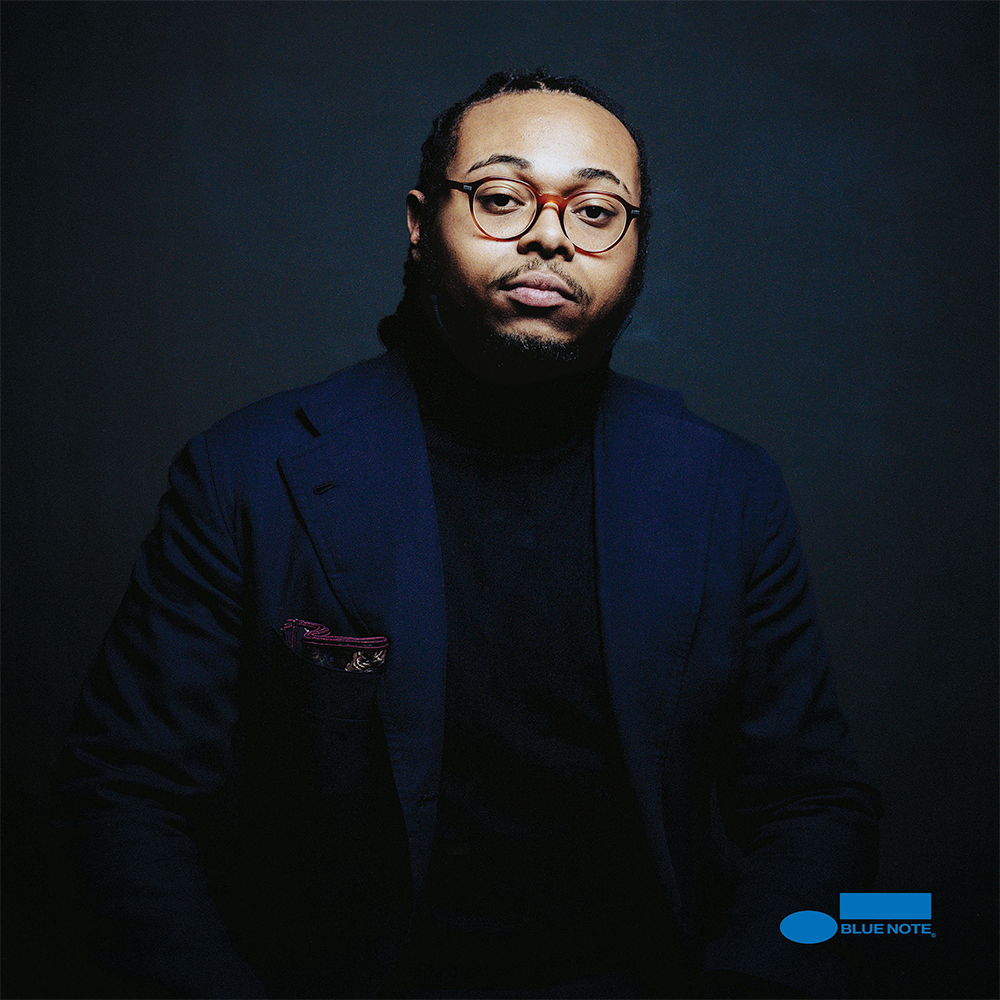
Omega (Blue Note)
Immanuel Wilkins
Released August 7, 2020
JazzTimes Top 10 New Jazz Releases of 2020
New York Times Best Jazz Albums of 2020
The Boston Globe Top 10 Jazz Albums of 2020
YouTube:
https://music.youtube.com/playlist?list=OLAK5uy_lIG6fREapZrr9RJ3r2Gomr7SUg8QswE28
Spotify:
About:
When Immanuel Wilkins created the music for “Mary Turner – An American Tradition,” one of many standout songs from his stellar debut album, Omega, he wanted to craft something that spoke directly to the Black experience in America. Wilkins, a 22-year-old alto saxophonist and bandleader from Upper Darby, Pa., wasn’t thinking about anything positive, he wanted to convey the deep pain his people have endured in this country for centuries. Mary Turner, a Black woman who was eight months pregnant, was killed in Georgia during a lynching rampage in 1918, after she publicly decried her husband’s murder by the same means. A mob of white people hanged her upside down, burned her, then cut out her baby and stomped on her unborn child.
Wilkins harnessed that pain into the song, using the first half to imagine Turner’s attempt to flee before the second half bursts into a flurry of wailing horns, intensifying piano chords, and torrential drum fills. It communicates the ungodly terror she must’ve felt in that moment. “Me and [pianist] Micah Thomas, we watch horror movies,” Wilkins says. “But what does it sound like to create an audible version of horror?”
Produced by Jason Moran and featuring Wilkins’ quartet with Thomas on piano, Daryl Johns on upright bass, and Kweku Sumbry on drums, Omega not only follows Wilkins’ pursuit of Jesus Christ, it’s an expansive opus about the totality of Black life. The opening track, “Warriors,” is a bright tune unpacking the love that’s closest to you. “It’s about friendships, family, your hood, and your community,” Wilkins says. “It’s about us serving as warriors for whatever we believe in.”
That message lands harder in 2020, as the world struggles through a global pandemic, and cities across America are uprising due to the killings of George Floyd, Breonna Taylor, and Ahmaud Arbery, three unarmed Black people who died at the hands of whites. It’s an all-too-familiar narrative: Floyd and Taylor were murdered by police officers, and Arbery was gunned down as he jogged through Satilla Shores, Georgia. We’re not far removed from 2014, when Mike Brown, Jr., an unarmed black teenager, was shot and killed by police officer Darren Wilson in Ferguson, Mo. Wilson wasn’t indicted; the decision led to widespread rebellion in the city. Omega’s “Ferguson – An American Tradition” captures the pulse of the area at that time, when the calm led to anger over the senseless loss of life. It tells the story in reverse, from the aftermath of the shooting to the initial gunshots. The song grows more riotous as it unfolds, and by its second half, Thomas and Sumbry amplify the track with dueling keys and percussion meant to orchestrate a revolution.
While there are parallels between the Ferguson and Turner tracks, the latter is meant to educate listeners who might be unaware of the activist. “All of the titles are for me trying to inspire research in a way,” Wilkins says. “Most people are familiar with Ferguson and so it inspires an interest to look into Mary Turner to see that both of these stories are American traditions in a way. It’s painting a picture of how the lynching of Black people is still going on today.” Conversely, “The Dreamer” is soothing, a reflective mix of bass, piano and drum brushes meant to honor the life of Black author, teacher and activist James Weldon Johnson, the first executive secretary of the NAACP.
Wilkins grew up just outside of Philadelphia to parents who got him involved with music at a young age. He started singing and playing violin at the age of three, then he took up the piano two years later. By Wilkins’ own admission, none of those instruments really worked out for him. But the music bug didn’t leave him, and by the third grade, he got a chance to join his elementary school band if he brought his own instrument. He asked his parents for a saxophone, though initially, they weren’t too thrilled about it. “They were like, ‘Well, we’ve been paying for lessons for all these instruments so you’re going to have to show us that you really want to play it,’” Wilkins recalls. His parents acquiesced, though they didn’t pay for saxophone lessons right away: “It wasn’t until maybe a couple of weeks after that I came home from church and worked my way through one of the hymns. That’s when they realized I was serious and wanted to pursue it.” Wilkins was a big fan of Kenny Garrett, the legendary saxophonist and former member of the Mel Lewis Orchestra. “That’s how I got into the saxophone,” Wilkins remembers.
As Wilkins learned to play jazz in elementary school, his parents also enrolled him in the Philadelphia Clef Club of Jazz and Performing Arts, where he studied under its music director, Lovett Hines. In the fourth grade, Wilkins started studying at the Kimmel Center for the Performing Arts under instructors Marc Johnson and Anthony Tidd. “I was studying with people who were serious cats and legends in the Philadelphia scene,” Wilkins says. “People don’t really get the opportunity to be around cats like that. I was able to work with the Sun Ra Arkestra and play with people like Mickey Roker, Edgar Bateman, Charles Fambrough, Marshall Allen, and Trudy Pitts. These people shaped who I am today.” As a junior at Upper Darby High School, he participated in the Grammy Camp, Jazz Session, where he and 31 other students got a chance to attend the Grammy Awards and play at the Recording Academy afterparty.
After he graduated high school, Wilkins moved to New York City in 2015 to attend The Juilliard School. In the city, he met trumpeter and composer Ambrose Akinmusire, who mentored Wilkins and helped him navigate the jazz scene. He also met a musician who would change his professional life, Jason Moran, the prominent pianist and composer who took the young saxophonist on tour. In what was one of Wilkins’ biggest gigs to date, he played alto in Moran’s “In My Mind: Monk at Town Hall, 1959,” a series of live performances honoring the great legacy of jazz pianist Thelonious Monk. Wilkins has since worked with a diverse range of artists including Solange Knowles, Gretchen Parlato, Wynton Marsalis, Gerald Clayton, Aaron Parks, and Joel Ross, making a striking appearance on the vibraphonist’s 2019 Blue Note debut KingMaker.
“Immanuel has always been leaning forward into the music,” says Moran. “He is a powerful player. He blends traditions in a way that only his generation knows how to do. His band is set to begin a new mode that I look forward to hearing develop. The future of the music rests with these musicians, and I trust their noses.”
As he studied at Juilliard, Wilkins quietly wrote most of the compositions for what would be his debut album, Omega. The first piece he wrote for it, back in 2013, was a four-part suite — “The Key,” “Saudade,” “Eulogy,” and “Guarded Heart.” Positioned near the end of the album, the suite is Omega’s centerpiece, a 20-plus minute expedition through prayerful and tumultuous tones that fully synthesize the album. Though it was compiled well before the protests and pandemic, Omega is still a timely opus that scores our collective transition and reformation.
“After the killing of George Floyd, there’s a serious demand to end these lynchings of Black folk,” Wilkins concludes. “What is change? And what’s the reality of what these things look like in practice? Sandra Bland, Michael Brown, Breonna Taylor, Tamir Rice, Philando Castile, what does the end of this look like.”
Track Listing:
1. Warriors (Immanuel Wilkins) 06:55
2. Ferguson [An American Tradition] (Immanuel Wilkins) 07:08
3. The Dreamer (Immanuel Wilkins) 03:37
4. Mary Turner [An American Tradition] (Immanuel Wilkins) 04:22
5. Grace and Mercy (Immanuel Wilkins) 06:49
6. The Key, Pt. 1 (Immanuel Wilkins) 02:46
7. Saudade, Pt. 2 (Immanuel Wilkins) 07:24
8. Eulogy, Pt. 3 (Immanuel Wilkins) 05:52
9. Guarded Heart, Pt. 4 (Immanuel Wilkins) 09:41
10. Omega (Immanuel Wilkins) 08:47
Personnel:
Immanuel Wilkins: saxophone
Micah Thomas: piano
Daryl Johns: bass, acoustic
Kweku Sumbry: drums
Recorded and Mixed: Chris Allen
Mastered by Greg Calbi
Producer: Jason Moran
Review:
As this review is being written, the streets of America are teeming with people of all races protesting the police killings of George Floyd and Rayshard Brooks and proclaiming that Black Lives Matter. Immanuel Wilkins made Omega before those deaths occurred, but he did not lack for other examples from the nightmare of America’s racial history. Two tracks subtitled “An American Tradition” are “Ferguson” and “Mary Turner.” Turner was eight months pregnant when she was lynched, upside down, in Georgia in 1918.
Such subject matter is a lot to take on for a 22-year-old alto saxophone player. Wilkins is ready. Jason Moran, who produced Omega, says something true: “Immanuel … blends traditions in a way that only his generation knows how to do.” Wilkins is neither straight-ahead nor avant-garde. He operates in a fertile new zone that is both. His lyrical extremity goes back to Charlie Parker and forward to Ornette Coleman and beyond. His chops are electric. His tonal range extends from mellifluous and sensuous to searing and raw, often in the same solo.
The track for Mary Turner is a remarkable act of the imagination. In four minutes, Wilkins portrays the atrocity with almost unbearable vividness, from Turner’s attempts to escape (in circling saxophone figures) to her terror (in louder saxophone calls over threatening drums) to the death throes of Turner and her unborn child (in hoarse saxophone screams and violent ensemble eruptions).
All of Omega’s rich material was written by Wilkins; his pieces are carefully ordered but contain openings for spontaneous rampant invention. The album’s centerpiece is a four-part suite. “The Key,” “Saudade,” “Eulogy,” and “Guarded Heart” move across many modes of emotion, from rapt through-composed contemplations to wild celebrations to graceful melodic unfoldings to jolts of passion.
Wilkins’ impressive young collaborators are pianist Micah Thomas, bassist Daryl Johns, and drummer Kweku Sumbry. Remember their names.
Omega is the most important debut jazz recording in years.
Thomas Conrad (JazzTimes)


